

More than 1,000 people, including Hezbollah members, wounded in Lebanon when pagers explode

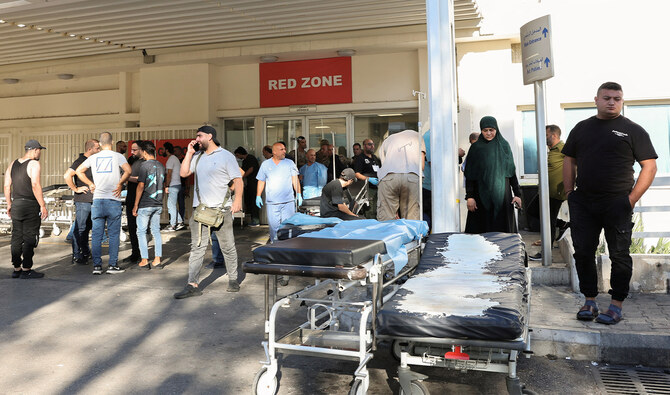
People gather outside a hospital, as hundreds of members of the Lebanese armed group Hezbollah, including fighters and medics, were seriously wounded on Tuesday when the pagers they use to communicate exploded, according to a security source, in Beirut, Lebanon, on September 17, 2024. (REUTERS)
Short Url
Updated 17 September 2024
Follow

More than 1,000 people, including Hezbollah members, wounded in Lebanon when pagers explode

  • Iran’s ambassador to Lebanon Mojtaba Amani was injured in the explosions, Iran’s Mehr news agency reports
  • Hezbollah says detonation of pagers “biggest security breach” group subjected to in nearly year of war with Israel

BEIRUT: More than 1,000 people, including Hezbollah fighters and medics, were wounded on Tuesday when the pagers they use to communicate exploded across Lebanon, security sources told Reuters.

A Hezbollah official, speaking on condition of anonymity, said the detonation of the pagers was the “biggest security breach” the group had been subjected to in nearly a year of war with Israel.

Iran’s Mehr news agency said the Iranian ambassador to Lebanon, Mojtaba Amani, was injured by one of the blasts. Reuters could not immediately confirm the report.

Israel and the Iran-backed Hezbollah have been engaged in cross-border warfare since the Gaza war erupted last October, the worst such escalation in years.

The Israeli military declined to comment on Reuters enquiries about the detonations.

A Reuters journalist saw ambulances rushing through the southern suburbs of the capital Beirut, a Hezbollah stronghold, amid widespread panic. A security source said that devices were also exploding in the south of Lebanon.

At Mt. Lebanon hospital, a Reuters reporter saw motorcycles rushing to the emergency room, where people with their hands bloodied were screaming in pain.

The head of the Nabatieh public hospital in the south of the country, Hassan Wazni, told Reuters that around 40 wounded people were being treated at his facility. The wounds included injuries to the face, eyes and limbs.

The wave of explosions lasted around an hour after the initial detonations, which took place about 3:45 p.m. local time (1345 GMT). It was not immediately clear how the devices were detonated.

Lebanese internal security forces said a number of wireless communication devices were detonated across Lebanon, especially in Beirut’s southern suburbs, leading to injuries.

Groups of people huddled at the entrance of buildings to check on people they knew who may have been wounded, the Reuters journalist said.

Regional broadcasters carrying CCTV footage which showed what appeared to be a small handheld device placed next to a grocery store cashier where an individual was paying spontaneously exploding. In other footage, an explosion appeared to knock out someone standing at a fruit stand at a market area.

Lebanon’s crisis operations center, which is run by the health ministry, asked all medical workers to head to their respective hospitals to help cope with the massive numbers of wounded coming into for urgent care. It said health care workers should not use pagers.

The Lebanese Red Cross said more than 50 ambulances and 300 emergency medical staff were dispatched to assist in the evacuation of victims.

Hezbollah fired missiles at Israel immediately after the Oct. 7 attacks by Hamas gunmen on Israel. Hezbollah and Israel have been exchanging fire constantly ever since, while avoiding a major escalation as war rages in Gaza to the south.

Tens of thousands of people have been displaced from towns and villages on both sides of the border by the hostilities.


Somaliland’s Israel deal could put Berbera port at risk

Updated 3 sec ago
Follow

Somaliland’s Israel deal could put Berbera port at risk

BERBERA: Somaliland says its recognition by Israel could be a boon for its Berbera port. But with missiles flying across the region, it could also be a target.
Berbera port on the Gulf of Aden has been transformed by the United Arab Emirates firm DP World over the past decade into a state-of-the-art facility on one of the world’s busiest trade routes.
Berbera still handles far fewer containers than nearby Djibouti or Mombasa, but port traffic was up 30 percent from 2023 to 2025, and recent diplomatic moves could lead to much more.
A deal under negotiation with Ethiopia, a landlocked neighbor with more than 130 million inhabitants, could see traffic rise by another 80 percent, said port authority director Ali Diriye Ahmed.
Ethiopia did not respond to queries on the subject.
And Israel’s recent decision to recognize Somaliland’s independence — the first country to do so since it declared autonomy from Somalia in 1991 — promises a “tremendous increase,” said Ahmed, already envisioning an expansion of the port.
But an alliance with Israel also brings risks, particularly as the US-Israeli attacks on Iran this weekend increase the threat of regional war.
Abdel Malek Al-Houthi, leader of the Houthi group in Yemen, had already warned that any Israeli presence in Somaliland would be considered a “military target.”
“We really don’t know what is going on there. Sometimes there are 20 planes coming in a week,” said a DP World employee, speaking on condition of anonymity.
“There is a widespread assumption that there is an Israeli military or security presence that is already in the country,” a Western diplomat told AFP on condition of anonymity, though any military cooperation will remain secretive.
If their presence was confirmed at the Emirati base, it could leave the port vulnerable to Houthi or Iranian missiles.
There is also a more local threat from Al-Shabab, the Somali affiliate of Al-Qaeda, that has said it will oppose any attempt by Israel to use Somaliland.
Somaliland authorities “only saw the recognition, without thinking about the future,” fears Roland Marchal, a regional specialist based at France’s Sciences Po university.

’Contribute to peace’

Hargeisa initially denied any negotiations regarding an Israeli military base on its soil, only to recently indicate that “nothing is off the table.”
“We are not partnering with Israel to be against anyone,” said Khadar Hussein Abdi, Somaliland’s minister of the presidency and adviser to President Abdirahman Mohamed Abdullahi.
Somaliland “wants to contribute to peace in the region,” he told AFP.
In Berbera, a peaceful but little-developed city of 70,000, the atmosphere remains optimistic.
Its mayor, Abdishakur Mohamoud Hassan, said population numbers and tax revenues had soared since DP World took control of the port, allowing for free primary schools and new health clinics.
With Israel’s recognition, “we expect this city to develop similarly to Dubai,” he said with a smile, adding that he was “not afraid” of attacks by Israel’s enemies.
“If a country like Ukraine has been resisting Russia for years, we too will not be intimidated by the Houthis,” he said.