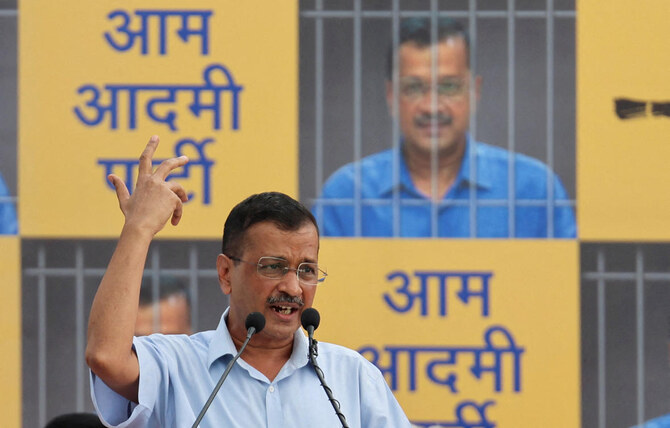
NEW DELHI: A top political opponent of Indian Prime Minister Narendra Modi quit as chief minister of the capital Delhi on Tuesday, days after being released on bail in a corruption case.
Arvind Kejriwal, a key leader in an opposition alliance that battled Modi in national elections this year, was detained in March on accusations his city government received kickbacks from allocating liquor licenses.
He is among several opposition figures facing graft probes. His party has described his arrest as a “political conspiracy” orchestrated by Modi’s ruling Bharatiya Janata Party (BJP).
The Supreme Court granted him bail last week on the condition that he refrained from signing official files or visiting his office.
Kejriwal responded by tendering his resignation to seek a fresh mandate from the public in Delhi polls slated for early next year.
The capital’s education minister Atishi, who goes by one name, will replace him in the interim.
“Atishi steps up to lead Delhi until the upcoming elections, carrying the weight of both CM Arvind Kejriwal’s vision and the national capital’s future,” a statement from their Aam Aadmi Party said.
Kejriwal, 56, began his career as a tax collector but quit his civil service job to become a national anti-corruption crusader, bringing him national fame.
Hundreds of cheering supporters greeted him as he left jail on Friday, accusing the government of trying to “break him” by putting him behind bars.
“My resolve is stronger than before,” he said. “God is by my side.”
Kejriwal refused to resign from his position while in custody despite questions over whether his jailing would prevent him from carrying out his official duties.
Atishi, 43, suggested after her nomination that she would still be looking to her predecessor for guidance.
“Delhi only has one chief minister. It is Arvind Kejriwal,” she said.
Kejriwal’s administration was accused of corruption when it liberalized the sale of liquor in the capital three years ago, surrendering a lucrative government stake in the sector.
He is among several prominent Modi opponents to face criminal investigation or trial in recent years.
US think tank Freedom House said this year that the BJP had “increasingly used government institutions to target political opponents.”


![]()

Top opponent of India PM Modi quits after release from jail
Short Url
https://arab.news/n6g5s
Top opponent of India PM Modi quits after release from jail
- The Supreme Court granted him bail last week on the condition that he refrained from signing official files or visiting his office
- Kejriwal responded by tendering his resignation to seek a fresh mandate from the public in Delhi polls slated for early next year


Latest updates





Recommended


© 2026 SAUDI RESEARCH & PUBLISHING COMPANY, All Rights Reserved And subject to Terms of Use Agreement.