India’s top court grants bail to opposition leader Kejriwal in graft case

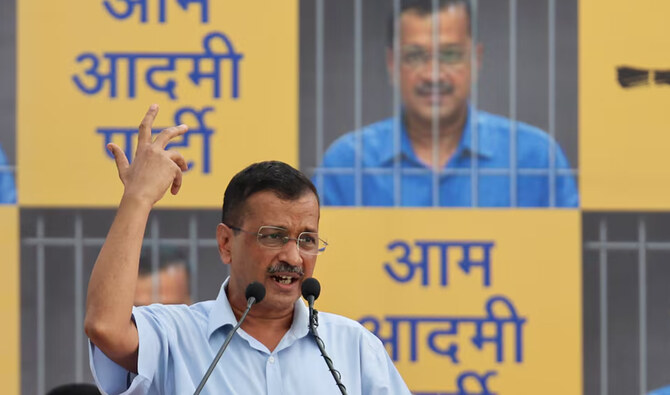
Delhi Chief Minister Arvind Kejriwal addresses supporters and members of the Aam Aadmi Party (AAP) at the party’s headquarters before he leaves to surrender himself to jail authorities, after interim bail granted by the Supreme Court in a liquor policy case came to an end, in New Delhi, India, June 2, 2024. (REUTERS)
Short Url
Updated 13 September 2024
Follow

India’s top court grants bail to opposition leader Kejriwal in graft case

  • Bail paves the way for release of Delhi Chief Minister almost six months after he was arrested
  • Kejriwal’s release expected to boost AAP party, allow him to campaign in regional elections 

NEW DELHI: India’s Supreme Court granted bail on Friday to opposition leader and Delhi Chief Minister Arvind Kejriwal in a graft case, paving the way for his release almost six months after he was arrested.
Kejriwal’s release is expected to boost the morale of his decade-old Aam Aadmi Party (AAP) as it will allow him to campaign in regional elections next month in the northern state of Haryana, where AAP is trying to make inroads, and in Delhi early next year.
Kejriwal was first taken into custody in March by India’s financial crime-fighting agency, weeks before the country’s national elections, in relation to alleged irregularities in the capital city’s liquor policy.
Although he was granted bail in that case in July, he remained in detention due to his arrest a month previously by the federal police in a graft case related to the same policy.
Kejriwal, 55, and AAP deny the allegations and say the cases are “politically motivated.”
Ordering Kejriwal’s release, Justice Surya Kant said that the issue related to “liberty” and “prolonged incarceration” could not be justified.
The two-judge bench was split, however, on Kejriwal’s appeal challenging his arrest, with Kant holding it lawful while Justice Ujjal Bhuyan said the timing raised serious questions.
The federal police “must not only be above board but must also be seen to remain so ... in a functional democracy governed by the rule of law, perception matters,” Bhuyan said.
In its first reaction following the verdict, AAP said, “Truth can be troubled, but not defeated.”
Opposition parties have been demanding Kejriwal’s release, saying his arrest was an attempt by Prime Minister Narendra Modi’s Bharatiya Janata Party (BJP) to deny them a level playing field in the polls, charges denied by Modi and BJP.
Other countries, including the US, had urged a “fair” and impartial trial.
On Friday, BJP said bail to Kejriwal did not mean he was innocent.


Venezuela’s acting president calls for oil industry reforms to attract more foreign investment

Updated 4 sec ago
Follow

Venezuela’s acting president calls for oil industry reforms to attract more foreign investment

  • In her speech, Rodríguez said money earned from foreign oil sales would go into two funds: one dedicated to social services for workers and the public health care system, and another to economic development and infrastructure projects

CARACAS, Venezuela: Venezuela’s acting President Delcy Rodriguez used her first state of the union address on Thursday to promote oil industry reforms that would attract foreign investment, an objective aggressively pushed by the Trump administration since it toppled the country’s longtime leader less than two weeks ago.
Rodríguez, who has been under pressure from the US to fall in line with its vision for the oil-rich nation, said sales of Venezuelan oil would go to bolster crisis-stricken health services, economic development and other infrastructure projects.
While she sharply criticized the Trump administration and said there was a “stain on our relations,” the former vice president also outlined a distinct vision for the future between the two historic adversaries, straying from her predecessors, who have long railed against American intervention in Venezuela.
“Let us not be afraid of diplomacy” with the US, said Rodriguez, who must now navigate competing pressures from the Trump administration and a government loyal to former President Nicolás Maduro.
The speech, which was broadcast on a delay in Venezuela, came one day after Rodríguez said her government would continue releasing prisoners detained under Maduro in what she described as “a new political moment” since his ouster.
Trump on Thursday met at the White House with Venezuelan opposition leader María Corina Machado, whose political party is widely considered to have won 2024 elections rejected by Maduro. But in endorsing Rodríguez, who served as Maduro’s vice president since 2018, Trump has sidelined Machado.
In her speech, Rodríguez said money earned from foreign oil sales would go into two funds: one dedicated to social services for workers and the public health care system, and another to economic development and infrastructure projects.
Hospitals and other health care facilities across the country have long suffered. Patients are asked to provide practically all supplies needed for their care, from syringes to surgical screws. Economic turmoil, among other factors, has pushed millions of Venezuelans to migrate from the South American nation in recent years.
In moving forward, the acting president must walk a tightrope, balancing pressures from both Washington and top Venezuelan officials who hold sway over Venezuela’s security forces and strongly oppose the US Her recent public speeches reflect those tensions — vacillating from conciliatory calls for cooperation with the US, to defiant rants echoing the anti-imperialist rhetoric of her toppled predecessor.
American authorities have long railed against a government they describe as a “dictatorship,” while Venezuela’s government has built a powerful populist ethos sharply opposed to US meddling in its affairs.
For the foreseeable future, Rodríguez’s government has been effectively relieved of having to hold elections. That’s because when Venezuela’s high court granted Rodríguez presidential powers on an acting basis, it cited a provision of the constitution that allows the vice president to take over for a renewable period of 90 days.
Trump enlisted Rodríguez to help secure US control over Venezuela’s oil sales despite sanctioning her for human rights violations during his first term. To ensure she does his bidding, Trump threatened Rodríguez earlier this month with a “situation probably worse than Maduro.”
Maduro, who is being held in a Brooklyn jail, has pleaded not guilty to drug-trafficking charges.
Before Rodríguez’s speech on Thursday, a group of government supporters was allowed into the presidential palace, where they chanted for Maduro, who the government insists remains the country’s president. “Maduro, resist, the people are rising,” they shouted.