NELAS, Portugal: Four people have died so far in wildfires raging in central and northern Portugal and over 40 have been injured, state news agency Lusa reported on Tuesday, as authorities evacuated more villages overnight.
The civil protection authority accounted for three deaths as of Monday night and would not comment on Lusa’s report.
More than 1,000 firefighters worked through the night to control a cluster of four blazes in the northwestern Aveiro district.
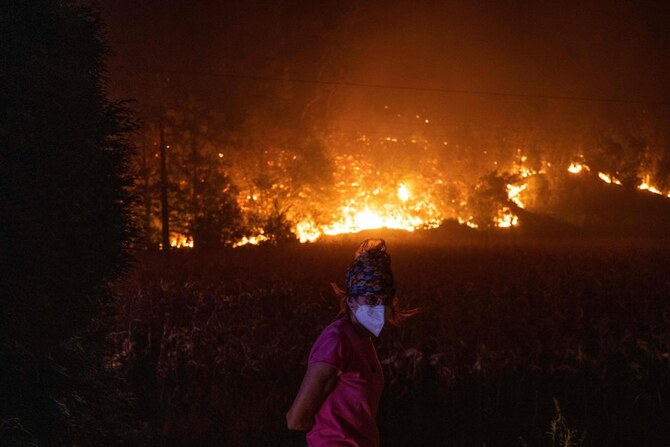
Reuters footage showed local residents pouring buckets of water on advancing flames near the town of Nelas about 50 km (31 miles) east of Aveiro.
There were 48 active wildfires in mainland Portugal mobilizing around 5,000 firefighters.
In Aveiro alone, the blazes have burned through more than 10,000 hectares (24,710 acres) of forest and scrubland in the past two days, officials said, roughly the same acreage that was consumed by fires through the end of August in the entire country.
National emergency and civil protection commander Andre Fernandes said late on Monday the Aveiro fires could engulf a further 20,000 hectares.
Authorities have closed several motorways, including a stretch of the main highway linking Lisbon and Porto, and suspended train connections on two railroad lines in northern Portugal.
Portugal and neighboring Spain have recorded fewer fires than usual after a rainy start to the year, but both remain vulnerable to the increasingly hot and dry conditions that scientists have blamed on global warming.
Temperatures topped 30 degrees Celsius (86 degrees Fahrenheit) across the country over the weekend, when the fires first broke out and were fanned by strong winds. The meteorology agency IPMA forecasts they would stay above 30 C (86 F) for the next two days, amid extremely low humidity.
The danger of fires will remain ‘high, very high or maximum’ in the northern and central regions, it said.
“We need to be realistic. We will have difficult hours in the coming days and we have to get ready for it,” Prime Minister Luis Montenegro told reporters on Monday night.
The government on Monday requested help from the European Commission under the EU civil protection mechanism, leading Spain, Italy and Greece to send two water-bombing aircraft each.

Portugal battles wildfires as death toll climbs to four
Short Url
https://arab.news/w2455
Portugal battles wildfires as death toll climbs to four
- More than 1,000 firefighters worked through the night to control a cluster of four blazes in the northwestern Aveiro district
- Authorities have closed several motorways, including a stretch of the main highway linking Lisbon and Porto
Sweden plans to tighten rules for gaining citizenship
STOCKHOLM: Sweden said Monday it planned to tighten rules to acquire citizenship, introducing “honest living” and financial requirements, a language and general knowledge test and raising the residency requirement from five to eight years.
If approved by parliament, the new rules would enter into force on June 6, Sweden’s national holiday, and would apply even to applications already being processed.
Migration Minister Johan Forssell, whose right-wing minority government holds a majority with the backing of the far-right Sweden Democrats, told reporters it was currently too easy to acquire Swedish citizenship.
“Citizenship needs to mean more than it does today,” he said.
“Pride is something you feel when you’ve worked hard at something. But working hard is not something that has characterised citizenship.
“It has been possible to become a citizen after five years without knowing a single word of Swedish, without knowing anything about our Swedish society, without having any own income.”
Referring to a case that recently made headlines, he said: “You can even become one while you’re sitting in custody accused of murder.
“This obviously sends completely wrong signals, both to those who do right by themselves and those who are already citizens.”
Following a large influx of migrants to Sweden during the 2015 migrant crisis, successive left- and right-wing governments have tightened asylum and migration rules.
The country has for years struggled to integrate migrants, with many not learning the language and living in disadvantaged areas with higher crime and jobless rates.
Under the new rules, those who have criminal records — in their home country or in Sweden — and who have served their sentence would have to wait up to 17 years before being allowed to apply for citizenship, up from the current 10 years.
In addition, those deemed to not adhere to “honest living” requirements would not be granted citizenship.
That could include racking up mountains of debt, being served restraining orders or even having a drug addiction.
Applicants would also have to have a monthly pre-tax income of 20,000 kronor ($2,225), excluding pensioners and students.
The citizenship tests would be similar to those used in neighboring Denmark and the United States, the government said, with the first tests due to be held in August.
If approved by parliament, the new rules would enter into force on June 6, Sweden’s national holiday, and would apply even to applications already being processed.
Migration Minister Johan Forssell, whose right-wing minority government holds a majority with the backing of the far-right Sweden Democrats, told reporters it was currently too easy to acquire Swedish citizenship.
“Citizenship needs to mean more than it does today,” he said.
“Pride is something you feel when you’ve worked hard at something. But working hard is not something that has characterised citizenship.
“It has been possible to become a citizen after five years without knowing a single word of Swedish, without knowing anything about our Swedish society, without having any own income.”
Referring to a case that recently made headlines, he said: “You can even become one while you’re sitting in custody accused of murder.
“This obviously sends completely wrong signals, both to those who do right by themselves and those who are already citizens.”
Following a large influx of migrants to Sweden during the 2015 migrant crisis, successive left- and right-wing governments have tightened asylum and migration rules.
The country has for years struggled to integrate migrants, with many not learning the language and living in disadvantaged areas with higher crime and jobless rates.
Under the new rules, those who have criminal records — in their home country or in Sweden — and who have served their sentence would have to wait up to 17 years before being allowed to apply for citizenship, up from the current 10 years.
In addition, those deemed to not adhere to “honest living” requirements would not be granted citizenship.
That could include racking up mountains of debt, being served restraining orders or even having a drug addiction.
Applicants would also have to have a monthly pre-tax income of 20,000 kronor ($2,225), excluding pensioners and students.
The citizenship tests would be similar to those used in neighboring Denmark and the United States, the government said, with the first tests due to be held in August.
© 2026 SAUDI RESEARCH & PUBLISHING COMPANY, All Rights Reserved And subject to Terms of Use Agreement.


