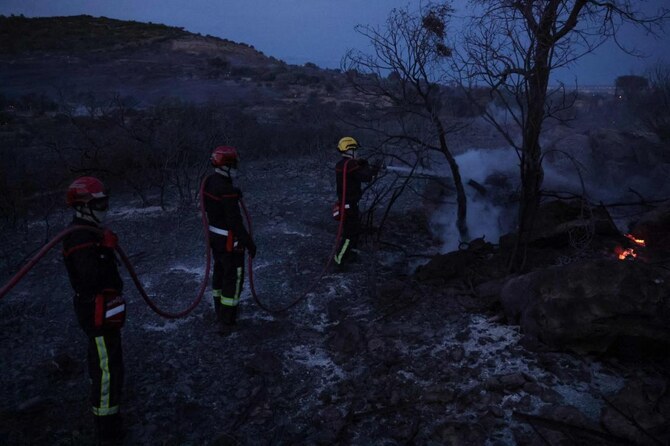
MARSEILLE: Two wildfires in southern France forced several thousand people to flee before the blazes were brought under control, officials said on Monday.
Some 3,000 holiday makers were evacuated from a camping site to a municipal building in the coastal town of Canet-en-Roussillon, near the city of Perpignan, in the face of a fire fanned by strong winds, rescue services said in a statement.
The fire, which destroyed one mobile home and partially damaged five others, was brought under control, they said.
Further up the Mediterranean coast, a fire that forced dozens from their homes in the coastal town of Frontignan, near the city of Montpellier, was also quelled.
“The fire has been under control for two and a half hours now,” a spokesman for the regional firefighters, Jerome Bonnafoux, told AFP shortly after sunrise.
“We’re still working on it because there are several hot spots where the risk of it flaring are high,” he added.
Of the 600 firefighters who rushed to put out the fire on Sunday, half were expected to keep working on the site throughout the day, he added.
The fire, which has destroyed at least 300 hectares (740 acres) of land, ignited near the A9 highway from Montpellier to the Spanish border.
Firefighters emptied the swimming pools of private homeowners to tackle the blaze, the mayor’s cabinet director said.

France wildfires force thousands to flee
Short Url
https://arab.news/w6gsp
France wildfires force thousands to flee
- Some 3,000 holiday makers were evacuated from a camping site to a municipal building
- The fire, which destroyed one mobile home and partially damaged five others, was brought under control
Pentagon shoots down government drone in Texas accident, congressional aides say
- Pentagon deployed laser-based anti-drone system, aides say
- System shot down Customs and Border Protection drone near Mexican border, aides say
WASHINGTON: The US military shot down a US government drone with a laser-based anti-drone system, an accident that prompted the Federal Aviation Administration to bar flights on Thursday in an area around Fort Hancock, Texas, congressional aides told Reuters.
The Pentagon did not immediately comment, but the FAA cited “special security reasons” in its notice about the restrictions on the airspace near the Mexican border.
US Representatives Rick Larsen, Bennie Thompson and Andre Carson, top Democrats on committees overseeing aviation and Homeland Security issues, said in a joint statement the Pentagon reportedly shot down a Customs and Border Protection drone, and criticized the lack of coordination.
The lawmakers said they warned months ago that the White House’s decision to sidestep a bipartisan proposal to train counter-drone operators and address coordination issues “was a short-sighted idea.”
“Now, we’re seeing the result of incompetence,” the statement said.
Congressional aides told Reuters the Pentagon was believed to have used the high-energy laser system to shoot down the CBP drone near the Mexican border, in an area that often has incursions from Mexican drones used by drug cartels. CBP and the White House did not immediately respond to requests for comment.
The FAA said it was expanding prior flight restrictions in the area to “include a greater radius to ensure safety” but said it did not impact commercial flights because of its location.
This month, the FAA said it was halting traffic for 10 days at the airport in nearby El Paso, Texas, only to reverse course and lift its order after about eight hours. Fort Hancock is about 50 miles (80 km) from El Paso.
Reuters and other media reported that the closure stemmed from concerns about the use of the laser-based anti-drone system and that the FAA had agreed to drop its restrictions around El Paso if the Pentagon agreed to delay further testing pending an FAA safety review.
Both the Pentagon and CBP told congressional aides earlier this week they believed they could deploy the laser without the FAA’s prior approval.
Aides said there was a lack of coordination between the FAA and Pentagon. The government informed congressional offices about the El Paso closure as well as the Fort Hancock incident late on Thursday.
The FAA notice barred all flights in the Fort Hancock area but said air ambulance or search and rescue flights can be authorized with the Joint Task Force-Southern Border. The flight restrictions are to last until June 24.
Government agencies briefed congressional staff earlier this week on the El Paso incident and are expected to brief lawmakers as soon as next week.
CBP deployed the laser technology this month to reportedly take down four suspected cartel drones, despite warnings from the FAA that the technology had not been deemed safe to use in the same vicinity as commercial flights, an aide told Reuters, adding agencies told them the laser had never before been deployed domestically.
The Pentagon did not immediately comment, but the FAA cited “special security reasons” in its notice about the restrictions on the airspace near the Mexican border.
US Representatives Rick Larsen, Bennie Thompson and Andre Carson, top Democrats on committees overseeing aviation and Homeland Security issues, said in a joint statement the Pentagon reportedly shot down a Customs and Border Protection drone, and criticized the lack of coordination.
The lawmakers said they warned months ago that the White House’s decision to sidestep a bipartisan proposal to train counter-drone operators and address coordination issues “was a short-sighted idea.”
“Now, we’re seeing the result of incompetence,” the statement said.
Congressional aides told Reuters the Pentagon was believed to have used the high-energy laser system to shoot down the CBP drone near the Mexican border, in an area that often has incursions from Mexican drones used by drug cartels. CBP and the White House did not immediately respond to requests for comment.
The FAA said it was expanding prior flight restrictions in the area to “include a greater radius to ensure safety” but said it did not impact commercial flights because of its location.
This month, the FAA said it was halting traffic for 10 days at the airport in nearby El Paso, Texas, only to reverse course and lift its order after about eight hours. Fort Hancock is about 50 miles (80 km) from El Paso.
Reuters and other media reported that the closure stemmed from concerns about the use of the laser-based anti-drone system and that the FAA had agreed to drop its restrictions around El Paso if the Pentagon agreed to delay further testing pending an FAA safety review.
Both the Pentagon and CBP told congressional aides earlier this week they believed they could deploy the laser without the FAA’s prior approval.
Aides said there was a lack of coordination between the FAA and Pentagon. The government informed congressional offices about the El Paso closure as well as the Fort Hancock incident late on Thursday.
The FAA notice barred all flights in the Fort Hancock area but said air ambulance or search and rescue flights can be authorized with the Joint Task Force-Southern Border. The flight restrictions are to last until June 24.
Government agencies briefed congressional staff earlier this week on the El Paso incident and are expected to brief lawmakers as soon as next week.
CBP deployed the laser technology this month to reportedly take down four suspected cartel drones, despite warnings from the FAA that the technology had not been deemed safe to use in the same vicinity as commercial flights, an aide told Reuters, adding agencies told them the laser had never before been deployed domestically.
© 2026 SAUDI RESEARCH & PUBLISHING COMPANY, All Rights Reserved And subject to Terms of Use Agreement.