MELBOURNE, Australia: Days of tribal violence in Papua New Guinea’s mountainous interior have left more than 35 people dead, a police official said on Tuesday.
Police Assistant Commissioner Joseph Tondon in Enga province said the death toll from the violence blamed on illegal miners was still being assessed.
“There was a fierce battle on Sunday. It’s estimated 35-plus men were killed in action,” Tondon told The Associated Press.
“I’m putting all the figures together. There were some innocent bystanders also murdered,” he added.
A United Nations’ humanitarian adviser for the South Pacific island nation, Mate Bagossy, said as many as 50 people had been killed in days of violence in Enga. He had no estimate for the number of wounded and was checking with local health facilities, which he said were ill-equipped to cope with medical emergencies.
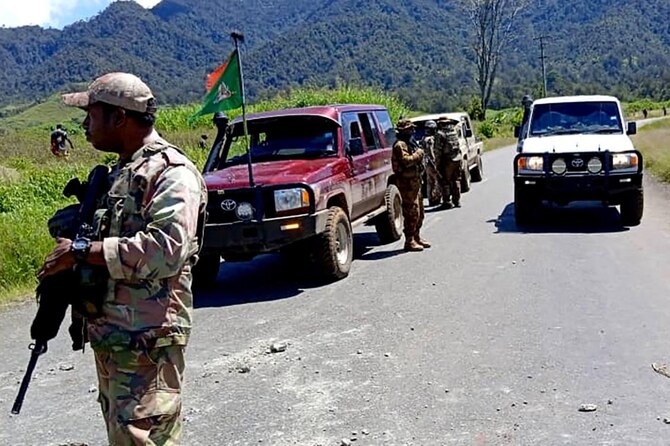
Authorities told aid agencies on Tuesday that up to 300 soldiers and police were moving to the area to restore peace, Bagossy said.
“We are not sure it’s calming. It’s not yet stabilized,” Bagossy said.
Fighting in the Porgera Valley broke out on the outskirts of Porgera town near the New Porgera gold mine, which has halted most of its operations because of the violence until at least Thursday.
Homes and businesses in Suyan village were razed in the fighting, the Post-Courier newspaper reported.
A disaster management meeting led by the Papua New Guinea’s National Disaster Center and the UN Resident Coordinator Richard Howard on Tuesday agreed to send a team to Porgera within days to assess humanitarian needs, the degree of danger and the area’s accessibility, Bagossy said.
One obstacle for responders delivering aid was that the main road to Porgera remained blocked 40 kilometers (25 miles) from town by rubble from a massive landslide on May 24. The national government estimates more than 2,000 villagers were buried and hundreds more displaced. The United Nations estimated only 670 villagers died but does not dispute that the death toll could be far higher.
Tribal warfare is a growing security problem across Papua New Guinea and is rife in Enga, where recovery has been slow since the landslide.
Bagossy did not know how many fighters were involved near Porgera, but social media video showed they were heavily armed.
“There is a combination of high-powered weapons, including assault rifles. That’s not very common yet — it’s expensive — but is becoming more and more common,” Bagossy said.
Community tensions had been simmering for some time, but the violence escalated last week.
“The reports that we got is that this was initiated as a ... relatively minor conflict between illegal miners,” Bagossy said.
“The conflict escalated into clashes between two groups and then those two groups have reportedly brought in their allies and this has caused an eruption of violence in the entire area of Porgera town and surrounds,” he added.


![]()

Days of tribal violence in Papua New Guinea leave more than 35 people dead, police say
Short Url
https://arab.news/bmhct
Days of tribal violence in Papua New Guinea leave more than 35 people dead, police say


Latest updates


Recommended


© 2026 SAUDI RESEARCH & PUBLISHING COMPANY, All Rights Reserved And subject to Terms of Use Agreement.