



PORT MORESBY, Papua New Guinea: Pope Francis called Saturday for an end to tribal conflicts that have wracked Papua New Guinea for decades and appealed for equitable development of its natural resources during a visit that also surfaced its problem of violence against women.
Dancers in swishing grass skirts performed for Francis as he opened his first full day in the South Pacific country with a mix of political and church business. He met with the governor general and dignitaries from around the region, and then addressed government authorities before visiting with local priests, nuns and street children.
Francis is on an 11-day, four-nation tour through Southeast Asia and Oceania, the longest and most challenging of his pontificate. He landed on Friday evening in Port Moresby, the capital of the Commonwealth nation, from Jakarta, Indonesia to open the second leg of his journey.
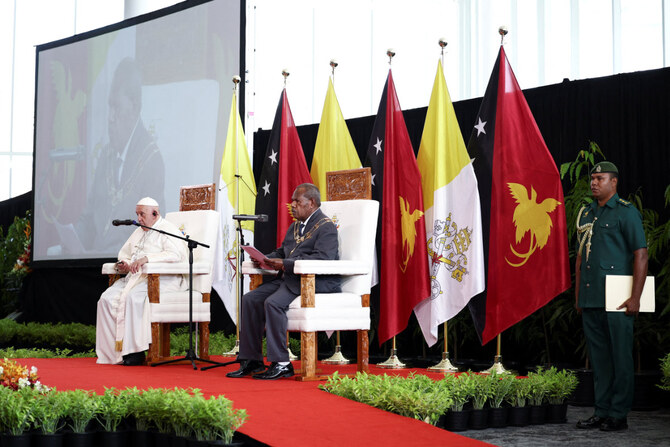
During his speech to government authorities and diplomats, Francis marveled at the diversity of Papua New Guinea’s people – there are some 800 languages spoken here – saying their variety must be “a challenge to the Holy Spirit, who creates harmony amid differences!”

An Indigenous man waits for the arrival of Pope Francis at APEC Haus in Port Moresby on Saturday. (REUTERS)
But he also noted that such diversity has long created conflict here, a reference to the tribal violence over land and other disputes that have long characterized the country’s culture but have grown more lethal in recent years. Francis appealed for a sense of civic responsibility and cooperation to prevail, to benefit everyone.
“It is my particular hope that tribal violence will come to an end, for it causes many victims, prevents people from living in peace and hinders development,” he said.
If people agree to sacrifice their personal interests for the common good, he said, “the necessary forces can be used to improve infrastructure, address the health and educational needs of the population and increase opportunities for dignified work.”
The poor, strategically important Commonwealth nation is home to more than 10 million people, most of whom are subsistence farmers.
Papua New Guinea’s governor general, Bob Bofeng Dadae, referred to the violence in his remarks, calling in particular for the need to protect women and respect their rights. It was a reference to the gender violence that has been normalized in a country where allegations of sorcery are common.
According to UN Women, 60 percent of the country’s women have experienced physical and or sexual violence from an intimate partner at some time in their lives, double the global average. Papua New Guinea ranked 160 out of 161 countries on a UN gender inequality index in 2021.
“We want to acknowledge the role of the woman and air the need for protection,” Bofeng Dadae said. “We also recognize the physical and the spiritual care that the church continues to give to those that are being abused, neglected or rejected by families and communities.”

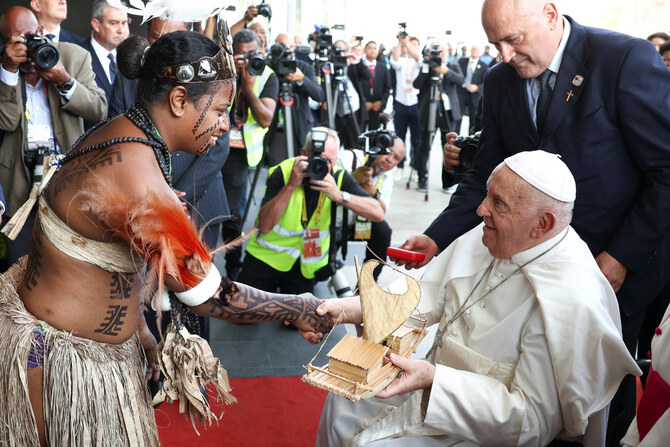
Pope Francis hands a gift to a traditional dancer as he arrives at APEC Haus in Port Moresby, Papua New Guinea, on Sept. 7, 2024. (AP)
Francis amended his remarks to pick up on the theme, saying women “are the ones who carry the country forward, they give life, build and grow a country, let us not forget the women who are on the front line of human and spiritual development.”
Francis also called for fair and environmentally sustainable extraction of country’s vast natural resources, which include gold, nickel and natural gas. Disputes over how wealth should be distributed and who is entitled to mining royalties which have often led to conflicts.
Francis, who has written entire encyclicals about the environment, has long insisted that development of natural resources must benefit local people, not just the multinational companies that extract them, and be pursued in an environmentally responsible way to preserve them for future generations.
He made that argument again Saturday, saying Papua New Guinea’s resources “are destined by God for the entire community.”
“Even if outside experts and large international companies must be involved in the harnessing of these resources, it is only right that the needs of local people are given due consideration when distributing the proceeds and employing workers,” he said.
“These environmental and cultural treasures represent at the same time a great responsibility, because they require everyone, civil authorities and all citizens, to promote initiatives that develop natural and human resources in a sustainable and equitable manner,” he said.
Finally, Francis called for a “definitive solution” to the question of Bougainville, an island region whose people voted overwhelmingly to become independent from Papua New Guinea in 2019. The outcome of the nonbinding referendum has not been implemented.
Later Saturday, Francis was visiting with charity workers who care for street children and then meeting with Papua New Guinea’s clergy and religious sisters at a Marian sanctuary. On Sunday, he travels deep into the jungle to meet with Argentine missionaries.
Despite the rigors of the trip and jet lag (Papua New Guinea is eight hours ahead of Rome time), the 87-year-old Francis appeared in relatively good form, though he coughed through his speech. He smiled as he handed out candies to young children dressed in traditional clothes who had performed for him.
Francis is the second pope to visit Papua New Guinea, after St. John Paul II visited first in 1984, then in 1995 to beatify Peter To Rot, a Catholic layman who was declared a martyr for the faith after he died in prison during World War II.


