COP29 hosts unveil busy program as main climate agenda stalls

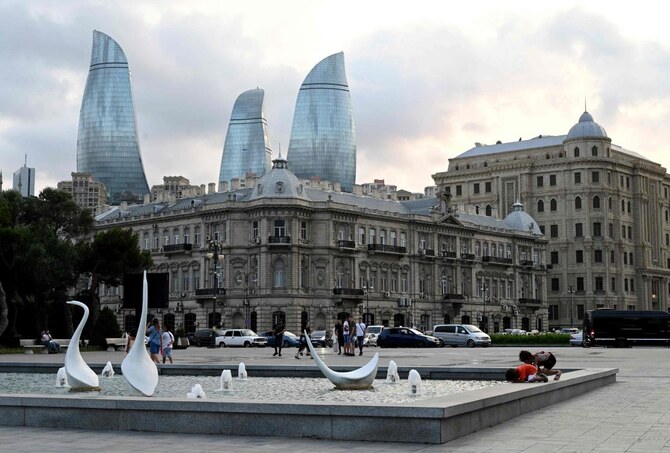
Key among these is a fund, proposed by Azerbaijan, that intends to raise money for developing countries through donations from fossil fuel producing countries and companies. (AFP)
Short Url
Updated 03 November 2024
Follow

COP29 hosts unveil busy program as main climate agenda stalls

  • Key among these is a fund, proposed by Azerbaijan, that intends to raise money for developing countries through donations from fossil fuel producing countries and companies

PARIS: COP29 host Azerbaijan said Tuesday that voluntary pledges on everything from tourism to world peace would be sought at the UN climate summit as disagreements over money stymie the main agenda.
Nations are supposed to agree at the November conference how much should be raised for developing countries to cope with climate change but the formal negotiations so far have been mired in disagreement.
With two months to go, Azerbaijan — which has remained upbeat despite the deadlock — has unveiled over a dozen initiatives on the sidelines that it hopes will “supplement” the difficult talks.
These include asking nations to observe a ceasefire during the marathon summit, to commit to reducing methane from organic waste and emissions from the tourism industry, and pledging to boost global energy storage, among others.
“Successive COP Presidencies have supplemented their mandated programs with non-negotiated action agendas... to achieve ambitious outcomes,” COP29 president Mukhtar Babayev wrote to the nearly 200 nations participating in the summit.
Key among these is a fund, proposed by Azerbaijan, that intends to raise money for developing countries through donations from fossil fuel producing countries and companies.
Azerbaijan — wedged between Iran and Russia and heavily dependent on fossil fuels — is expected to make the first contribution to this so-called “climate finance action fund.”
The fund needs $1 billion and 10 countries as shareholders to launch. Azerbaijan says there has already been early interest, but has not offered specifics.
Voluntary initiatives at the COPs, such as non-binding pledges and commitments, are features of these summits but are distinct from the long and protracted negotiations that produce binding agreements, by consensus, with UN backing.
This year’s summit in Baku is supposed to agree on how much developing countries need to adapt to a warming planet, and where that money should come from.
This target will replace the $100 billion that wealthy countries agreed to pay in climate aid, every year, from 2020.
That amount was only reached for the first time in 2022, and has long been criticized as grossly inadequate.
The lead-up to COP29 has been slow, and two months until the final deliberations nations are no closer to agreeing on what the new figure should be, and who should pay it.
The UN published a draft document in late August setting out seven rough options for a finance deal, laying bare the conflicting positions between nations.


Geoeconomic confrontation tops global risks in 2026: WEF report

Updated 20 min 53 sec ago
Follow

Geoeconomic confrontation tops global risks in 2026: WEF report

  • Also armed conflict, extreme climate, public polarization, AI
  • None ‘a foregone conclusion,’ says WEF’s MD Saadia Zahidi

DUBAI: Geoeconomic confrontation has emerged as the top global risk this year, followed by state-based armed conflict, according to a new World Economic Forum report.

The Global Risks Report 2026, released on Wednesday, found that both risks climbed eight places year-on-year, underscoring a sharp deterioration in the global outlook amid increased international competition.

The top five risks are geoeconomic confrontation (18 percent of respondents), state-based armed conflict (14 percent), extreme weather events (8 percent), societal polarization (7 percent) and misinformation and disinformation (7 percent).

The WEF’s Managing Director Saadia Zahidi said the report “offers an early warning system as the age of competition compounds global risks — from geoeconomic confrontation to unchecked technology to rising debt — and changes our collective capacity to address them.

“But none of these risks are a foregone conclusion.”

The report assesses risks across three timeframes: immediate (2026); short-to-medium term (next two years); and long term (next 10 years).

Economic risks show the largest overall increase in the two-year outlook, with both economic downturn and inflation jumping eight positions.

Misinformation and disinformation rank fifth this year but rise to second place in the two-year outlook and fourth over the 10-year horizon.

The report suggests this reflects growing anxiety around the rapid adoption of artificial intelligence, with adverse outcomes linked to AI surging from 30th place in the two-year timeframe to fifth in the 10-year outlook.

Uncertainty dominates the global risk outlook, according to the report.

Surveyed leaders and experts view both the short- and long-term outlook negatively, with 50 percent expecting a turbulent or stormy global environment over the next two years, rising to 57 percent over the next decade.

A further 40 percent and 32 percent, respectively, describe the outlook as unsettled across the two- and 10-year timeframes, while just 1 percent anticipate a calm global outlook in either period.

Environmental risks ease slightly in the short-term rankings. Extreme weather fell from second to fourth place and pollution from sixth to ninth. Meanwhile, critical changes to Earth systems and biodiversity loss dropped seven and five positions, respectively.

However, over the next decade, environmental threats re-emerge as the most severe, with extreme weather, biodiversity loss, and critical changes to Earth systems topping the global risk rankings.

Looking ahead over the next decade, around 75 percent of respondents anticipate a turbulent or stormy environmental outlook, making it the most pessimistic assessment across all risk categories.

Zahidi said that “the challenges highlighted in the report underscore both the scale of the potential perils we face and our shared responsibility to shape what comes next.”

Despite the gloomy outlook, Zahidi signaled a positive shift in global cooperation.

 “It is also clear that new forms of global cooperation are already unfolding even amid competition, and the global economy is demonstrating resilience in the face of uncertainty.”

Now in its 21st year, the Global Risks Report highlights a core message: global risks cannot be managed without cooperation.

As competition intensifies, rebuilding trust and new forms of collaboration will be critical, with the report stressing that today’s decisions will shape future outcomes.

The report was released ahead of WEF’s annual meeting, which will be held in Davos from Jan. 19 to 23.