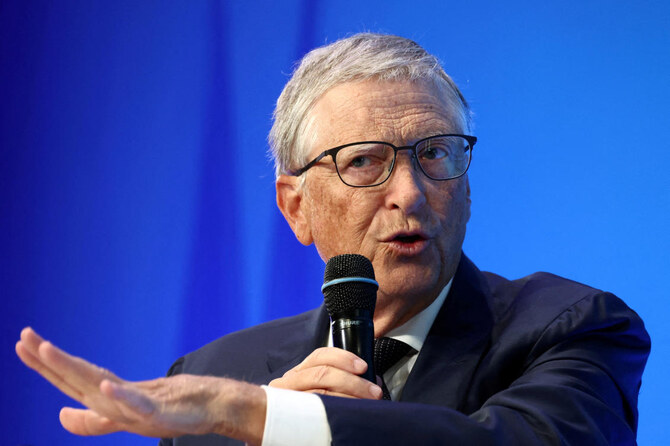
LONDON: Malnutrition is the world’s worst child health crisis and climate change will only make things more severe, according to Microsoft-co-founder turned philanthropist Bill Gates.
Between now and 2050, 40 million more children will have stunted growth and 28 million more will suffer from wasting, the most extreme and irreversible forms of malnutrition, as a result of climate change, the Bill & Melinda Gates Foundation said in a report on Tuesday.
“Unless you get the right food, broadly, both in utero and in your early years, you can never catch up,” Gates told Reuters in an online interview last week, referring to a child’s physical and mental capacity, both of which are held back by a lack of good nutrition. Children without enough of the right food are also more vulnerable to diseases like measles and malaria, and early death.
“Around 90 percent of the negative effect of climate change works through the food system. Where you have years where your crops basically fail because of drought or too much rain,” he said.
Gates was speaking ahead of the publication of the Bill and Melinda Gates Foundation’s annual Goalkeepers report, which tracks progress on the United Nations Sustainable Development Goals (SDGs), around reducing poverty and improving health. The report includes the projections above.
In 2023, the World Health Organization estimated that 148 million children experienced stunting and 45 million experienced wasting.
Gates called for more funding for nutrition, particularly through a new platform led by UNICEF aiming to co-ordinate donor financing, the Child Nutrition Fund, as well as more research. But he said the money should not be taken away from other proven initiatives, like routine childhood vaccinations, for this purpose.
“(Nutrition) was under-researched ... it’s eye-opening how important this is,” he added, saying initiatives like food fortification or improving access to prenatal multi-vitamins could be as effective as some vaccines in improving child health in the world’s poorest countries.
The Gates Foundation said in January it plans to spend more on global health this year than ever before — $6.8 billion – as wider funding efforts stall.

Climate change will escalate child health crisis due to malnutrition, says Gates
https://arab.news/5by75
Climate change will escalate child health crisis due to malnutrition, says Gates
- “Around 90 percent of the negative effect of climate change works through the food system. Where you have years where your crops basically fail because of drought or too much rain,” he said
EU parliament approves 90-bn-euro loan for Ukraine amid US cuts
- awmakers voted by 458 to 140 in favor of the loan, intended to cover two-thirds of Ukraine’s financial needs for 2026 and 2027
The EU parliament on Wednesday approved a 90-billion-euro loan for Ukraine, providing a financial lifeline to cash-strapped Kyiv four years into Russia’s invasion.
Lawmakers voted by 458 to 140 in favor of the loan, intended to cover two-thirds of Ukraine’s financial needs for 2026 and 2027 and backed by the EU’s common budget — after plans to tap frozen Russian central bank assets fell by the wayside.
Military aid to Ukraine hit its lowest level in 2025 as the US pulled funding, leaving Europe almost alone in footing the bill and averting a complete collapse, the Kiel Institute said Wednesday.
Kyiv's allies allocated 36 billion euros ($42.9 billion) in military aid in 2025, down 14 percent from 41.1 billion euros the previous year, according to Kiel, which tracks military, financial and humanitarian assistance pledged and delivered to Ukraine since Russia's full-scale invasion.
Military aid in 2025 was even lower than in 2022, despite the invasion not taking place until February 24 that year.
US aid came to a complete halt with President Donald Trump's return to the White House in early 2025.
Washington provided roughly half of all military assistance between 2022 and 2024.
European countries have thus made a significant effort to plug the gap, increasing their collective allocation by 67 percent in 2025 compared with the 2022-2024 average.
Without that effort, the US cuts could have been even more damaging, the institute argued.
However, the think tank points to "growing disparities" among European contributors, with Northern and Western European countries accounting for around 95 percent of military aid.
The institute calculated that Northern European countries (Denmark, Estonia, Finland, Iceland, Latvia, Lithuania, Norway, and Sweden) provided 33 percent of European military aid in 2025, despite accounting for only eight percent of the combined GDP of European donor countries.
Southern Europe, which accounts for 19 percent of the combined GDP of European donors, contributed just three percent.
To help fill the gap left by the United States, NATO launched the PURL programme, under which European donors purchased US weapons for Ukraine, worth 3.7 billion euros in 2025.
Kiel called the initiative a "notable development", which had enabled the acquisition of Patriot air-defense batteries and HIMARS multiple-launch rocket systems.
European allies are also increasingly placing orders with Ukraine's own defence industry, following a trend started by Denmark in 2024.
War-torn Ukraine's defence production capacity has "grown by a factor of 35" since 2022, according to Kiel, but Kyiv lacks the funds to procure enough weapons to keep its factories working at full capacity.
Orders from 11 European donor countries helped bridge that gap last year.
In the second half of 2025, 22 percent of weapons purchases for Ukraine were procured domestically, a record high.