Turkmenistan set to become first Central Asian state to gain access to Gwadar port under CPEC — report

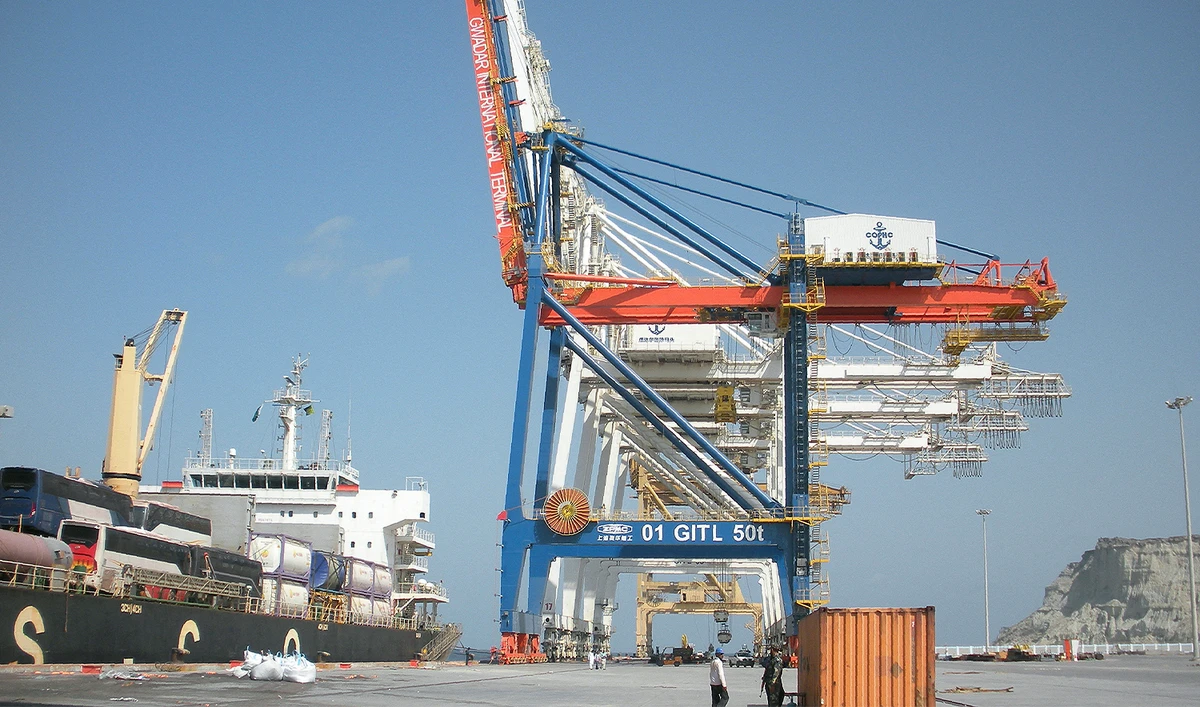
In this photograph taken on October 4, 2017, a Pakistani naval personnel stands guard near a ship carrying containers at Gwadar Port. (AFP/File)
Short Url
Updated 16 September 2024
Follow

Turkmenistan set to become first Central Asian state to gain access to Gwadar port under CPEC — report

  • Pakistan and Turkmenistan will soon sign agreement in this regard, Pakistani state media says
  • Both countries already working on TAPI gas pipeline, rail track and fiber connectivity projects

ISLAMABAD: Turkmenistan is set to become the first Central Asian country to gain access to Pakistan’s strategically positioned Gwadar port under the China Pakistan Economic Corridor (CPEC), Pakistani state media reported on Sunday.

The Gwadar port lies at the heart of CPEC, a part of China’s Belt and Road Initiative under which Beijing has pledged more than $60 billion in infrastructure and energy projects in Pakistan.

It aims to connect China to the Arabian Sea through a network of roads, railways, pipelines and ports in Pakistan and help Islamabad expand and modernize its economy.

Pakistan and Turkmenistan will soon sign an agreement in this regard, the state-run Radio Pakistan broadcaster reported.

“The government has constituted a committee to examine the draft agreement between Gwadar Port and Turkmenbashi Port under CPEC,” the report read.

Pakistan and Turkmenistan are already working on various joint projects, including Turkmenistan–Afghanistan–Pakistan–India (TAPI) gas pipeline, rail track and fiber connectivity, to connect South and Central Asia.

Cash-strapped Pakistan hopes to leverage its strategic geopolitical position and enhance its role as a pivotal trade and transit hub connecting the landlocked Central Asian republics with the rest of the world.
Imran Khan not a ‘national security threat,’ ex-PM’s party responds to Pakistan military

Updated 06 December 2025
Follow

Imran Khan not a ‘national security threat,’ ex-PM’s party responds to Pakistan military

  • Pakistan’s military spokesperson on Friday described Khan’s anti-army narrative as a “national security threat”
  • PTI Chairman Gohar Ali Khan says words used by military spokesperson for Khan were “not appropriate”

ISLAMABAD: Former prime minister Imran Khan’s Pakistan Tehreek-e-Insaf (PTI) party on Saturday responded to allegations by Pakistan military spokesperson Lt. Gen. Ahmed Sharif Chaudhry from a day earlier, saying that he was not a “national security threat.”

Chaudhry, who heads the military’s media wing as director general of the Inter-Services Public Relations (ISPR), spoke to journalists on Friday, in which he referred to Khan as a “mentally ill” person several times during the press interaction. Chaudhry described Khan’s anti-army narrative as a “national security threat.”

The military spokesperson was responding to Khan’s social media post this week in which he accused Chief of Defense Forces Field Marshal Asim Munir of being responsible for “the complete collapse of the constitution and rule of law in Pakistan.” 

“The people of Pakistan stand with Imran Khan, they stand with PTI,” the party’s secretary-general, Salman Akram Raja, told reporters during a news conference. 

“Imran Khan is not a national security threat. Imran Khan has kept the people of this country united.”

Raja said there were several narratives in the country, including those that created tensions along ethnic and sectarian lines, but Khan had rejected all of them and stood with one that the people of Pakistan supported. 

PTI Chairman Gohar Ali Khan, flanked by Raja, criticized the military spokesperson as well, saying his press talk on Thursday had “severely disappointed” him. 

“The words that were used [by the military spokesperson] were not appropriate,” Gohar said. “Those words were wrong.”

NATURAL OUTCOME’

Speaking to reporters earlier on Saturday, Pakistan’s Defense Minister Khawaja Asif defended the military spokesperson’s remarks against Khan.

“When this kind of language is used for individuals as well as for institutions, then a reaction is a natural outcome,” he said. 

“The same thing is happening on the Twitter accounts being run in his [Khan’s] name. If the DG ISPR has given any reaction to it, then I believe it was a very measured reaction.”

Khan, who was ousted after a parliamentary vote of confidence in April 2022, blames the country’s powerful military for removing him from power by colluding with his political opponents. Both deny the allegations. 

The former prime minister, who has been in prison since August 2023 on a slew of charges he says are politically motivated, also alleges his party was denied victory by the army and his political rivals in the 2024 general election through rigging. 

The army and the government both deny his allegations.