MANILA: The Philippines insisted on Monday that it had not given up a South China Sea reef, two days after it pulled out a ship stationed there following a months-long standoff with rival claimant China.
Manila had deployed the coast guard flagship BRP Teresa Magbanua to Sabina Shoal in April to stop Beijing from building an artificial island there, as it has atop several other disputed features in the strategic waterway.
But the ship was abruptly called back to the western Philippine island of Palawan, with Manila citing damage from an earlier clash with Chinese ships, ailing crew members, dwindling food and bad weather.
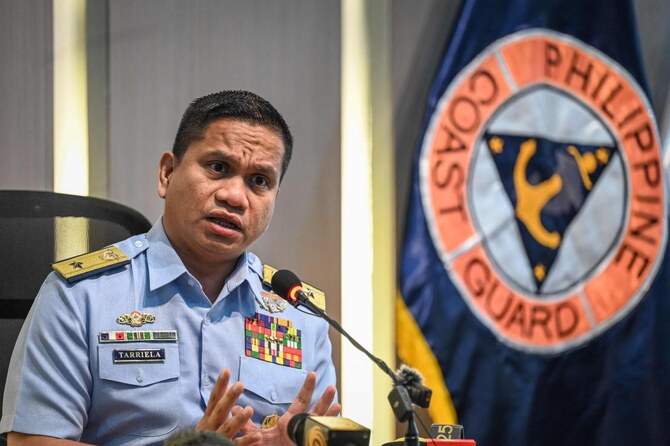
“We have not lost anything. We did not abandon anything. Escoda Shoal is still part of our exclusive economic zone,” Philippine Coast Guard spokesman Commodore Jay Tarriela told a news conference Monday, using the Filipino name for Sabina Shoal.
Beijing claims most of the South China Sea, including Sabina Shoal, despite an international tribunal ruling that its assertions have no merit.
It has acted aggressively toward Philippine government vessels at Sabina and other disputed features in recent months, ramming, blocking, water-cannoning and even boarding them, causing damage and injuries.
The confrontations have sparked concern that the United States, a military ally of Manila, could be drawn into armed conflict with China.
With the Chinese harassing resupply missions, Tarriela said it came to a point that the BRP Teresa Magbanua’s water desalinator broke down, forcing the crew to rely on rainwater for drinking “for more than one month now.”
He said the crew were also reduced to “eating porridge for three weeks,” which “obviously is not nutritious.”
Following the ship’s pullout, China’s coast guard insisted on Sunday that Beijing “has indisputable sovereignty” over Sabina.
It warned the Philippines to “stop inciting propaganda and risking infringements,” adding Beijing would “continue to carry out rights protection and law enforcement activities” there.
But Tarriela on Monday maintained the withdrawal from Sabina was “not a defeat,” rejecting comparisons to the Scarborough Shoal, which Manila lost to Beijing after a similar months-long standoff in 2012.
He said it would be “impossible” for China to totally stop the Philippines from sending its ships around the 137-square-kilometer (53-square-mile) Sabina Shoal.
“The coast guard can carry out whatever it takes for us to make sure that China will not be able to occupy and even reclaim Escoda Shoal,” he said.
“We have other coast guard vessels that, as we speak right now, may have been or may already be proceeding to Escoda Shoal,” Tarriela said without providing details, citing operational security considerations.
Sabina is located 140 kilometers (86 miles) west of Palawan and about 1,200 kilometers from Hainan island, the nearest major Chinese landmass.


![]()

Philippines says ‘we have not lost’ South China Sea reef after pullout
Short Url
https://arab.news/48ygs
Philippines says ‘we have not lost’ South China Sea reef after pullout
- Beijing claims most of the South China Sea, including Sabina Shoal, despite an international tribunal ruling that its assertions have no merit


Latest updates


© 2026 SAUDI RESEARCH & PUBLISHING COMPANY, All Rights Reserved And subject to Terms of Use Agreement.