

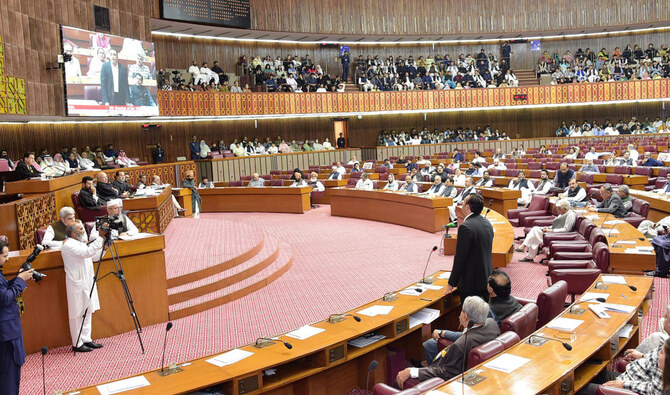

ISLAMABAD: Pakistan’s parliament was adjourned on Sunday without the tabling of a history-making ‘constitutional amendment package’ that is expected to increase the retirement age of superior judges by three years and change the process by which the Supreme Court chief justice is appointed.
The package of reforms, widely believed to include as many as 22 amendments to the constitution, has raised widespread concerns among opposition parties and independent experts who say the moves are aimed at increasing the government’s power in making key judicial appointments and dealing with the defection of lawmakers during house votes.
Ahead of the parliamentary session, Defense Minister Khawaja Asif, a senior member of the ruling Pakistan Muslim League-Nawaz (PMLN) party, told reporters the government had the 224 votes, two-thirds majority, needed to pass the amendment. He also refuted reports that the amendment was being introduced to grant an extension to Supreme Court Chief Justice Qazi Faez Isa, widely believed to be aligned with the ruling coalition led by Prime Minister Shehbaz Sharif and in opposition to its chief rival, the Pakistan Tehreek-e-Insaf (PTI) party of jailed former PM Imran Khan, who has threatened nationwide protests against the reforms.
Close to midnight on Sunday, Asif spoke to reporters after the National Assembly session was adjourned, saying the required numbers for the constitutional amendment had not been achieved.
“That is why the session is adjourned,” he told the media. “The government is engaged with political parties to develop consensus.”
Asif admitted that Fazl-ur-Rehman, president of the Jamiat Ulema-e-Islam-F (JUIF), had not agreed to the government’s proposals.
“We have made it clear that we need to properly read the draft [amendment] and deliberate on it before supporting it and we were not given the draft,” JUIF’s Abdul Ghafoor Haideri told reporters.
“Now after the parliamentary committee meeting, we will deliberate on this in our party and then decide on the future course.”
Earlier, the government had assured that the amendments were not meant to be “person-specific or individual-specific legislation.”
“Whatever is going to happen will be for the greater good of the people. It would be to benefit the people, the nation,” Information Minister Ataullah Tarar told reporters.
PM Sharif’s office quoted him as saying at a dinner for legislators on Saturday night that the legislation would be passed “in the national and public’s interest” and to “ensure the sanctity of parliament.”
AMENDMENTS
The coalition government is proposing that the retirement age of superior judges be increased by three years. Currently, Article 179 of the Constitution envisages that a judge of the Supreme Court shall hold office until he attains the age of retirement of 65 years, whereas Article 195 of the Constitution says that a judge of a high court shall hold office until he attains the age of 62 years. The current chief justice retires on Oct. 25.
The government is also mulling revising the seniority principle in the appointment of the top judge, the coalition government’s spokesperson on legal affairs Aqeel Malik told media this week.
At present, according to Article 175A of the Constitution, the senior most judge of the Supreme Court is appointed as the chief justice on the basis of the principle of seniority, but there are widespread reports that the constitutional amendment envisions a five-member panel comprising top court judges as responsible for appointing the chief justice.
The reform package also includes a proposal to allow the transfers of judges from one high court to another and changes to Article 63-A of the Constitution, which relates to the disqualification of legislators who cross party lines in voting for a constitutional amendment.
“If passed, the reforms could mark a seismic shift in the country’s judiciary, shaking up long-established procedures and leaving a lasting impact on how the judicial and executive branches interact,” Pakistan’s Express Tribune newspaper said in a news analysis.
In an interaction with reporters, PTI Chairman Gohar Khan said the constitutional package was an “attack” on the judiciary and its freedom.
“We believe the government is adopting an unconstitutional process,” he said. “Primarily, every aspect of the state needs to be independent, especially the judiciary, it cannot be compromised, … If there is any attempt to do this to the judiciary, we will strongly condemn it.”
RESERVED SEATS
The amendments have been proposed after a string of Supreme Court judgments that have ostensibly challenged Sharif’s coalition government, mostly notably a July 12 verdict by a 13-member bench of the Supreme Court that declared the PTI eligible for reserved parliamentary seats.
The verdict dealt a major blow to Sharif’s weak ruling coalition, which may lose its two-thirds majority in Pakistan’s parliament if the verdict is implemented. Sharif’s PML-N party has filed a review petition in the Supreme Court against the verdict.
PTI candidates contested the Feb. 8 general elections as independents after the party was barred from polls on the technical grounds that it did not hold genuine intra-party polls, which is a legal requirement.
Subsequently, the PTI-backed candidates won the most seats in the election, but the Election Commission of Pakistan (ECP) ruled independents were ineligible for their share of 70 reserved seats — 60 for women, 10 for non-Muslims. The reserved seats were then distributed among other parties, mostly those in the ruling coalition, a decision Khan allies contested in the court.
Reserved parliamentary seats for women and minorities are allocated in Pakistan in proportion to the number of seats a political party wins in general elections. This completes the National Assembly’s total 336 seats.
A simple majority in Pakistan’s parliament is 169 seats.


