LIMA: Peru will on Saturday lay to rest polarizing former president Alberto Fujimori, who ruled with an iron fist in the 1990s and later spent 16 years in prison for crimes against humanity.
Fujimori, who had Japanese heritage, was revered by many for crushing leftist guerrillas and for boosting the economy, but reviled by others as an autocrat who signed off on brutal human rights abuses.
He died on Wednesday, aged 86, after a long battle with cancer.
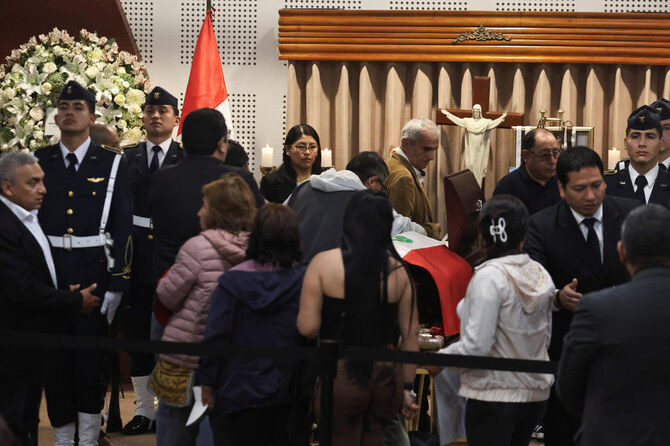
After lying in state for three days he will be buried on Saturday following a state funeral.
The death of the ex-leader, who loomed large over Peruvian politics long after he faxed in his resignation from exile in Japan in 2000, triggered a vigorous debate on social media over his legacy.
Thousands of admirers queued at the National Museum in Lima on Thursday and Friday to pay their respects at his open casket.
“He defeated terrorism and in reality was the best president Peru could have had,” Jackeline Vilchez, from a family of self-described “fujimoristas,” said outside the former leader’s residence, where she came to pay her respects.
But relatives of the victims of army massacres carried out on his watch lamented that he went to the grave without showing remorse for their deaths.
“He left without asking forgiveness from their families, he made a mockery of us,” Gladys Rubina, the sister of one of the civilian victims, said, sobbing.
Fujimori, an engineer by training, worked as a university maths professor before entering politics.
In 1990, he caused a surprise by defeating acclaimed writer Mario Vargas Llosa to win the presidency.
His neoliberal economic policies won him the support of the ruling class and international financial institutions.
He also won praise for crushing a brutal insurgency by Shining Path and Tupac Amaru leftist rebels in a conflict that left more than 69,000 people dead and 21,000 missing between 1980 and 2000, according to a government truth commission.
But the brutal tactics employed by the military saw him spend his twilight years in jail.
In 2009, he was sentenced to 25 years in prison for crimes against humanity over two massacres carried out in the name of Peru’s so-called war on terror — one at a house party, the other in a university dormitory — that left 25 people dead.
As recently as July, Fujimori had been considering a comeback attempt in 2026 elections, according to his daughter Keiko, also a politician.
But he was dogged by ill health and had only recently completed treatment for tongue cancer.
Fujimori claimed he paved the way for Peru to become one of the leading countries of Latin America.
As he turned 80 in 2018, he said: “Let history judge what I got right and what I got wrong.”
One of the most dramatic episodes of his presidency was a four-month hostage ordeal at the Japanese embassy in Lima in late 1996 and early 1997.
It ended with him sending in special forces, who saved nearly all 72 hostages and killed the 14 rebel hostage-takers.
Fujimori’s downfall began in 2000 after his spy chief was exposed for corruption.
He fled to Japan and sent a fax announcing his resignation. Congress voted to sack him instead.
He was eventually arrested when he set foot in Chile and was extradited to Peru, where he was put on trial.
In December 2017, then-president Pedro Pablo Kuczynski pardoned Fujimori on health grounds.
The Supreme Court later annulled the pardon and, in January 2019, he was returned to jail from hospital before finally being released about five years later.


![]()

Peru bids farewell to divisive former leader Fujimori
Short Url
https://arab.news/babhc
Peru bids farewell to divisive former leader Fujimori
- Fujimori was revered by many for crushing leftist guerrillas and for boosting the economy
- But he was reviled by others as an autocrat who signed off on brutal human rights abuses


Latest updates


© 2026 SAUDI RESEARCH & PUBLISHING COMPANY, All Rights Reserved And subject to Terms of Use Agreement.