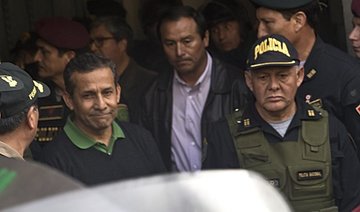
LIMA: A Peruvian court ordered former president Alberto Fujimori on Monday to stand trial for the 1992 killings of six farmers, arguing that he lacks immunity despite a recent pardon for a different crime.
The National Criminal Court said the pardon granted to Fujimori in a human rights case for which he was serving a 25-year sentence did not apply to the murders of the group.
Prosecutors asked to try the ex-president and 23 others for the death squad killings.
Fujimori, 79, was pardoned by the current Peruvian president, Pedro Pablo Kuczynski, on December 24 on humanitarian grounds because of ill health.
The former leader had been serving a sentence for crimes that included commanding death squads that killed suspected civilian sympathizers of leftwing guerrillas that his regime was fighting.
The pardon triggered street protests in Peru and was slammed by international rights groups as a blow in the struggle against impunity.
Kuczynski’s pardon was seen by many as quid pro quo for help from Fujimori’s lawmaker son Kenji days earlier in beating an impeachment vote in Congress over alleged corruption.
Miguel Perez, Fujimori’s attorney, said it was not yet clear if the issue of immunity could be addressed again.
Perez told local media that he tried to have the ex-president serve as a witness in the new case, but failed. “So in this trial, he simply will be listed as one of the accused,” Perez said.
Prosecutors are seeking 25 years in prison for the ex-leader.
“Mr Fujimori now has resumed his status as a defendant, and in the case of the pardon, there was no sensible justification,” human rights lawyer Carlos Rivera said.
Fujimori’s daughter Keiko, leader of the largest party in congress, the right-wing Fuerza Popular, said she regretted that her father would be tried again.
She expressed hope the charges would not mean her father will be taken into custody again, give his age and poor health.
“Alberto Fujimori deserves to be free as he confronts this process,” Keiko Fujimori wrote on Twitter.
Kuczynski had pledged not to pardon Alberto Fujimori in the earlier case. But he did so just days after Kenji Fujimori’s vote in his favor, sparking speculation the pardon was a political quid pro quo.
Rights groups and relatives of victims asked the Inter-American Court of Human Rights earlier this month to rule against a pardon for Fujimori.
Kuczynski — who defeated Keiko Fujimori for the presidency in 2016 — said he had pardoned the ex-president for humanitarian reasons.
The pardon has drawn heavy criticism from victims of Fujimori’s 1990-2000 rule, as well as their relatives and human rights advocates.
Two United Nations human rights experts also said the pardon was a “slap in the face” to victims of his brutal rule.
“The presidential pardon granted to Alberto Fujimori on politically motivated grounds undermines the work of the Peruvian judiciary and the international community to achieve justice,” UN special rapporteurs Agnes Callamard and Pablo de Greiff said in a statement in December.
“We are appalled by this decision. It is a slap in the face for the victims and witnesses whose tireless commitment brought him to justice.”
Still, Fujimori earned respect from many Peruvians for his ruthless and unflinching campaign to defeat leftist guerrillas during his presidency.


![]()

Peru court orders former president Fujimori tried for 1992 mass killing
Peru court orders former president Fujimori tried for 1992 mass killing

Latest updates




© 2026 SAUDI RESEARCH & PUBLISHING COMPANY, All Rights Reserved And subject to Terms of Use Agreement.