LIMA: Peru will on Saturday lay to rest polarizing former president Alberto Fujimori, who ruled with an iron fist in the 1990s and later spent 16 years in prison for crimes against humanity.
Fujimori, who had Japanese heritage, was revered by many for crushing leftist guerrillas and for boosting the economy, but reviled by others as an autocrat who signed off on brutal human rights abuses.
He died on Wednesday, aged 86, after a long battle with cancer.
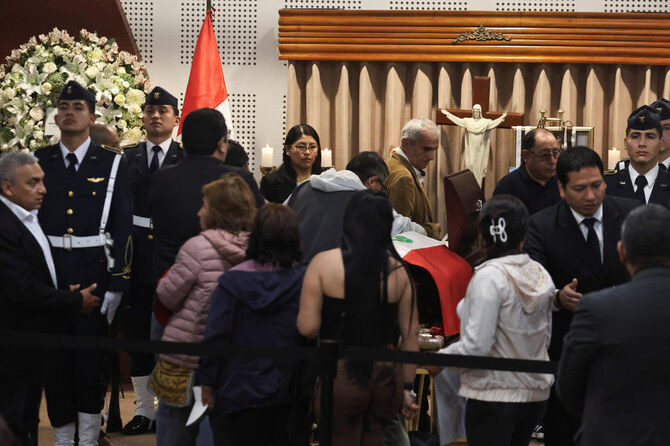
After lying in state for three days he will be buried on Saturday following a state funeral.
The death of the ex-leader, who loomed large over Peruvian politics long after he faxed in his resignation from exile in Japan in 2000, triggered a vigorous debate on social media over his legacy.
Thousands of admirers queued at the National Museum in Lima on Thursday and Friday to pay their respects at his open casket.
“He defeated terrorism and in reality was the best president Peru could have had,” Jackeline Vilchez, from a family of self-described “fujimoristas,” said outside the former leader’s residence, where she came to pay her respects.
But relatives of the victims of army massacres carried out on his watch lamented that he went to the grave without showing remorse for their deaths.
“He left without asking forgiveness from their families, he made a mockery of us,” Gladys Rubina, the sister of one of the civilian victims, said, sobbing.
Fujimori, an engineer by training, worked as a university maths professor before entering politics.
In 1990, he caused a surprise by defeating acclaimed writer Mario Vargas Llosa to win the presidency.
His neoliberal economic policies won him the support of the ruling class and international financial institutions.
He also won praise for crushing a brutal insurgency by Shining Path and Tupac Amaru leftist rebels in a conflict that left more than 69,000 people dead and 21,000 missing between 1980 and 2000, according to a government truth commission.
But the brutal tactics employed by the military saw him spend his twilight years in jail.
In 2009, he was sentenced to 25 years in prison for crimes against humanity over two massacres carried out in the name of Peru’s so-called war on terror — one at a house party, the other in a university dormitory — that left 25 people dead.
As recently as July, Fujimori had been considering a comeback attempt in 2026 elections, according to his daughter Keiko, also a politician.
But he was dogged by ill health and had only recently completed treatment for tongue cancer.
Fujimori claimed he paved the way for Peru to become one of the leading countries of Latin America.
As he turned 80 in 2018, he said: “Let history judge what I got right and what I got wrong.”
One of the most dramatic episodes of his presidency was a four-month hostage ordeal at the Japanese embassy in Lima in late 1996 and early 1997.
It ended with him sending in special forces, who saved nearly all 72 hostages and killed the 14 rebel hostage-takers.
Fujimori’s downfall began in 2000 after his spy chief was exposed for corruption.
He fled to Japan and sent a fax announcing his resignation. Congress voted to sack him instead.
He was eventually arrested when he set foot in Chile and was extradited to Peru, where he was put on trial.
In December 2017, then-president Pedro Pablo Kuczynski pardoned Fujimori on health grounds.
The Supreme Court later annulled the pardon and, in January 2019, he was returned to jail from hospital before finally being released about five years later.

Peru bids farewell to divisive former leader Fujimori
https://arab.news/babhc
Peru bids farewell to divisive former leader Fujimori
- Fujimori was revered by many for crushing leftist guerrillas and for boosting the economy
- But he was reviled by others as an autocrat who signed off on brutal human rights abuses
Accused militant is taken into custody in the deadly 2012 Benghazi attack
- Zubayar Al-Bakoush, identified by officials as a member of an extremist militia in Libya, had been wanted by the United States for more than a decade
- Al-Bakoush, 58, appeared Friday afternoon in federal court in Washington
WASHINGTON: An alleged participant in the deadly 2012 attack on the US compound in Benghazi, Libya, has been taken into custody to face prosecution for the rampage that killed four Americans and emerged as a divisive political issue, the Justice Department said Friday.
Zubayar Al-Bakoush, identified by officials as a member of an extremist militia in Libya, had been wanted by the United States for more than a decade. He is accused in a newly unsealed indictment of joining a mob that crashed the front gates of the diplomatic mission with assault rifles and explosives, setting off hours of violence that also included deadly fires.
Al-Bakoush arrived early Friday at an airfield in Virginia after what FBI Director Kash Patel described as a “transfer of custody” and will face charges in Washington, including murder, attempted murder, arson and conspiring to provide material support to terrorists.
Al-Bakoush, 58, appeared Friday afternoon in federal court in Washington, wearing a gray hoodie and using a wheelchair. He did not enter a plea and answered routine questions from a federal magistrate through an interpreter who appeared remotely. He was ordered detained until a hearing tentatively set for next week.
“I have complete trust in the court and the jury,” Al-Bakoush said through the interpreter. He added that he has “complete confidence” there will be justice in his case.
The arrest represents the latest effort by the Justice Department as an institution to hold to account the militants believed responsible for the killings of Ambassador Chris Stevens and three other Americans. Another Libyan militant alleged to be a leader of the attack was captured by US special forces more than a decade ago and later convicted and sentenced to prison, and a third accused participant is also imprisoned.
“We have never stopped seeking justice for that crime against our nation,” Attorney General Pam Bondi said as she announced the arrest at a news conference with Patel and US Attorney Jeanine Pirro, the top federal prosecutor in Washington whose office will be handling the case.
The attack almost immediately became a political flashpoint in Washington as Republicans challenged President Barack Obama and then-Secretary of State Hillary Clinton on security at the facility, the military response to the violence and the Democratic administration’s changing narrative about who was responsible and why.
A final report by a Republican-led congressional panel faulted the Obama administration for security deficiencies at the Libyan outpost and a slow response to the attack. The report, however, found no wrongdoing by Clinton. Clinton at the time dismissed the report as an echo of previous probes with no new discoveries, saying it was “time to move on.” Other Democrats denounced the Republicans’ report as “a conspiracy theory on steroids.”
On the night of Sept. 11, 2012, US officials have said, more than 20 militants armed with AK-47s and grenade launchers breached the gate of the consulate compound in Benghazi and set buildings on fire. The fire led to the deaths of Stevens, the ambassador, and State Department employee Sean Smith.
Other State Department personnel escaped to a nearby US facility known as the annex. That area came under attack from gunfire and a precision mortar barrage, resulting in the deaths of security officers Tyrone Woods and Glen Doherty.
The indictment accuses Al-Bakoush of being part of the armed group that traveled to the mission. It also says he conducted surveillance and attempted to break into cars of diplomatic mission staff.
The case will be the latest US prosecution to focus attention on the Benghazi attacks.
Ahmed Abu Khattala, who was captured in Libya in 2014, was convicted in a jury trial and sentenced to more than two decades in prison. His attorneys argued that the evidence was inconclusive and that he was singled out because of his ultra-conservative Muslim beliefs.
Another Libyan national, Mustafa Al-Imam, was captured in 2017 and convicted two years later for his role. His attorneys argued that he had been suffering from mental trauma and seasickness when he agreed to speak with American officials aboard a US Navy vessel days after his abduction.
“The Benghazi saga was a painful one for Americans,” Pirro said Friday. “It has stayed with all of us. And let me be very clear: There are more of them out there. Time will not stop us from going after these predators no matter how long it takes in order to fulfill our obligation to those families who suffered horrific pain at the hands of these violent terrorists.”


