

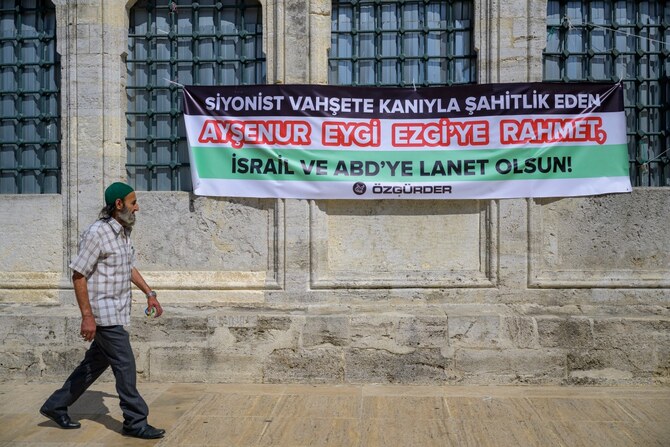
Investigation casts doubt on Israeli forces’ account of US-Turkish activist’s death

The Post’s findings cast doubt on the justification for using live fire in this case, highlighting concerns about the broader use of excessive force by Israeli soldiers in the West Bank. (AFP/File)
Short Url
Updated 13 September 2024
Follow

Investigation casts doubt on Israeli forces’ account of US-Turkish activist’s death

  • Washington Post investigation suggests Aysenur Ezgi Eygi’s was the result of a ‘mischaracterization’ of events by soldiers
  • Reconstruction of events reveals Eygi was shot about 20 minutes after protesters had retreated

LONDON: Turkish-American activist Aysenur Ezgi Eygi’s death was the result of a “mischaracterization” of events by Israeli forces, raising fresh doubts about the official account, according to an investigation by the Washington Post.

Eygi was fatally shot in the head in early September while participating in a protest against Israeli settlements in the West Bank.

Although Israeli authorities initially described her death as likely “indirect and unintentional,” the Post’s investigation, based on 13 eyewitness testimonies and over 50 videos and photos provided by the International Solidarity Movement, paints a different picture.

The report indicates that the protests had largely subsided before Israeli soldiers opened fire.

Eygi was shot roughly 30 minutes after the height of confrontations, and about 20 minutes after protesters had retreated down the main road, some 200 yards (183 meters) away from Israeli forces.

Eygi herself had withdrawn to an olive grove far from the soldiers, approximately 180 meters away, before being struck by a bullet.

Witnesses claimed that a Palestinian teenager standing about 18 meters away from Eygi may have been the intended target of Israeli fire.

The Israeli army declined to comment on the investigation.

According to one of her colleagues, Eygi had explicitly decided beforehand she did not want to be “near any action.”

The report described chaotic scenes of violence following Friday prayers in the town of Beita, near Nablus, in the West Bank.

After young Palestinians erected barricades and threw rocks, Israeli soldiers responded with teargas and live ammunition.

Eygi, however, had moved to an olive grove far from the confrontation when she was hit by the fatal bullet.

The Post’s findings cast doubt on the justification for using live fire in this case, highlighting concerns about the broader use of excessive force by Israeli soldiers in the West Bank.

Israeli rights groups have noted that soldiers are often given broad discretion to open fire, even based on perceived future threats from suspects.

The incident has prompted international criticism, including from US President Joe Biden, who expressed sadness and anger over the death, though he echoed the Israeli account that the shooting was accidental.

Eygi’s family, however, has rejected this explanation, accusing the US government of accepting Israel’s narrative without independent investigation.

“President Biden is still calling her killing an accident based only on the Israeli military’s story. This is not only insensitive and false, it is complicit in the Israeli military’s agenda to take Palestinian land and whitewash the killing of an American,” the family said in a statement earlier this week.

Tensions between the US and Israel have grown more strained in recent months, particularly as violence in the West Bank has surged since the Oct. 7 Hamas-led attacks.

At least 634 Palestinians have been killed by Israeli forces during this period, according to the UN.


Paris exhibition marks 200 years of Le Figaro and the enduring power of the press

Updated 17 January 2026
Follow

Paris exhibition marks 200 years of Le Figaro and the enduring power of the press

  • The exhibition celebrated the bicentennial of Le Figaro, offering visitors a rare opportunity to step inside the newspaper’s vast historical archive

PARIS: One of France’s most influential newspapers marked a major milestone this month with a landmark exhibition beneath the soaring glass nave of the Grand Palais, tracing two centuries of journalism, literature and political debate.
Titled 1826–2026: 200 years of freedom, the exhibition celebrated the bicentennial of Le Figaro, offering visitors a rare opportunity to step inside the newspaper’s vast historical archive. Held over three days in mid-January, the free exhibition drew large crowds eager to explore how the title has both chronicled and shaped modern French history.
More than 300 original items were displayed, including historic front pages, photographs, illustrations and handwritten manuscripts. Together, they charted Le Figaro’s evolution from a 19th-century satirical publication into a leading national daily, reflecting eras of revolution, war, cultural change and technological disruption.
The exhibition unfolded across a series of thematic spaces, guiding visitors through defining moments in the paper’s past — from its literary golden age to its role in political debate and its transition into the digital era. Particular attention was paid to the newspaper’s long association with prominent writers and intellectuals, underscoring the close relationship between journalism and cultural life in France.
Beyond the displays, the program extended into live journalism. Public editorial meetings, panel discussions and film screenings invited audiences to engage directly with editors, writers and media figures, turning the exhibition into a forum for debate about the future of the press and freedom of expression.
Hosted at the Grand Palais, the setting itself reinforced the exhibition’s ambition: to place journalism firmly within the country’s cultural heritage. While the exhibition has now concluded, the bicentennial celebrations continue through special publications and broadcasts, reaffirming Le Figaro’s place in France’s public life — and the enduring relevance of a free and questioning press in an age of rapid change.