


MOSCOW/LONDON: Russia on Friday accused six British diplomats of spying and said it decided to expel them. The UK said the “completely baseless” move came weeks ago and was linked to its action in May to revoke the credentials of an attaché at the Russian Embassy and limit Moscow’s diplomatic activities in London,
The latest East-West tensions unfolded as British Prime Minister Keir Starmer visits Washington for talks that will include Ukraine’s request to use Western-supplied weapons to strike targets inside Russia. President Vladimir Putin has warned that Kyiv’s use of long-range weapons would put NATO at war with Moscow.
Russia’s Federal Security Service said in an online statement that the Foreign Ministry withdrew the British envoys’ accreditations, and Russian TV quoted an FSB official as saying it was decided to expel them.
The FSB said it received documents indicating the diplomats were sent to Russia by a division of the UK’s Foreign Office “whose main task is to inflict a strategic defeat on our country,” and that they were involved in “intelligence-gathering and subversive activities.” It did not identify the six diplomats.
The FSB warned that if other diplomats are found to be carrying out “similar actions,” it “will demand early termination of their missions” to Russia.
Russian TV said the six diplomats had met with independent media and rights groups that have been declared “foreign agents” — a label Russian authorities have actively used against organizations and individuals critical of the Kremlin.
Foreign Ministry spokesperson Maria Zakharova said in a statement that the diplomats were carrying out “subversive actions aimed at causing harm to our people.”
“We fully agree with the assessments of the activities of the British so-called diplomats expressed by the Russian FSB,” she added in an online statement. “The British Embassy has gone far beyond the limits outlined by the Vienna Conventions.”
Kremlin spokesperson Dmitry Peskov said breaking off diplomatic relations with the UK was not on the table right now.
In calling the Russian allegations “completely baseless,” the UK Foreign Office said the expulsions happened weeks ago, linking them to Britain’s decision in May to revoke the credentials of an attaché at Moscow’s London embassy and to impose a five-year time limit on all Russian diplomats in Britain.
“The Russian authorities revoked the diplomatic accreditation of six UK diplomats in Russia last month, following action taken by the UK government in response to Russian state-directed activity across Europe and in the UK,” the Foreign Office said in a statement. “We are unapologetic about protecting our national interests.”
In May, the UK expelled Russia’s defense attaché in London, alleging he was an undeclared intelligence officer, and it closed several Russian diplomatic properties in Britain that it said were being used for spying. About a week later, Russia reciprocated and expelled Britain’s defense attaché.
Expulsions of diplomats — both Western envoys working in Russia and Russians in the West — have become increasingly common since Moscow launched its invasion of Ukraine in 2022.
Last year, the Russian news outlet RBC counted that Western countries and Japan expelled a total 670 Russian diplomats between the start of 2022 and October 2023, while Moscow responded by expelling 346 diplomats. According to RBC, that was more than in the previous 20 years combined.
On his way to visit the US, Starmer said Britain does not “seek any conflict with Russia.”
“Russia started this conflict. Russia illegally invaded Ukraine. Russia could end this conflict straight away,” he told reporters.
“Ukraine has the right to self-defense and we’ve obviously been absolutely fully supportive of Ukraine’s right to self-defense — we’re providing training capability, as you know. But we don’t seek any conflict with Russia — that’s not our intention in the slightest,” he said.
Ukraine wants approval to use some weapons to strike deeper into Russia and there are signs that President Joe Biden might shift US policy in response.
While the issue is expected to be at the top of the agenda for their meeting, it appeared unlikely that Biden and Starmer would announce any policy changes at this time, according to two US officials familiar with planning for the talks. The officials spoke on condition of anonymity because they were not authorized to discuss the private deliberations.
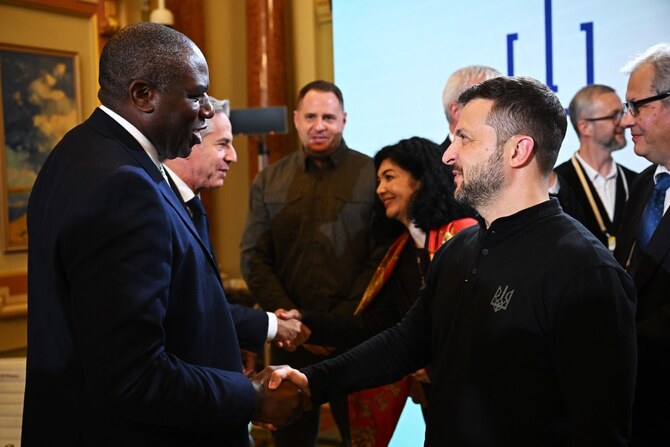
Ukrainian officials renewed their pleas to use Western-provided long-range missiles against targets deeper inside Russia during this week’s visit to Kyiv by US Secretary of State Antony Blinken and British Foreign Secretary David Lammy.
Blinken said he had “no doubt” that Biden and Starmer would discuss the matter during their visit, noting the US has adapted and “will adjust as necessary” as Russia’s battlefield strategy has changed.


