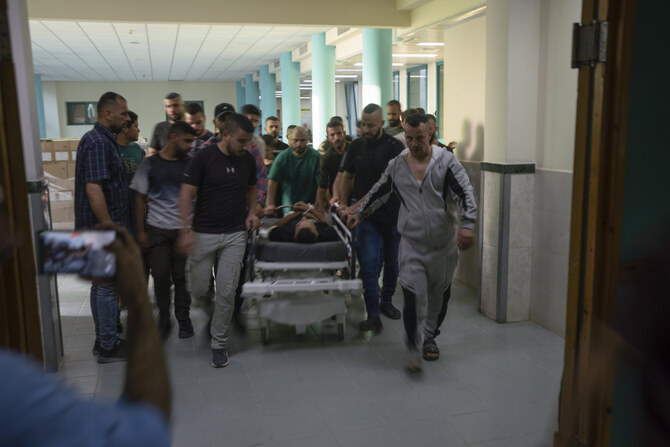
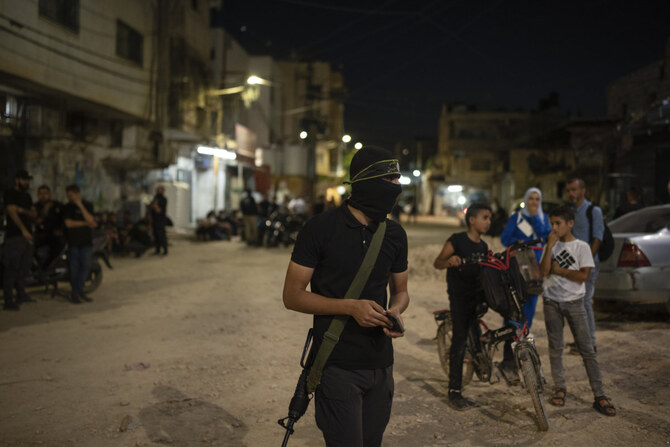

JENIN, West Bank: As the world’s attention focuses on the deadly war in Gaza, less than 80 miles away scores of Palestinian teens have been killed, shot and arrested in the West Bank, where the Israeli military has waged a monthslong crackdown.
More than 150 teens and children 17 or younger have been killed in the embattled territory since Hamas’ brutal attack on communities in southern Israel set off the war last October. Most died in nearly daily raids by the Israeli army that Amnesty International says have used disproportionate and unlawful force.
Amjad Hamadneh lost son Mahmoud when the 15-year-old’s school dismissed students at the start of a May raid.
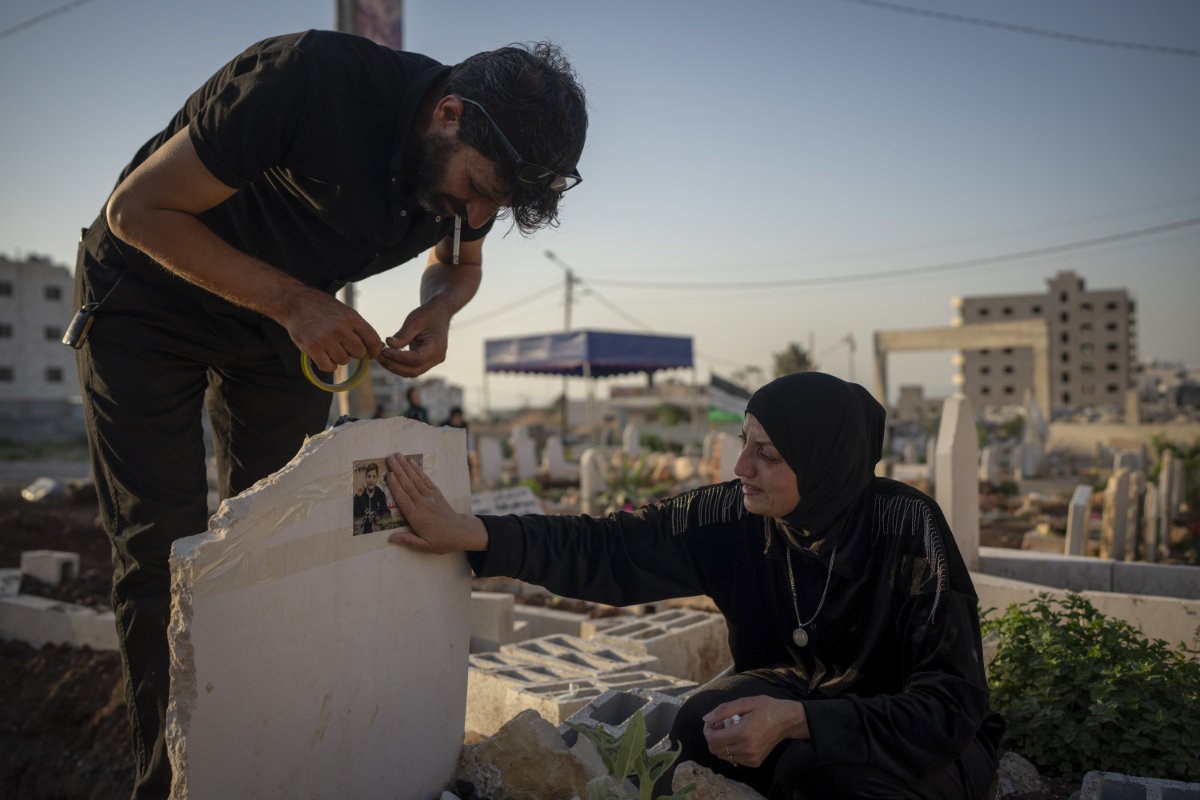
Amjad Hamadneh tapes a photograph to the grave of his son, Mahmoud, who was killed by an Israeli sniper on his way home from school in Jenin, West Bank, on June 5, 2024. (AP)
“He didn’t do anything. He didn’t make a single mistake,” says Amjad Hamadneh, whose son, a buzz-cut devotee of computer games, was one of two teens killed that morning by a sniper.
“If he’d been a freedom fighter or was carrying a weapon, I would not be so emotional,” says his father, an unemployed construction worker. “But he was taken just as easily as water going down your throat. He only had his books and a pencil case.”
It is clear from statements by the Israeli military, insurgents and families in the West Bank that a number of the Palestinian teens killed in recent months were members of militant groups.
Many others were killed during protests or when they or someone nearby threw rocks or homemade explosives at military vehicles. Still others appear to have been random targets. Taken together, the killings raise troubling questions about the devaluation of young lives in pursuit of security and autonomy.
The Israeli army said in a statement to The Associated Press that it has stepped up raids since Oct. 7 to apprehend militants suspected of carrying out attacks in the West Bank and that “the absolute majority of those killed during this period were armed or involved in terrorist activities at the time of the incident.”
On the June afternoon that 17-year-old Issa Jallad was killed, video from a neighbor’s security camera shows, he was on a friend’s motorbike with an Israeli armored vehicle in close pursuit. Days later, a poster outside his family’s home in Jenin showed him cradling an assault rifle and declared him a holy warrior.
But the grainy tape, reviewed by AP days after the raid, and others from nearby cameras do not explain where he fit in the conflict. The Israeli army said that its soldiers had spotted two militants handling a powerful explosive device. When the pair tried to flee, troops opened fire and “neutralized them.”
But an Israeli human rights group, B’Tselem, says its review of multiple security camera videos showed Jallad and his friend posed no threat.
“We all expected to be in this situation,” said the teen’s brother, Mousa Jallad. “It could happen to any of us.”
Jenin’s refugee camp has long been notorious as a hotbed of Palestinian militancy, raided repeatedly by Israeli forces who have occupied the West Bank since seizing control in their 1967 war with neighboring Arab states.
The embattled territory was already seeing deadly clashes before the war began. But Israeli forces, which police about 3 million Palestinians while assigned to protect 500,000 Jewish settlers, has significantly stepped up raids in the months since.
Youths represent almost a quarter of the nearly 700 Palestinians slain in the West Bank since the war began, the most since the violent uprising known as the Second Intifada in the early 2000s. More than 20 Israeli civilians and soldiers have been killed in the territory since October.
A military spokesman said the Israeli army makes great efforts to avoid harming civilians during raids and “does not target civilians, period.” He said human rights groups focus on a few outlier cases.
Military operations in the West Bank are fraught because forces are pursuing militants, many in their teens, who often hide among the civilian population, said the spokesman, Lt. Col. Nadav Shoshani.
“In many cases many of them are 15, 16 years old who are not wearing uniforms and might surprise you with a gun, with a knife,” he said.
Critics say the crackdown is shaped by retribution, not only military strategy.
When sirens erupted at the start of the May raid, Amjad Hamadneh says, he called Mahmoud on his cellphone and was relieved to hear that the brothers had reached their school. But then Mahmoud’s twin brother, Ahmed, called back to say that the principal had dismissed classes. As students poured into the street, the brothers were separated in the chaos.
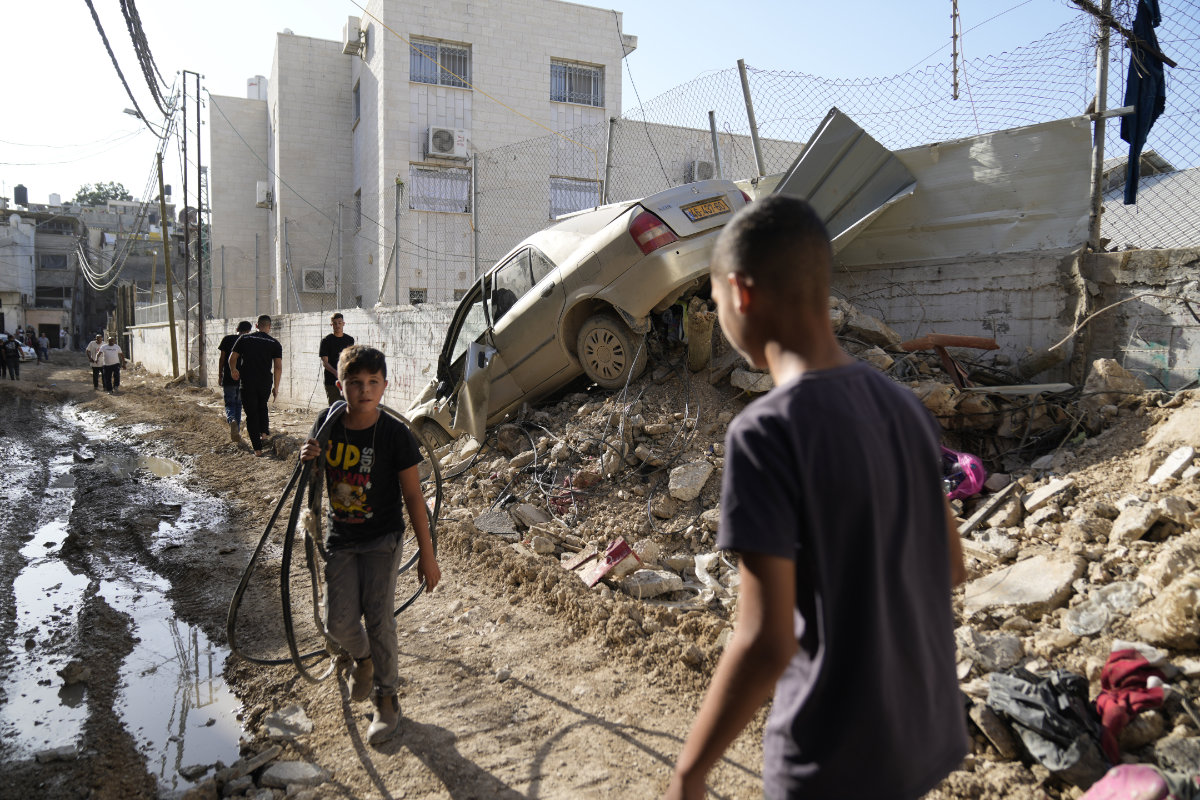
Young Palestinian refugees walk past a damaged vehicle in the West Bank refugee camp of Tulkarem on Sept. 12, 2024. (AP)
Four bullets hit Mahmoud as he fled, and another pierced his skull. He was the third student from his school killed in a raid since the war began.
A former classmate, Osama Hajjir, who had dropped out of school to work, was also killed, along with a teacher from a nearby school and a doctor from the hospital down the street.
“Now when I hear the sound of sirens I go to my room and stay there,” says Karam Miazneh, another classmate, who was shot during the raid but survived. “I’m still in fear that they will come to shoot me and kill me.”
Immediately after the May raid, a spokesman for the army said it had carried out the operation with Israeli border police and the country’s internal security agency, destroying an explosive device laboratory and other structures used by militants. But police recently declined to comment, and three weeks after the AP asked the military to answer questions about the May raid, an army spokesman said he was unable to comment until he could confer with police.
When Amjad Hamadneh heard his son had been wounded, he sped through Jenin’s twisting streets, drawing gunfire as he neared the hospital. But Mahmoud was already gone.
Nearby, Osama’s father, Muhamad, broke down as he leaned over his son’s body. Months earlier he’d snapped a photo of the smiling teen beside graffiti touting Jenin as “the factory of men,” tirelessly cranking out fighters in the resistance against Israel. Now, he pressed that same, still-smooth face between his hands.
“Oh, my son. Oh, my son,” he sobbed. “My beautiful son.”
Since Mahmoud Hamadneh was killed, his siblings ask frequently to visit his grave. His younger sister now sleeps in his bed so her surviving brother, Ahmed, will not be in the room alone.
“I feel like I cannot breathe. We used to do everything together,” Ahmed says. His father listens closely, despairing later that such grief could drive the teen into militancy. If the risk is so clear to a Palestinian father, he says, why don’t Israeli soldiers see it?
“They think that if they kill us that people will be afraid and not do anything,” he says. “But when the Israelis kill someone, 10 fighters will be created in his place.”