

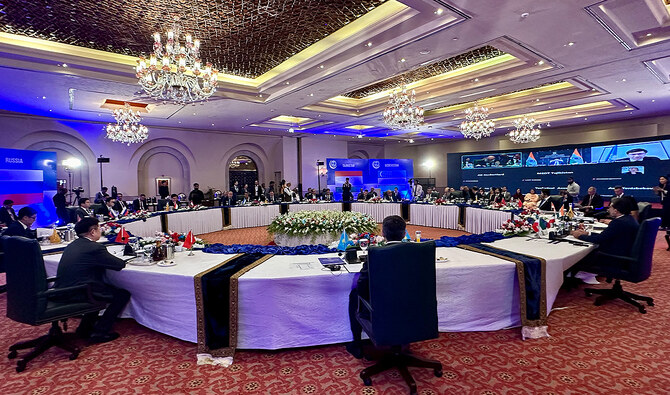

ISLAMABAD: Commerce Minister Jam Kamal on Thursday said Pakistan was keen to explore trade avenues among the Shanghai Cooperation Organization (SCO) member countries, highlighting his country’s geographical location as a natural hub for trade and investment collaboration.
The minister expressed these views while presiding over in Islamabad the 23rd meeting of ministers of SCO member states responsible for foreign, economic and trade activities. The SCO represents a major cross-regional bloc, accounting for nearly half of the world’s population and a substantial portion of global gross domestic product (GDP).
Pakistan hosted the meeting in its capacity as the incumbent chair of the SCO Council of Heads of Government, the second highest SCO forum, which deals with all economic, trade, social, cultural and humanitarian issues as well as personnel and budgetary matters of the organization.
During his inaugural address, Khan noted that the SCO region was home to some of the world’s fastest-growing economies and a significant portion of the global population that presented immense potential for trade and economic collaboration.
“Pakistan’s geographical location at the crossroads of South Asia, Central Asia and the Middle East positions it as a natural hub for trade and investment,” he said. “Pakistan is keen to leverage this strategic advantage to contribute to the collective growth of the SCO region.”
The minister said trade not only drives economic growth but also serves as a bridge to encourage mutual understanding, peace and prosperity among peoples of SCO countries.
“Pakistan welcomes and remains committed to deepening trade ties among the SCO member states in line with the national laws and policies of the member states,” he said. “We believe that by leveraging our collective strengths, we can create a more integrated and prosperous region.”
Citing the intra-SCO trade data, Khan said the overall trade between SCO member states remained 16 percent of their total foreign trade last year.
“Member countries imported 19 percent of their total imports from within SCO, while for export this was about 14 percent,” he added.
He said Pakistan envisions a robust and interconnected SCO region where trade flows seamlessly across the borders, where businesses thrive, and where innovation and entrepreneurship are nurtured, within the national laws and policies of member states.
Participating in the meeting virtually from New Delhi, India’s Deputy Commerce Minister Sunil Bharatwal highlighted the significance of the SCO region in the world economy.
“We see trade as an engine of growth and driver of economic development,” he said, adding that it was “mutual trust, inclusiveness as well as transparency” that were key to preserving the fundamental principles and objectives of the multilateral trading system and sustaining global supply chains. India’s priorities in SCO were shaped by the development of the global economy, he added.
“SCO stands for security, economic development, connectivity, unity, respect for sovereignty and territorial integrity, and humanitarian protection,” he said.
Ling Ji, Vice Minister for Commerce and Deputy China International Trade Representative, emphasized that SCO member states must take the “right steps” to participate in the global economic and social reforms.
“To strengthen the various aspects of cooperation, one is to stick to the original intention of promoting trade and investment, liberalization and convenience between the member states,” he added.
In their country-wise statements, the SCO ministers also shared their views on the prospects and measures to deepen the economic and trade cooperation among SCO countries.
Adoption of SCO ministerial statement
The Pakistani commerce ministry said the collective vision of the SCO ministers on these issues was articulately summarized in the ministerial statement adopted by the meeting, which among other things underscored the importance of fair-trade practices and the pursuit of sustainability in economic development.
“The statement also emphasized the need to counter the protectionist trade measures, promote innovation and cooperation in digital technologies as well as to strengthen trade ties within the SCO region,” the ministry said, adding that to this end, members underscored the role of the World Trade Organization (WTO) and called for strengthening a WTO-based, non-discriminatory multilateral trading system.
“One of the key outcomes of the meeting was the approval of the Pakistani proposal on cooperation between the Trade Promotion Organizations (TPOs) of the SCO region.”
The commerce ministry said the implementation of this Pakistani proposal would meaningfully enhance collaboration between trade promotion bodies of SCO member states, facilitate greater trade integration and create new economic opportunities across the region.
The statement added that the meeting also approved the Kazakh proposal for the creation of a database of economic preferences for the SCO region, which will act as a comprehensive resource for member states to access information on economic incentives and preferences within the bloc, fostering a more cohesive business environment.
“Additionally, the ministerial meeting approved the Russian proposal on the promotion of the creative economy within the region, highlighting the importance of innovation-driven economic growth,” the ministry added.
Founded in 2001, the SCO is a major trans-regional organization spanning South and Central Asia, with China, Russia, Pakistan, India, Uzbekistan, Tajikistan, Kyrgyzstan and Kazakhstan as its permanent members. The SCO member states collectively represent nearly half of the world’s population and a quarter of global economic output.
The organization’s agenda of promoting peace and stability, and seeking enhanced linkages in infrastructure, economic, trade and cultural spheres, is aligned with Pakistan’s own vision of enhancing economic connectivity as well as peace and stability in the region.


