DERA ISMAIL KHAN: A sit-in by police in the Lakki Marwat district of the northwestern Khyber Pakhtunkhwa province against a surge in militancy and the targeted assassinations of officers entered its fourth day on Thursday, with seven people killed in attacks in the region in the last 24 hours, police said.
Security officials, policemen and polio vaccinators were among the seven fatalities. In a latest attack in Bannu, a southern district in KP, unidentified gunmen opened fire on police guards escorting a polio vaccination team on Thursday morning, killing a policeman.
Pakistan has seen a number of militant attacks in recent months, with most of them taking place in Khyber Pakhtunkhwa where religiously motivated groups like the Pakistani Taliban (TTP) have stepped up assaults, daily targeting security forces convoys and check posts, and carrying out targeted killings and kidnappings of security and government officials.
At least 77 policemen have been killed in ambushes and target killings in Khyber Pakhtunkhwa in 2024, according to police figures.
“Unfortunately, another brave colleague, police officer Noor Alam Jan, lost his life in a targeted attack by unidentified gunmen when he was guarding a polio team this [Thursday] morning in Domail,” Matiullah Khan, a police officer with Bannu police, told Arab News.
The killing comes a day after police in the Bajaur tribal district announced a boycott of polio security duties following the killing of a cop by unknown gunmen.
Last week, 13 people were wounded when a roadside bomb targeted a police vehicle escorting an anti-polio team in Pakistan’s South Waziristan tribal district, officials said.
On Tuesday this week, Bajaur police said a security official was killed and four were injured when their vehicle was hit by a planted bomb near the Niamat Khan village of the volatile district.
On Thursday, police officer Zabihullah Wazir said two laborers and a Frontier Corps paramilitary soldier were killed during an exchange of gunfire between security officials and suspected militants in Angoor Adda, an area bordering Afghanistan in Pakistan’s South Waziristan tribal district.
The Pakistan army has a heavy presence in the Khyber Pakhtunkhwa province, which borders Afghanistan, where it has been battling militants from the Al-Qaeda, Pakistani Taliban and other groups for nearly two decades.
There have been protests in several districts of KP since July, when Pakistan’s cabinet announced that a new military operation would be launched amid a surge in terror attacks across the country. People in the northwestern region have rejected plans for an armed operation and demand that civilian agencies like the provincial police and the counter-terrorism department be better equipped.
PROTESTS GROW
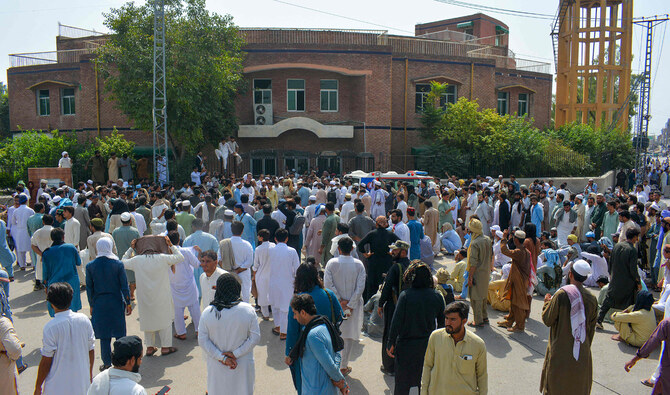
Police in Lakki Marwat have been staging a sit-in for the last four days after unidentified gunmen attacked a police van in the district, killing an officer. Two brothers of a serving police man in the district were separately gunned down.
Police and local elders in Lakki Marwat are demanding the military’s complete withdrawal from KP and the transfer of power to civilian law enforcers to restore peace and stability in the region.
Lakki Marwat police spokesman Shahid Marwat told Arab News the protests had “gained momentum” on Thursday, with more and more people and policemen joining the protest camp and loudspeaker announcements asking businesses to remain shut.
Marwat said police officials from other districts like Bannu were also arriving in Lakki Marwat to join the sit-in in solidarity with their colleagues.
“Today, protesters closed down all main arteries linking Peshawar-Karachi and Lakki Marwat-Punjab on the Indus Highway,” he said.
The sit-in by policemen has also been joined by representatives of civil society and political parties as well as tribal elders and members of the public, the spokesman added.
KP government Spokesman Barrister Muhammad Ali Saif did not return phone calls and text messages on Thursday inquiring about the government’s plans to deal with the protests in Lakki Marwat.
Islamabad says militants mainly associated with the banned Tehreek-e-Taliban-e-Pakistan frequently launch attacks from hideouts in neighboring Afghanistan, targeting police and other security forces.
Islamabad has even blamed Kabul’s Afghan Taliban rulers for facilitating anti-Pakistan militants. Kabul denies the charges.
Ali Amin Gandapur, the chief minister of Khyber Pakhtunkhwa, said this week he would hold direct talks with the rulers in Kabul to take action against Afghanistan-based militant groups.
“My [Khyber Pakhtunkhwa] police has lost trust, my people have lost trust, where are you [federal government, army] taking my youth, my people?” Gandapur said as he addressed a ceremony on Wednesday evening.
“I am saying let me send a representative to Afghanistan to talk to them. Afghanistan is our neighbor, we speak the same language, we have a longer than 1,200 km border. Let me talk to them that what is happening in Afghanistan.
“I announce here … I will talk to Afghanistan myself, I will talk to them as a province. I am telling you as the representative of this province, I will send an emissary and arrange a meeting, I will sit with them and talk and Inshallah I will solve this issue through talks.”
Islamabad says it has consistently taken up the issue of cross-border attacks with the Taliban administration. The issue has also led to clashes between the border forces of the two countries on multiple occasions in recent months, including on Sunday when security forces in Pakistan said they had killed eight Afghan Taliban fighters in a border clash following what Islamabad described as “unprovoked firing” on its checkpoints.


![]()

Gunmen kill cop guarding polio vaccinators as Pakistan police protests against militancy grow
Short Url
https://arab.news/jmr7t
Gunmen kill cop guarding polio vaccinators as Pakistan police protests against militancy grow
- Police sit-in against surge in militancy, assassinations of officers entered fourth day in Lakki Marwat
- At least 77 policemen have been killed in ambushes and target killings in Khyber Pakhtunkhwa in 2024
Latest updates


Recommended


© 2026 SAUDI RESEARCH & PUBLISHING COMPANY, All Rights Reserved And subject to Terms of Use Agreement.