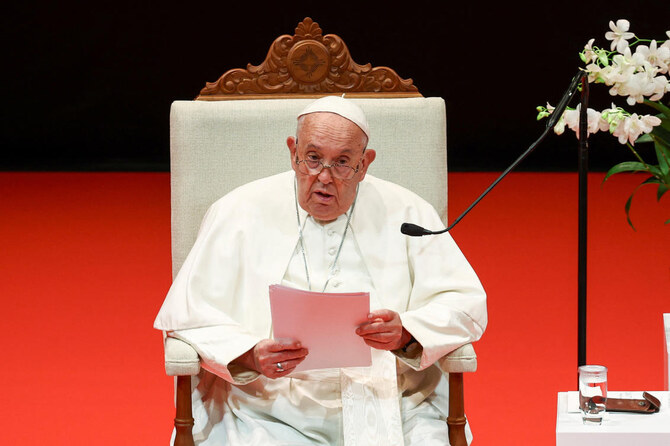
SINGAPORE: Pope Francis made a plea for migrant workers to be paid fairly on Thursday, as he visited the affluent city-state of Singapore on the last stop of his marathon Asia-Pacific tour.
The 87-year-old pope said “special attention” should be paid to “protecting the dignity of migrant workers,” in an address to local political leaders and dignitaries.
“These workers contribute a great deal to society and should be guaranteed a fair wage,” he said.
There are an estimated 170 million migrant workers around the world — about five percent of the global workforce — according to the International Labour Organization.
Most live in the Americas, Europe and Central Asia.
But cheap labor has been instrumental in the rapid growth of gleaming metropolises such as Dubai, Doha and Singapore.
About 300,000 low-wage migrant workers are estimated to work in Singapore.
Advocates say they lack adequate protection against exploitation and sometimes endure poor living conditions, charges the government denies.
The issue shot to the fore during the Covid-19 pandemic, when tens of thousands of migrant workers were forcibly locked down in dormitories.
Many migrants in Singapore come from South Asia and from the Philippines, which has a large and notably devout Catholic majority.
“I’m so happy that the pope has chosen to speak on this topic,” a 34-year-old Filipino domestic helper told AFP, asking not to be named because she did not have permission from her employer.
“Even if they don’t raise my salary, I’m still happy to know that the pope himself is fighting and praying for us” she said.
The woman said she earned $460 a month, in a nation where the median gross income is $3,985, according to Ministry for Manpower statistics for 2023.
Another South Indian worker welcomed the pope’s comments, but said he was happy after five years in the city state.
“Yes, the work is very hard and a higher salary would be better but I’m happy.”
The pope did not refer to workers in Singapore explicitly. But his comments are likely to cause unease inside a government which is fiercely protective of its image.
Still, the Argentine pontiff was otherwise glowing about his hosts, praising the “entrepreneurial spirit” and dynamism that built a “mass of ultra-modern skyscrapers that seem to rise from the sea.”
“Singapore is a mosaic of ethnicities, cultures and religions living together in harmony,” he said, painting the population of almost six million as a shining light for the world.
“I encourage you to continue to work in favor of the unity and fraternity of humanity and the common good of all peoples and all nations,” he said.
About 30 percent of Singaporeans are Buddhist, 20 percent have no religion and the rest are a mix of Catholic, Protestant, Taoist and Hindu.
Singapore is the last stop on the pope’s 12-day, four-nation Asia-Pacific trip aimed at boosting the Catholic Church’s standing in the world’s most populous region.
Francis has defied doubts about his health during a journey that has taken him from a Jakarta grand mosque to a remote jungle of Papua New Guinea.
Despite recently undergoing hernia surgery and dealing with a string of respiratory issues, he has carried out dozens of public engagements, energized congregations and repeatedly sat for hours in the brutal tropical heat.
In East Timor, he held a mass for 600,000 faithful — almost half the nation’s population.
Although the crowds were markedly smaller in Singapore, groups of enthusiasts still lined the main roads trying to get a glimpse of the head of the Catholic Church.
Security was tight, with roads closed and police manning a string of roadblocks.
Welinda Elorde, a 56-year-old cancer survivor traveled from the Philippines for the occasion.
“I think I’m going to cry when I see him. I can feel the emotions now,” she said.
“I’m hoping for complete healing.”

Pope Francis says migrant workers need ‘a fair wage’
https://arab.news/bcqyx
Pope Francis says migrant workers need ‘a fair wage’
- There are an estimated 170 million migrant workers around the world – about five percent of the global workforce
- Cheap labor has been instrumental in the rapid growth of gleaming metropolises such as Dubai, Doha and Singapore
Tensions flare in Minnesota as protesters and federal agents repeatedly square off
- The Trump administration has repeatedly defended the immigration agent who shot Good, saying he acted in self-defense
- With the Department of Homeland Security pledging to send more than 2,000 immigration officers into Minnesota, the state, joined by Minneapolis and St. Paul, sued President Donald Trump’s administration Monday to halt or limit the surge
MINNEAPOLIS: Federal officers dropped tear gas and sprayed eye irritant at activists Tuesday during another day of confrontations in Minneapolis while students miles away walked out of a suburban school to protest the Trump administration’s bold immigration sweeps.
The government’s immigration crackdown is next headed to a federal court where Minnesota and two mayors are asking a judge to immediately suspend the operation. No hearing has been set on the request.
Gas clouds filled a Minneapolis street near where Renee Good was fatally shot in the head by an immigration agent last week. A man scrubbed his eyes with snow and screamed for help while agents in an unmarked Jeep sprayed an orange irritant and drove away.
It’s common for people to boo, taunt and blow orange whistles when they spot heavily armed agents passing through in unmarked vehicles or walking the streets, all part of a grassroots effort to warn the neighborhood and remind the government that they’re watching.
“Who doesn’t have a whistle?” a man with a bag of them yelled.
Brita Anderson, who lives nearby and came to support neighborhood friends, said she was “incensed” to see agents in tactical gear and gas masks, and wondered about their purpose.
“It felt like the only reason they’d come here is to harass people,” Anderson said.
Separately, a judge heard arguments and said she would rule by Thursday or Friday on a request to restrict the use of force, such as chemical irritants, on people who are observing and recording agents’ activities. Government attorneys argued that officers are acting within their authority and must protect themselves.
In Brooklyn Park, Minnesota, students protesting the immigration enforcement operation walked out of school, as students in other communities have done this week.
With the Department of Homeland Security pledging to send more than 2,000 immigration officers into Minnesota, the state, joined by Minneapolis and St. Paul, sued President Donald Trump’s administration Monday to halt or limit the surge.
The lawsuit says the Department of Homeland Security is violating the First Amendment and other constitutional protections by focusing on a progressive state that favors Democrats and welcomes immigrants.
“This is, in essence, a federal invasion of the Twin Cities in Minnesota, and it must stop,” state Attorney General Keith Ellison said.
Minneapolis Mayor Jacob Frey said: “What we are seeing is thousands — plural — thousands of federal agents coming into our city. And, yeah, they’re having a tremendous impact on day-to-day life.”
Dozens of protests or vigils have taken place across the US to honor Good since the 37-year-old mother of three was killed.
Homeland Security says it has made more than 2,000 arrests in the state since early December and is vowing to not back down. Spokesperson Tricia McLaughlin, responding to the lawsuit, accused Minnesota officials of ignoring public safety.
“President Trump’s job is to protect the American people and enforce the law — no matter who your mayor, governor, or state attorney general is,” McLaughlin said.
The Trump administration has repeatedly defended the immigration agent who shot Good, saying he acted in self-defense. But that explanation has been widely panned by Frey, Minnesota Gov. Tim Walz and others based on videos of the confrontation.
Two Democratic lawmakers from Massachusetts announced Tuesday they are sponsoring a bill to make it easier for people to sue and overcome immunity protections for federal officers who are accused of violating civil rights. The bill stands little chance of passage in the Republican-controlled Congress.
In Wisconsin, Lt. Gov. Sara Rodriguez is proposing that the state ban civil immigration enforcement around courthouses, hospitals, health clinics, schools, churches and other places. She is hoping to succeed Gov. Tony Evers, a fellow Democrat, who is not running for a third term.
“We can take a look at that, but I think banning things absolutely will ramp up the actions of our folks in Washington, D.C.,” Evers said, referring to the Trump administration. “They don’t tend to approach those things appropriately.”


