

Study finds fish farming wastewater boosts date fruit weight, nutrients
Study finds fish farming wastewater boosts date fruit weight, nutrients/node/2570956/saudi-arabia
Study finds fish farming wastewater boosts date fruit weight, nutrients
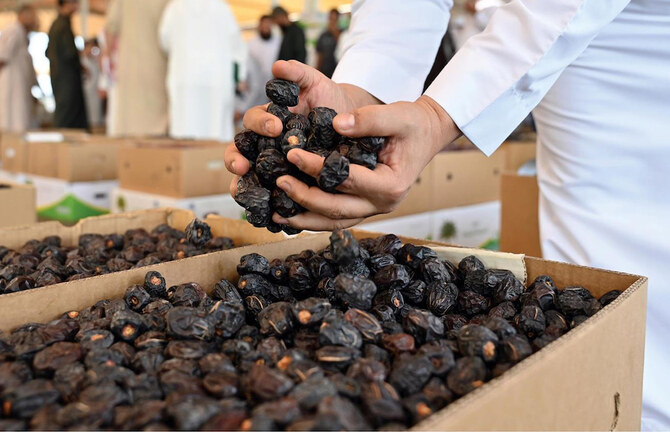
According to the study, date palms irrigated with fish farming water saw a 26 percent increase in fruit weight, 17 percent in length, and 13 percent in diameter. (SPA)
Study finds fish farming wastewater boosts date fruit weight, nutrients
Updated 13 September 2024
Arab News
RIYADH: The Saudi Ministry of Environment has introduced an innovative irrigation technique using fish farming wastewater, significantly increasing date palm productivity across the Kingdom.
Recent research reveals that this method boosts soil nutrient levels and enhances various qualities of dates, improving their economic value, reported the Saudi Press Agency on Wednesday.
Conducted by a specialized team, the study, titled “The Impact of Using Fish Farm Wastewater on Palm Production” highlights this approach as a breakthrough in sustainable agriculture.
Nutrients in fish food residues, especially ammonia, enhance soil health and crop yield, SPA stated.
According to the study, date palms irrigated with fish farming water saw a 26 percent increase in fruit weight, 17 percent in length, and 13 percent in diameter.
Key nutrients in the dates also surged: sugar content increased by 25 percent, zinc by 367 percent, manganese by 112 percent, copper by 9 percent, calcium by 15 percent, phosphorus by 42 percent, and iron by 162 percent.
This research supports a national initiative to expand applied agricultural research, integral to the Kingdom’s transformation strategy.
The study estimates that the Kingdom’s 362 fish farms produce 386 million cubic meters of wastewater annually. Utilizing this for irrigation could significantly improve local date production and quality, aligning with Vision 2030’s sustainability goals.
The study also emphasizes economic benefits, including enhanced soil nitrogen and organic matter, reduced dependence on synthetic fertilizers, water conservation, increased farmer income, and promotion of a circular economy.
Ethiopian Cultural Days brings aroma of coffee, flavorful food to Alsuwaidi Park
The Global Harmony Cultural Series is open to visitors every day from 4:00 p.m. until midnight
Updated 3 sec ago
Haifa Alshammari
RIYADH: Ethiopian Ambassador to Saudi Arabia Muktar Kedir Abdu attended the opening of Ethiopian Cultural Days at Alsuwaidi Park in Riyadh on Thursday.
The Ministry of Media and the General Entertainment Authority organized Ethiopian Cultural Days as part of the Global Harmony Cultural Series, which has focused on several other countries so far, including Yemen, Indonesia, Syria, and Uganda.
The event witnessed the presence of the Ethiopian ambassador to Saudi Arabia, Muktar Kedir Abdu. (AN photo Huda Bashatah)
The Global Harmony Cultural Series is open to visitors every day from 4:00 p.m. until midnight.
During Ethiopian Cultural Days, guests will see Ethiopian dance groups showcasing diverse folk dances from various regions of Ethiopia.
The Global Harmony Cultural Series opens its doors for visitors every day from 4:00 PM until midnight, welcoming visitors from all nationalities and age groups to enjoy food, culture, live performances, and more. (AN photo Huda Bashatah)
“What caught my attention the most was the DJ. My friends and I come almost every day for the DJ,” Turki Mesmeh, a frequent visitor to Global Harmony, told Arab News. “They brought their cultures to us, all the way to the Alsuwaidi neighborhood.”
Ethiopia has an enormously rich history. According to National Geographic, the ancient African kingdom of Aksum was based in what is now northern Ethiopia and parts of Eritrea. It emerged as a powerful and wealthy civilization from the 1st to the 10th century CE, controlling the trade routes between the Roman Empire, India, and the Arabian Peninsula. Ethiopia was also among the first countries in Africa to adopt Christianity.
The Global Harmony Cultural Series opens its doors for visitors every day from 4:00 PM until midnight, welcoming visitors from all nationalities and age groups to enjoy food, culture, live performances, and more. (AN photo Huda Bashatah)
Guests to Ethiopian Cultural Days will also discover a range of Ethiopian cuisine.
“The most important dishes are tibs and kitfo. Tibs is meat, fried with tomatoes and other ingredients,” Welday Meles, owner of the Ethiopian restaurant Lucy, told Arab News.
The Global Harmony Cultural Series opens its doors for visitors every day from 4:00 PM until midnight, welcoming visitors from all nationalities and age groups to enjoy food, culture, live performances, and more. (AN photo Huda Bashatah)
Kitfo is raw minced beef mixed with chili and clarified butter, and is similar to steak tartare.
Another popular dish is beyaynetu, a dish — or series of small dishes — made from a wide variety of ingredients and served with injera — Ethiopia’s famous spongy flatbread made from fermented teff flour.
It is widely known that Ethiopia is the origin of coffee, the beverage that dominates global consumption, and this goes back to an ancient story about a goat herder named Kaldi, who noticed his goats becoming unusually energetic after eating red berries from a particular tree. These red berries were coffee beans. (AN photo Huda Bashatah)
And no celebration of Ethiopia would be complete without coffee. Not only because the coffee plant originated there — legend has it that a goat herder named Kaldi discovered coffee when he noticed that his animals became unusually energetic after eating red berries from a particular tree — but also because the country has preserved its traditional rituals, diverse varieties, and deep cultural connection to coffee, remaining one of its most significant global producers.
Rahika Mohammed, a participant at the event, explained that, in Ethiopia, coffee is commonly served with “popcorn and mastic incense,” adding that “the cup must be full when served.”