


JEDDAH: Saudi Arabia is drawing attention from local and international investors as the Kingdom continues to prosper, according to a top global asset management company official.
In an interview with Arab News, BlackRock’s Managing Director, Head of Middle East Client Business and CEO Saudi Arabia Yazeed Al-Mubarak, said that the global client base has shown a growing interest in gaining exposure to Middle Eastern assets.
He also underlined that regional investors are increasingly seeking more appealing opportunities within the local market.
“As Vision 2030 and its accompanying capital investment comes to life, Saudi Arabia has become an increasingly attractive destination for local and international investment,” Al-Mubarak said.
In August, BlackRock signed a memorandum of understanding in New York with the Saudi Real Estate Refinance Co., fully owned by the Kingdom’s sovereign wealth fund.
The signing occurred during an official visit to the US by Saudi Arabia’s Minister of Municipalities and Housing Majid Al-Hogail.
The deal seeks to develop the real estate finance sector in the Kingdom and increase the share of businesses in the industry’s capital markets.
The agreement was signed by SRC CEO Majid Al-Abduljabbar and Al-Mubarak in the presence of BlackRock President Robert Kapito.
Al-Mubarak said that SRC is leading the way in developing mortgage refinancing solutions for Saudi banks and housing finance companies, enabling global institutional investors to engage with this expanding and high-quality fixed-income asset class.
Commenting on his company’s memorandum with SRC, the CEO said the announcement is an agreement to develop a high-quality fixed-income asset class of mortgage-related securities.
Providing insight on how BlackRock foresees this partnership impacting the real estate finance market in the Kingdom, he said that the Saudi housing sector is experiencing rapid growth due to population expansion, urbanization, and proactive government initiatives.
“Central to this growth is the Housing Program under Vision 2030 that aims to increase homeownership to 70 percent by 2030,” he said.
He added: “The mortgage market has quadrupled in size over the last five years, exceeding $150 billion and expected to further grow to nearly $200 billion. Prior year’s momentum slowed in 2022-2023 due to house price appreciation, rising mortgage rates, and a significant reduction in historical subsidy programs.”
Al-Mubarak further said that to support this growth and bank lending, SRC is looking to issue securitizations locally and internationally to provide additional funding capacity and contribute to the development of the Saudi debt capital markets.
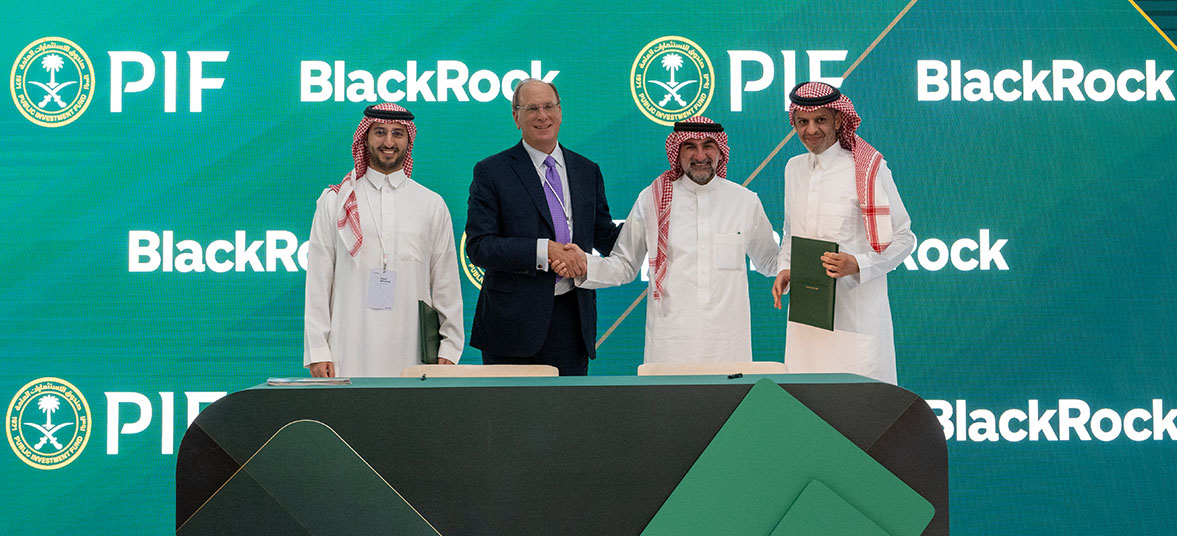
Larry Fink, chairman and CEO of BlackRock, with Yazeed Al-Humied, deputy governor and head of MENA investments at PIF, in April at the launch of BlackRock Riyadh Investment Management. PIF
Commenting on how this collaboration aligns with the Kingdom’s Vision 2030 and what role his firm sees itself playing in achieving these goals, the managing director pointed to BlackRock Riyadh Investment Management, or BRIM – launched in April with an initial investment mandate of up to $5 billion from PIF.
The company – dubbed the first-of-its-kind in the Kingdom by BlackRock’s CEO Larry Fink when it was announced – will further develop Saudi Arabia’s asset management sector, including the housing capital markets, and provide a broad range of attractive backing strategies for Middle Eastern and global clients.
“BRIM will encompass investment strategies across a range of asset classes for the Saudi market, including both public and private markets, managed by a Riyadh-based investment team,” Al-Mubarak told Arab News.
He added that the guarantee offering provided by the Saudi Mortgage Guarantee Services Co., or Damanat, fully owned by the Saudi Real Estate Development Fund, will now act as an enabler for BRIM’s mortgage-focused fixed income strategies.
Speaking of the long-term goals of this partnership, Al-Mubarak said that these include the development of the Kingdom’s mortgage securitization framework, as well as related investment strategies to enable investors to access this market.
Al-Mubarak discussed his company’s initial partnership with SRC and the Ministry of Municipalities and Housing, stating that while there are no firm plans at this stage, his company is enthusiastic about working with both entities on future projects.


