Russian lawmaker warns the West over supplies of long-range missiles to Ukraine

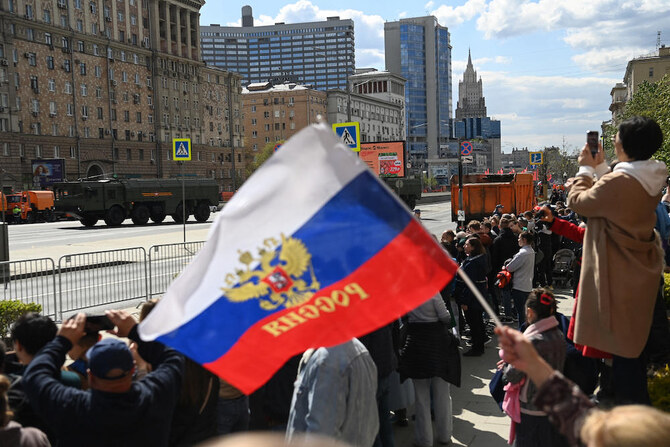
Above, Russian Iskander-M missile launchers move along the Garden Ring road after the Victory Day military parade in central Moscow on May 9, 2023. (AFP)
Short Url
Updated 11 September 2024
Follow

Russian lawmaker warns the West over supplies of long-range missiles to Ukraine

  • Washington and other European states are becoming parties to the war in Ukraine – Vyacheslav Volodin, the speaker of Russia’s Duma
  • Sources said last week that the US was close to an agreement to give Ukraine of long range weapons

MOSCOW: Russia will consider the United States and its allies to be parties to the Ukraine war and Moscow will use more powerful weapons if the West allows Ukraine to use long-range weapons for strikes deep into Russia, a senior lawmaker said on Wednesday.
“Washington and other European states are becoming parties to the war in Ukraine,” Vyacheslav Volodin, the speaker of Russia’s Duma, the lower house of parliament, said on Telegram.
Volodin said that the United States, Germany, France, and Britain were becoming parties to the conflict.
“All this will lead to the fact that our country will be forced to respond using more powerful and destructive weapons to protect its citizens,” Volodin said.
US President Joe Biden said on Tuesday that his administration was “working that out now” when asked if the US would lift restrictions on Ukraine’s use of long range weapons in the war.
Sources said last week that the US was close to an agreement to give Ukraine such weapons, but that Kyiv would need to wait several months as the US works through technical issues ahead of any shipment.
US Secretary of State Antony Blinken said that Iran had supplied Russia with ballistic missiles in what he said was a “dramatic escalation.” Tehran said the claims were “ugly propaganda.”
Ukrainian President Volodymyr Zelensky has been pleading for Western countries to supply longer-range missiles and to lift restrictions on using them to hit targets such as military airfields inside Russia.
Russian President Vladimir Putin said in June that he could deploy conventional missiles within striking distance of the United States and its European allies if they allowed Ukraine to strike deeper into Russia with long-range Western weapons.
The conflict in eastern Ukraine began in 2014 after a pro-Russian president was toppled in Ukraine’s Maidan Revolution and Russia annexed Crimea, with Russian-backed separatist forces fighting Ukraine’s armed forces.
Russia invaded Ukraine in 2022 with thousands of troops, triggering the biggest confrontation between Russia and the West since the depths of the Cold War.
Putin casts the conflict in Ukraine as part of an existential battle with a declining and decadent West which he says humiliated Russia after the Berlin Wall fell in 1989 by encroaching on what he considers Moscow’s sphere of influence, including Ukraine.
The West and Ukraine describe the invasion as an imperial-style land grab by Putin and has vowed to defeat Russia on the battlefield.


Nigeria signals more strikes likely in ‘joint’ US operations

Updated 5 sec ago
Follow

Nigeria signals more strikes likely in ‘joint’ US operations

  • vNigeria on Friday signalled more strikes against jihadist groups were expected after a Christmas Day bombardment by US forces against militants in the north of the country
LAGOS: Nigeria on Friday signalled more strikes against jihadist groups were expected after a Christmas Day bombardment by US forces against militants in the north of the country.
The west African country faces multiple interlinked security crises in its north, where jihadists have been waging an insurgency in the northeast since 2009 and armed “bandit” gangs raid villages and stage kidnappings in the northwest.
The US strikes come after Abuja and Washington were locked in a diplomatic dispute over what Trump characterised as the mass killing of Christians amid Nigeria’s myriad armed conflicts.
Washington’s framing of the violence as amounting to Christian “persecution” is rejected by the Nigerian government and independent analysts, but has nonetheless resulted in increased security coordination.
“It’s Nigeria that provided the intelligence,” the country’s foreign minister, Yusuf Tuggar, told broadcaster Channels TV, saying he was on the phone with US State Secretary Marco Rubio ahead of the bombardment.
Asked if there would be more strikes, Tuggar said: “It is an ongoing thing, and we are working with the US. We are working with other countries as well.”
- Targets unclear -
The Department of Defense’s US Africa Command, using an acronym for the Daesh group, said “multiple Daesh terrorists” were killed in an attack in the northwestern state of Sokoto.
US defense officials later posted video of what appeared to be the nighttime launch of a missile from the deck of a battleship flying the US flag.
Which of Nigeria’s myriad armed groups were targeted remains unclear.
Nigeria’s jihadist groups are mostly concentrated in the northeast of the country, but have made inroads into the northwest.
Researchers have recently linked some members from an armed group known as Lakurawa — the main jihadist group located in Sokoto State — to Islamic State Sahel Province (ISSP), which is mostly active in neighboring Niger and Mali.
Other analysts have disputed those links, though research on Lakurawa is complicated as the term has been used to describe various armed fighters in the northwest.
Those described as Lakurawa also reportedly have links to Al-Qaeda affiliated group for the Support of Islam and Muslims (JNIM), a rival group to ISSP.
While Abuja has welcomed the strikes, “I think Trump would not have accepted a ‘No’ from Nigeria,” said Malik Samuel, an Abuja-based researcher for Good Governance Africa, an NGO.
Amid the diplomatic pressure, Nigerian authorities are keen to be seen as cooperating with the US, Samuel told AFP, even though “both the perpetrators and the victims in the northwest are overwhelmingly Muslim.”
Tuggar said that Nigerian President Bola Tinubu “gave the go-ahead” for the strikes.
The foreign minister added: “It must be made clear that it is a joint operation, and it is not targeting any religion nor simply in the name of one religion or the other.”