

Pakistan to launch Shariah-compliant certificates worth $178.6 million this month

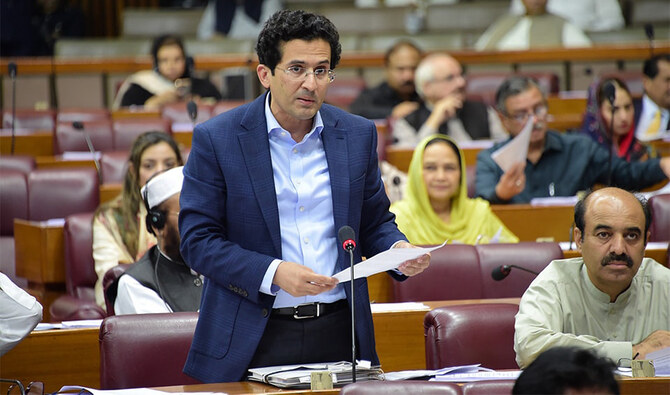
Pakistan’s State Minister for Finance Ali Pervaiz Malik speaks during a session of National Assembly in Islamabad, Pakistan on September 3, 2024. (Ali Pervaiz Malik/Facebook/File)
Short Url
Updated 11 September 2024
Follow

Pakistan to launch Shariah-compliant certificates worth $178.6 million this month

  • State minister highlights government’s commitment to promoting Islamic banking 
  • Central bank has set target to increase Pakistan’s Islamic banking share to 35% by 2025

ISLAMABAD: Pakistan’s State Minister for Finance Ali Pervaiz Malik said on Tuesday new Shariah-compliant certificates worth $178.6 million would be launched this month to facilitate lending activity under an interest-free system, state-run media reported.

A Shariah-compliant certificate is a document issued by the Federal Shariah Court verifying that a financial product or transaction conforms to Islamic principles and laws. Last year, the Securities and Exchange Commission of Pakistan (SECP) issued the first-ever Shariah-compliant certificate to two real estate investment trusts. In April, it also issued a license to the first Shariah-compliant brokerage house in Pakistan.

“In response to the Calling Attention Notice, Minister of State for Finance Ali Pervaiz Malik said new Shariah-compliant certificates worth $178.6 million will be launched this month,” Radio Pakistan said on Tuesday, as the minister briefed the National Assembly about the government’s “commitment to promoting Islamic banking” in the country. 

Earlier this week, Pak-Qatar Family Takaful Limited (PQFTL), a leading Pakistani Shariah-compliant family insurance provider, introduced an instant withdrawal facility for its customers, which would allow participants to withdraw partial funds in case of emergencies with ease and instant access through the company’s mobile app or its online portal. 

Last year, Pakistan’s central bank set a target to increase the share of Islamic banking in the country to 35% by 2025.

In 2021, the Federal Shariat Court, which determines whether Pakistani laws comply with Islamic law, directed the government to eliminate interest from the country’s banking system by 2027. 

At present, the share of Islamic banking in the overall commercial banking system in the country is 20%.

Pakistan has six full-fledged Islamic banks offering a wide range of products and the annual growth rate of Islamic banks’ assets and deposits has been 25% and 22% respectively over the last five years, according to central bank data.


Pakistan terms climate change, demographic pressures as ‘pressing existential risks’

Updated 06 December 2025
Follow

Pakistan terms climate change, demographic pressures as ‘pressing existential risks’

  • Pakistan has suffered frequent climate change-induced disasters, including floods this year that killed over 1,000
  • Pakistan finmin highlights stabilization measures at Doha Forum, discusses economic cooperation with Qatar 

ISLAMABAD: Pakistan’s Finance Minister Muhammad Aurangzeb on Saturday described climate change and demographic pressures as “pressing existential risks” facing the country, calling for urgent climate financing. 

The finance minister was speaking as a member of a high-level panel at the 23rd edition of the Doha Forum, which is being held from Dec. 6–7 in the Qatari capital. Aurangzeb was invited as a speaker on the discussion titled: ‘Global Trade Tensions: Economic Impact and Policy Responses in MENA.’

“He reaffirmed that while Pakistan remained vigilant in the face of geopolitical uncertainty, the more pressing existential risks were climate change and demographic pressures,” the Finance Division said. 

Pakistan has suffered repeated climate disasters in recent years, most notably the 2022 super-floods that submerged one-third of the country, displaced millions and caused an estimated $30 billion in losses. 

This year’s floods killed over 1,000 people and caused at least $2.9 billion in damages to agriculture and infrastructure. Scientists say Pakistan remains among the world’s most climate-vulnerable nations despite contributing less than 1 percent of global greenhouse-gas emissions.

Aurangzeb has previously said climate change and Pakistan’s fast-rising population are the only two factors that can hinder the South Asian country’s efforts to become a $3 trillion economy in the future. 

The finance minister noted that this year’s floods in Pakistan had shaved at least 0.5 percent off GDP growth, calling for urgent climate financing and investment in resilient infrastructure. 

When asked about Pakistan’s fiscal resilience and capability to absorb external shocks, Aurangzeb said Islamabad had rebuilt fiscal buffers. He pointed out that both the primary fiscal balance and current account had returned to surplus, supported significantly by strong remittance inflows of $18–20 billion annually from the Middle East and North Africa (MENA) and Gulf Cooperation Council (GCC) regions. 

Separately, Aurangzeb met his Qatari counterpart Ali Bin Ahmed Al Kuwari to discuss bilateral cooperation. 

“Both sides reaffirmed their commitment to strengthening economic ties, particularly by maximizing opportunities created through the newly concluded GCC–Pakistan Free Trade Agreement, expanding trade flows, and deepening energy cooperation, including long-term LNG collaboration,” the finance ministry said. 

The two also discussed collaboration on digital infrastructure, skills development and regulatory reform. They agreed to establish structured mechanisms to continue joint work in trade diversification, technology, climate resilience, and investment facilitation, the finance ministry said.