

Saudi Arabia to develop $3.3bn sports complex with UK tech partnership

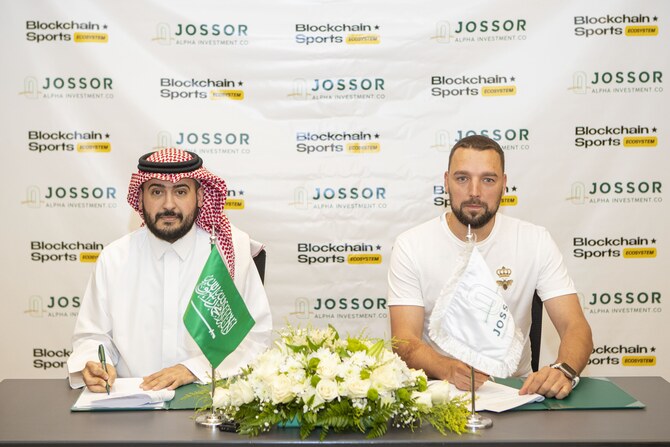
Abdulrahman Al-Qarni, chairman of Jossor Alpha Investment and Dmitry Saksonov, founder of Blockchain Sports Ecosystem, at the signing ceremony in Riyadh. Photo/Supplied
Short Url
Updated 10 September 2024
Follow

Saudi Arabia to develop $3.3bn sports complex with UK tech partnership

RIYADH: Saudi Arabia is set to develop a $3.3 billion sports complex through a new partnership between Alpha Jossor Investments and Blockchain Sports Ecosystem, a UK-based tech company.

The collaboration aims to create one of the largest innovative athletic hubs in the Middle East and North Africa, integrating advanced technology solutions and attracting significant investments in the sports and entertainment sectors, according to a press release issued on Tuesday.

The complex will feature a cutting-edge football academy with state-of-the-art training facilities. Additionally, it will include real estate developments in the form of 1,500 villas and over 3,300 apartments, estimated at $1.6 billion. These developments will support sustainable urban living and align with Saudi Arabia’s Vision 2030 goals of boosting tourism and foreign investment.

The project is part of Saudi Arabia’s broader Vision 2030 initiative to diversify the economy and reduce dependence on oil. The Kingdom aims to increase sports participation from 13 percent to 40 percent of the population by 2030 and is investing approximately $2 billion annually in the sector. These efforts are projected to generate $22 billion in economic impact over the next decade and create over 100,000 jobs in sports and related industries.

Alpha Jossor Investments will play a crucial role in managing and attracting foreign investment for the project.

Faisal Janahi, CEO of Alpha Jossor Investments, highlighted the partnership’s importance in advancing the company’s mission of delivering high-impact investments aligned with Vision 2030.

“Our partnership with Blockchain Sports Ecosystem is a strong step toward creating an innovative sports hub in Saudi Arabia, aligning with our vision for sustainable growth” Janahi noted. 

Blockchain Sports Ecosystem brings a team of over 1,200 experts from eight countries, specializing in integrating advanced technologies such as performance tracking, artificial intelligence, extended reality, and blockchain into athletic development.

The company operates football academies globally, including three in Brazil, where it trains over 600 youth from low-income families to become professional footballers.

With partnerships spanning over 30 football academies worldwide, Blockchain Sports Ecosystem has garnered endorsements from top players such as Romario, Zico, and Wesley Sneijder.

The partnership was formalized through a memorandum of understanding signed by Abdulrahman Al-Qarni, chairman of Alpha Jossor Investments, and Dmitry Saksonov, founder of Blockchain Sports Ecosystem, at a ceremony in Riyadh. The event, attended by football stars including Kevin Kuranyi, Jay-Jay Okocha, Mikael Silvestre, and Jens Lehmann, underscored the strategic importance of this initiative in transforming the sports landscape in Saudi Arabia.

“With the advanced technologies Blockchain Sports Ecosystem has developed, the upcoming project will set a new standard for the global sports community,” Saksonov said.

As part of the MoU, the companies will also collaborate on developing a digital platform for managing athlete identities. This platform will facilitate secure and transparent transactions within the sports industry and support global scouting efforts.

The digital ID service aims to connect over 16 countries and identify top talent for training opportunities at the new Saudi academy.

Blockchain Sports Ecosystem’s technologies, protected under INTEROCO copyright and recognized in 181 countries, will further enhance the project’s global reach.


Saudi investment pipeline active as reforms advance, says Pakistan minister

Updated 08 February 2026
Follow

Saudi investment pipeline active as reforms advance, says Pakistan minister

ALULA: Pakistan’s Finance Minister Mohammed Aurangzeb described Saudi Arabia as a “longstanding partner” and emphasized the importance of sustainable, mutually beneficial cooperation, particularly in key economic sectors.

Speaking to Arab News on the sidelines of the AlUla Conference for Emerging Market Economies, Aurangzeb said the relationship between Pakistan and Saudi Arabia remains resilient despite global geopolitical tensions.

“The Kingdom has been a longstanding partner of Pakistan for the longest time, and we are very grateful for how we have been supported through thick and thin, through rough patches and, even now that we have achieved macroeconomic stability, I think we are now well positioned for growth.”

Aurangzeb said the partnership has facilitated investment across several sectors, including minerals and mining, information technology, agriculture, and tourism. He cited an active pipeline of Saudi investments, including Wafi’s entry into Pakistan’s downstream oil and gas sector.

“The Kingdom has been very public about their appetite for the country, and the sectors are minerals and mining, IT, agriculture, tourism; and there are already investments which have come in. For example, Wafi came in (in terms of downstream oil and gas stations). There’s a very active pipeline.”

He said private sector activity is driving growth in these areas, while government-to-government cooperation is focused mainly on infrastructure development.

Acknowledging longstanding investor concerns related to bureaucracy and delays, Aurangzeb said Pakistan has made progress over the past two years through structural reforms and fiscal discipline, alongside efforts to improve the business environment.

“The last two years we have worked very hard in terms of structural reforms, in terms of what I call getting the basic hygiene right, in terms of the fiscal situation, the current economic situation (…) in terms of all those areas of getting the basic hygiene in a good place.”

Aurangzeb highlighted mining and refining as key areas of engagement, including discussions around the Reko Diq project, while stressing that talks with Saudi investors extend beyond individual ventures.

“From my perspective, it’s not just about one mine, the discussions will continue with the Saudi investors on a number of these areas.”

He also pointed to growing cooperation in the IT sector, particularly in artificial intelligence, noting that several Pakistani tech firms are already in discussions with Saudi counterparts or have established offices in the Kingdom.

Referring to recent talks with Saudi Minister of Economy and Planning Faisal Alibrahim, Aurangzeb said Pakistan’s large freelance workforce presents opportunities for deeper collaboration, provided skills development keeps pace with demand.

“I was just with (Saudi) minister of economy and planning, and he was specifically referring to the Pakistani tech talent, and he is absolutely right. We have the third-largest freelancer population in the world, and what we need to do is to ensure that we upscale, rescale, upgrade them.”

Aurangzeb also cited opportunities to benefit from Saudi Arabia’s experience in the energy sector and noted continued cooperation in defense production.

Looking ahead, he said Pakistan aims to recalibrate its relationship with Saudi Arabia toward trade and investment rather than reliance on aid.

“Our prime minister has been very clear that we want to move this entire discussion as we go forward from aid and support to trade and investment.”