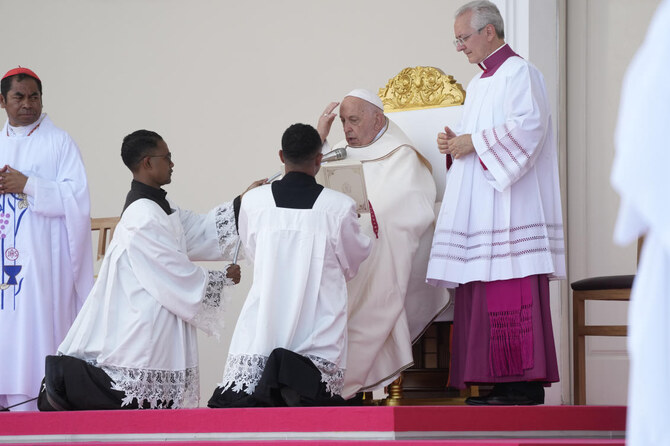
DILI, East Timor: Pope Francis hosted a mass for hundreds of thousands of devotees in East Timor on Tuesday, rallying the faithful of the most Catholic country outside the Vatican in tropical heat.
Pilgrims have clamored to the capital to catch a glimpse of the 87-year-old pontiff, greeting him with a rapturous reception in a coastal area of Dili ahead of his sermon.
Around 600,000 people were in attendance at the mass as it got underway, the Vatican said in a statement, citing local authorities.
“I am so happy for everyone in East Timor. Now I want to see Papa Francisco here and give my present to Papa Francisco. I am so emotional,” said Mary Michaela, 17, who said she would attend the service.
It was the main event of the third leg of Francis’s 12-day Asia-Pacific tour, which has already taken in Indonesia and Papua New Guinea, and will conclude in Singapore.
Many arrived for the mass hours early to get a prime spot, waiting in the heat.
Firefighters sprayed devotees with water, and many held white-and-yellow Vatican umbrellas to protect themselves from the glaring sun.
Prime Minister Xanana Gusmao joined crowds to lift spirits with a sing-along, before pouring water into the mouths of those waiting to perform for Pope Francis.
Earlier on Tuesday he met the Catholic faithful at a cathedral in Dili, calling for the “perfume of the Gospel” to be spread against alcoholism, violence and a lack of respect for women.
On his first day in East Timor, Francis addressed the country’s leaders, hailing a new era of “peace” since independence in 2002, and also called on them to prevent abuse against young people in a nod to recent Catholic Church child abuse scandals.
But it was the mass that rallied the faithful of Asia’s youngest country.
“I am grateful I can join this Holy Mass regardless of my age. I don’t know if I would still be able to come if the pope visited even a few years later,” said 49-year-old housewife Felicidade do Rosario.
Around 300,000 people had officially registered for the mass, the government said.
Hundreds of thousands were estimated to have shown up, bringing an estimated total to nearly half the country’s entire population, according to the Vatican.
“It is a blessing of God to us, the people in this land,” said Atanasio Sarmento de Sousa, a 46-year-old member of the committee organizing the pope’s visit.
The sheer number of people descending on Dili caused at least one local telecom company to inform customers their signal would be affected by the pope’s visit.
In 2023, around a million people congregated in the Democratic Republic of Congo capital Kinshasa for Pope Francis’s visit.
The record is still held by Philippine capital Manila in 2015 where more than six million people are believed to have gathered to see Francis.
This visit is only the second papal trip to East Timor, where around 98 percent of the population is Catholic, after John Paul II in 1989.
East Timor’s capital had a $12 million makeover before the visit, including $1 million spent on an altar where the pope will sit on stage next to a crucifix.
The cost has attracted criticism because East Timor is one of the poorest countries in the world.
Rights groups also say some makeshift homes were demolished in preparation for the mass. The government says they were erected illegally.
Authorities have also relocated street vendors in areas where Francis will travel, prompting further criticism on social media.
However, others who had traveled to see the pope were more optimistic about the occasion.
“There are still many problems that need to be taken care of, but the pope has come here to bring joyful news,” said Felix Kosat, an Indonesian Catholic priest.
“So let’s make changes.”


![]()

Pope Francis hosts East Timor mass for more than half a million faithful
Short Url
https://arab.news/vzsg7
Pope Francis hosts East Timor mass for more than half a million faithful
- Pilgrims have clamored to the capital to catch a glimpse of the 87-year-old pontiff
- Many arrived for the mass hours early to get a prime spot, waiting in the heat


Latest updates


Recommended


© 2026 SAUDI RESEARCH & PUBLISHING COMPANY, All Rights Reserved And subject to Terms of Use Agreement.