DILI, East Timor: When the Vatican acknowledged in 2022 that the Nobel Peace Prize-winning, East Timorese independence hero Bishop Carlos Ximenes Belo had sexually abused young boys, it appeared that the global clergy sexual abuse scandal that has compromised the Catholic Church’s credibility around the world had finally arrived in Asia’s newest country.
And yet, the church in East Timor today is stronger than ever, with most downplaying, doubting or dismissing the claims against Belo and those against a popular American missionary who confessed to molesting young girls. Many instead focus on their roles saving lives during the country’s bloody struggle against Indonesia for independence.
Pope Francis will come face to face with the Timorese faithful on his first trip to the country, a former Portuguese colony that makes up half of the island of Timor off the northern coast of Australia. But so far, there is no word if he will meet with victims or even mention the sex abuse directly, as he has in other countries where the rank-and-file faithful have demanded an accounting from the hierarchy for how it failed to protect their children.
Even without pressure from within East Timor to address the scandals, it would be deeply meaningful to the victims if Francis did, said Tjiyske Lingsma, the Dutch journalist who helped bring both abuse cases to light.
“I think this is the time for the pope to say some words to the victims, to apologize,” she said in an interview from Amsterdam.
The day after Lingsma detailed the Belo case in a September 2022 report in De Groene Amsterdammer magazine, the Vatican confirmed that Belo had been sanctioned secretly two years earlier.
In Vatican spokesman Matteo Bruni’s statement, he said the church had been aware of the case since 2019 and had imposed disciplinary measures in 2020, including restrictions on Belo’s movements and a ban on voluntary contact with minors.
Despite the official acknowledgement, many in East Timor still don’t believe it, like Dili university student Martinha Goveia, who is still expecting Belo will show up to be at Francis’ side during his upcoming visit.
If he’s not there, she said, “that is not good in my opinion,” because it will confirm he is being sanctioned by the Vatican.
Vegetable trader Alfredo Ximenes said the allegations and the Vatican’s acknowledged sanctions were merely rumors, and that he hoped Belo would come to welcome the pope and refute the claims in person.
“Our political leaders should immediately meet him to end the problem and persuade him to return, because after all he has contributed greatly to national independence,” Ximenes said.
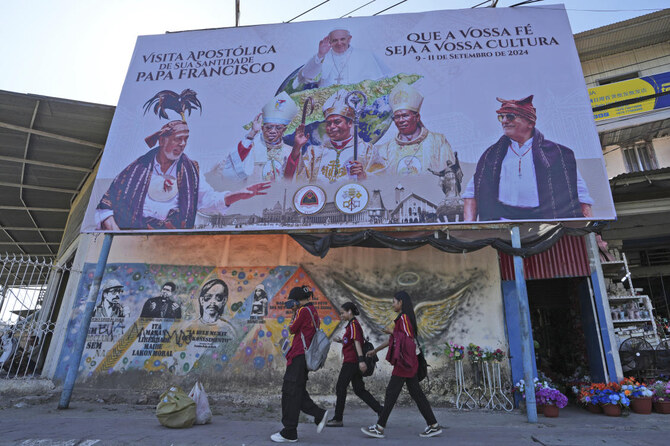
Timorese officials refused to answer questions about the Belo case, but there’s been no attempt to avoid mentioning him, with a giant billboard in Dili welcoming Pope Francis, whose visit starts Sept. 9, placed right above a mural honoring Belo and three others as national heroes.
Only about 20 percent of East Timor’s people were Catholic when Indonesia invaded in 1975, shortly after Portugal abandoned it as a colony.
Today, some 98 percent of East Timor’s 1.3 million people are Catholic, making it the most Catholic country in the world outside the Vatican.
A law imposed by Indonesia requiring people to choose a religion, combined with the church’s opposition to the military occupation and support for the resistance over years of bloody fighting that saw as many as 200,000 people killed, helped bring about that flood of new members.
Belo won the Nobel Peace Prize for his bravery in drawing international attention to Indonesian human rights abuses during the conflict, and American missionary Richard Daschbach was widely celebrated for his role in helping save lives in the struggle for independence.
Their heroic status, and societal factors in Asia, where the culture tends to confer much power on adults and authority figures, helps explain why the men are still revered while elsewhere in the world such cases are met with outrage, said Anne Barrett Doyle, of the online resource Bishop Accountability.
“Bishops are powerful, and in developing countries where the church is dominant, they are inordinately powerful,” Barrett Doyle said.
“But no case we’ve studied exhibits as extreme a power differential as that which exists between Belo and his victims. When a child is raped in a country that is devoutly Catholic, and the sexual predator is not only a bishop but a legendary national hero, there is almost no hope that justice will be done.”
In 2018, as rumors built against Daschbach, the priest confessed in a letter to church authorities to abusing young girls from at least 1991 to 2012.
“It is impossible for me to remember even the faces of many of them, let alone the names,” he wrote.
The 87-year-old was defrocked by the Vatican and criminally charged in East Timor, where he was convicted in 2021 and is now serving 12 years in prison.
But despite his confession and court testimony from victims that detailed the abuse, Prime Minister Xanana Gusmao, an independence hero himself, has visited Daschbach in prison — hand-feeding him cake and serving him wine on his birthday — and has said winning the ex-priest’s early release is a priority for him.
In Belo’s case, six years after winning the Nobel Prize, which he shared with current East Timor President Jose Ramos-Horta, he suddenly retired as the head of the church in East Timor in 2002, citing health reasons and stress.
Not long after his retirement, Belo, today 76, was sent by the Vatican and his Salesian missionary order to another former Portuguese colony, Mozambique, to work as a missionary priest.
There, he has said, he spent his time “teaching catechism to children, giving retreats to young people.” Today he lives in Portugal.
Suspicion arose that Belo, like others before him, had been allowed to quietly retire rather than face any reckoning, given the reputational harm to the church that would have caused.
In a 2023 interview with The Associated Press, Pope Francis suggested that indeed was the case, reasoning that was how such matters were handled in the past.
“This is a very old thing where this awareness of today did not exist,” Francis said. “And when it came out about the bishop of East Timor, I said, ‘Yes, let it go in the open.’ ... I’m not going to cover it up. But these were decisions made 25 years ago when there wasn’t this awareness.”
Lingsma said she first heard allegations against Belo in 2002, the same year East Timor, also known as Timor-Leste, won its formal independence after the Indonesian occupation ended in 1999. She said she wasn’t able to investigate the case and build enough evidence to publish her story on him until two decades later.
Her story garnered international attention, as well as the Vatican’s acknowledgement of the case, but in East Timor was primarily met with skepticism and negative reactions toward her reporting. Her 2019 story exposing the Daschbach case eventually prompted authorities to charge him, but also did not lead to the outpouring of anger that she had anticipated.
“The reaction was silence,” she recalled.
During the fight for independence, priests, nuns and missionaries put themselves at great risk to help people, like “parents wanting to save their children,” helping form today’s deep connection between the church and people of East Timor, said Timorese historian Luciano Valentim da Conceixao.
The church’s role is even enshrined in the preamble to the young country’s constitution, which says that the Catholic Church “has always been able to take on the suffering of all the people with dignity, placing itself on their side in the defense of their most fundamental rights.”
Because so many remember the church’s significant role during those dark days, it has fostered an environment where it is difficult for victims of abuse to speak out for fear of being labeled anti-church, and where men like Belo and Daschbach continue to receive support from all walks of society.
“Pedophilia and sexual violence are common enemies in East Timor, and we should not mix them up with the struggle for independence,” said Valentim da Costa Pinto, executive director of The Timor-Leste NGO Forum, an umbrella organization for some 270 NGOs.
The chancellor of the Dili Diocese today, Father Ludgerio Martins da Silva, said the cases of Belo and Daschbach were the Vatican’s jurisdiction, and that most people consider the sex abuse scandals a thing of the past.
“We don’t hear a lot of people ask about bishop Belo because he left the country... twenty years ago,” da Silva said.
Still, Lingsma said she knew of ongoing allegations against “four or five” other priests, including two who were now dead, “and if I know them, I’m the last person to know.”
“That also shows that this whole reporting system doesn’t work at all,” she said.
Da Conceixao, the historian, said he did not know enough about the cases against Daschbach or Belo to comment on them, but that he was well acquainted with their role in the independence struggle and called them “fearless freedom fighters and clergymen.”
“Clergymen are not free from mistakes,” da Conceixao conceded. “But we, the Timorese, have to look with a clear mind at the mistakes they made and the good they did for the country, for the freedom of a million people, and of course the value is not the same.”
Because of that prevailing attitude, Barrett Doyle said “the victims of those two men have to be the most isolated and least supported clergy sex abuse victims in the world right now. “
For that reason, Francis’ visit to East Timor could be a landmark moment in his papacy, she said, if he were to denounce Daschbach and Belo by name and praise the courage of the victims, sending a message that would resonate globally.
“Given the exalted status of the Catholic Church in East Timor, just imagine the impact of papal fury directed at Belo, Daschbach and the yet unknown number of other predatory clergy in that country,” she said.
“Francis could even address the country’s hidden victims, promising his support and urging them to contact him directly about their abuse — he literally could save lives.”


![]()

Pope Francis is visiting East Timor after a clergy abuse scandal, but will he address it?
Short Url
https://arab.news/c2nhn
Pope Francis is visiting East Timor after a clergy abuse scandal, but will he address it?
- Despite the official acknowledgement, many in East Timor still don’t believe it
- Pope Francis will come face to face with the Timorese faithful on his first trip to the country


Latest updates


© 2026 SAUDI RESEARCH & PUBLISHING COMPANY, All Rights Reserved And subject to Terms of Use Agreement.