

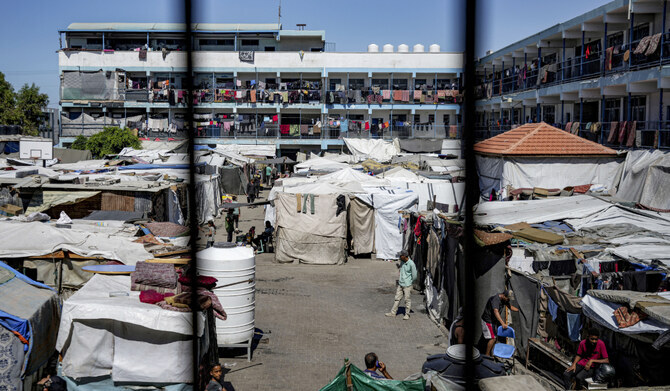

CAIRO: Gaza’s civil defense agency said Tuesday that an Israeli strike on a humanitarian zone in the south of the Palestinian territory killed 40 people and wounded 60 others, with the Israeli army saying it had targeted a Hamas command center in the area.
The strike hit Al-Mawasi — in Gaza’s main southern city of Khan Yunis — which was designated a safe zone by the Israeli military early in the war, with tens of thousands of displaced Palestinians seeking refuge there.
However, Israel’s military has occasionally carried out operations in and around the area, including a strike in July that it said killed Hamas military chief Mohammed Deif, and which Gaza health authorities said killed more than 90 people.
Gaza civil defense official Mohammed Al-Mughair told AFP early Tuesday that “40 martyrs and 60 injured were recovered and transferred” to nearby hospitals following the overnight strike.
“Our crews are still working to recover 15 missing people as a result of targeting the tents of the displaced in Mawasi, Khan Yunis,” Mughair added.
In a separate statement, civil defense spokesman Mahmoud Basal said that people sheltering in the camp had not been warned of the strike, adding a shortage of tools and equipment was hindering rescue operations.
“More than 20 to 40 tents were completely damaged,” he said, adding the strike left behind “three deep craters.”
“There are entire families who disappeared under the sand in the Mawasi Khan Yunis massacre.”
The Israeli military said in a statement early Tuesday that its aircraft had “struck significant Hamas terrorists who were operating within a command and control center embedded inside the Humanitarian Area in Khan Yunis.”
“The terrorist organizations in the Gaza Strip continue to systematically abuse civilian and humanitarian infrastructure, including the designated Humanitarian Area, to carry out terrorist activity against the State of Israel and IDF troops,” it added.
Hamas said in a statement on Tuesday that claims its fighters were present at the scene of the strike were “a blatant lie.”
Over the course of the war, Israel has repeatedly accused Hamas of using civilians as human shields, an accusation the group denies.
Hamas’s October 7 attack on Israel that sparked the war in Gaza resulted in the deaths of 1,205 people, mostly civilians, including some hostages killed in captivity, official Israeli figures show.
Militants seized 251 hostages during the attack, 97 of whom are still held in Gaza, including 33 the Israeli military says are dead.
Israel’s retaliatory offensive in the Gaza Strip has so far killed at least 40,988 people, according to the health ministry in the Hamas-run territory.
The UN human rights office says most of the dead are women and children.
The vast majority of Gaza’s 2.4 million people have been displaced at least once during nearly a year of war, according to the United Nations.
From 1,200 inhabitants per square kilometer before the war, the Al-Mawasi humanitarian zone now houses “between 30,000 and 34,000 people per square kilometer,” and its protected area shrank from 50 square kilometers to 41, the UN has calculated.
The United States, Qatar and Egypt have been mediating in efforts to forge a ceasefire and hostage-prisoner exchange deal between Israel and Hamas, but talks remain stalled.
Hamas is demanding a complete Israeli withdrawal from Gaza as part of any deal, but Israel insists troops must remain along the Gaza-Egypt border.


