PARIS: A leading opponent of Vladimir Putin, freed in a prisoner swap last month, on Monday urged the West against allowing the Russian leader any “face-saving” way out of the war against Ukraine, saying the end of his quarter-century of rule was the only solution for peace.
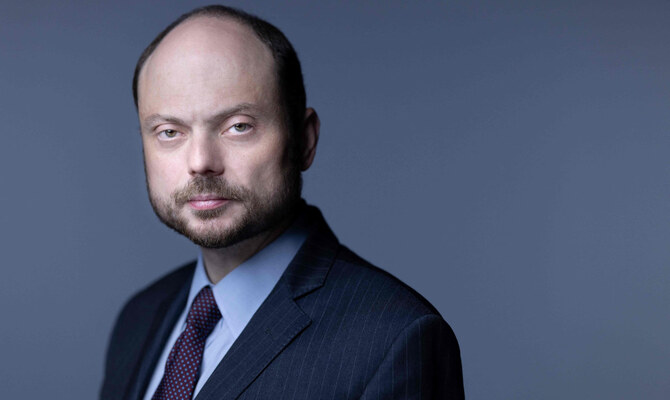
Vladimir Kara-Murza, who had been serving a 25-year sentence in a Siberian penal colony on treason and other charges after denouncing the invasion of Ukraine, was one of 16 Russian dissidents and foreign nationals freed on August 1 in the largest East-West prisoner swap since the Cold War.
In an interview with Agence France-Presse in Paris, Kara-Murza, 43, predicted he would be able to return to his homeland as the “regime” of Putin would not last.
Arriving in France after visits to countries including Germany, he acknowledged there was “fatigue” in Western societies over the war sparked by Russia’s February 2022 invasion of Ukraine but insisted the “Putin regime must be defeated.”
“It is very important that Vladimir Putin is not allowed to win the war against Ukraine,” said Kara-Murza, who met with French President Emmanuel Macron later Monday.
“It is very important that Vladimir Putin is not allowed to have a face-saving exit from this war in Ukraine.”
The Cambridge-educated Kara-Murza lashed out at Western “realpolitik” in dealing with Russia under Putin, which he said had made the Russian leader “the monster he is today.”
“Enough of realpolitik,” he said.
“If, God forbid, the Putin regime is allowed to present the outcome of this war as a victory and survive in power, all this means is that a year or 18 months from now we will be talking about another war, conflict or another catastrophe.”
Kara-Murza, a dual Russian and UK national, said he would be “honored” to go to Ukraine and meet with President Volodymyr Zelensky, adding that he was in favor of building bridges between Russia’s pro-democracy movement and Ukraine.
“We will have to find ways of living together and of overcoming this horrendous tragedy that the Putin regime has unleashed,” he said.
“It is not going to be an easy process, it’s not going to be a quick process, but we know that it’s possible.”
He said he felt a “special kind of solidarity” with Ukrainian officers who were held in his Siberian prison camp, even though they were not allowed to speak to each other.
Kara-Murza said he had been “absolutely certain” he would die in the penal colony in the Omsk region — until one morning he was suddenly put on a plane to Moscow and then with other prisoners involved swapped in the Turkish capital Ankara.
“Nobody has ever asked our consent,” he said. “They herded us on a plane like cattle and threw us out of Russia.”
Macron applauded the Kremlin opponent for his “courage” during their meeting late Monday, while reiterating “France’s support for all defenders of human rights and freedom of expression,” the presidency said in a statement.
Kara-Murza earlier said he had no doubt he would return to his country.
“Not only is the Putin regime not forever, I think... it will be over in the very foreseeable future,” he said.
“And we will have a mammoth task ahead of us in rebuilding our country from the ruins that Putin is going to leave.”
Pointing to the collapse of Tsarist rule in 1917 and the fall of the Soviet Union in 1991, Kara-Murza said that “major political change in Russia comes suddenly, unexpectedly and no one is ever prepared for it.”
Kara-Murza, who sees as his mentor the campaigner Boris Nemtsov, who was assassinated in Moscow in 2015, brushed off fears for his own safety outside Russia.
“Security is not a word that comes into the vocabulary of somebody who is in opposition to Putin’s regime in Russia,” said Kara-Murza, who was the target of two poisoning attacks against his life even before his arrest in 2022.
“Whether Putin likes it or not, the future is coming,” he said.
Kara-Murza recalled his own shock at hearing about the death of opposition leader Alexei Navalny in a remote Arctic prison camp in February.
“I heard the news on the radio,” he said. “I don’t think I have the words to describe the feeling,” he said, adding that at first he could not believe it.
“After months and months in solitary confinement, your mind starts playing tricks on you,” he said. “I thought that maybe I’d made all of this up.”
He said he was confident Navalny was killed on the orders of Putin.
“Any Western leader who shakes hands with Vladimir Putin is shaking hands with a murderer.”
His wife Yevgenia, who tirelessly campaigned for his release, said “rage” against the “crimes” committed by the Kremlin in Ukraine and Russia had sustained her.
“The rage that I’ve been feeling for all these years... outweighs any fears that I can experience,” she said, pledging to continue to fight for the release of other political prisoners.
Vladimir called himself “the luckiest man in the world.”
“I would not be sitting here speaking with you today if it wasn’t for Yevgenia,” he said.


![]()

Kremlin opponent Kara-Murza urges against ‘face-saving exit’ for Putin in Ukraine war
Short Url
https://arab.news/cwf3t
Kremlin opponent Kara-Murza urges against ‘face-saving exit’ for Putin in Ukraine war
- Vladimir Kara-Murza, who had been serving a 25-year sentence in a Siberian penal colony on treason and other charges after denouncing the invasion of Ukraine


Latest updates


Recommended


© 2026 SAUDI RESEARCH & PUBLISHING COMPANY, All Rights Reserved And subject to Terms of Use Agreement.