Edward B. Johnson, the second CIA officer in Iran for the ‘Argo’ rescue mission, dies at age 81

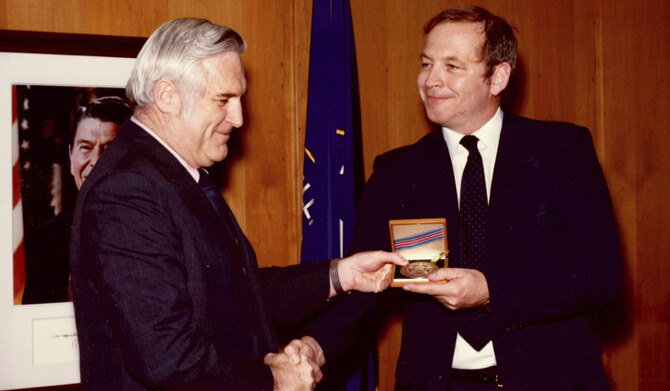
This photograph released by the CIA on behalf of the family of former CIA officer Edward B. Johnson shows Johnson, right, receiving the CIA's Intelligence Star from John N. McMahon, then the agency's deputy director for operations, in May 1980. (AP)
Short Url
Updated 10 September 2024
Follow

Edward B. Johnson, the second CIA officer in Iran for the ‘Argo’ rescue mission, dies at age 81

  • Both Johnson and Mendez received the CIA’s Intelligence Star, its second-highest award for valor, for the operation

DUBAI, United Arab Emirates: Edward B. Johnson, who as a Central Intelligence Agency officer traveled into Iran with a colleague to rescue six American diplomats who fled the 1979 US Embassy takeover in Tehran, has died, the CIA confirmed on Monday. He was 81.
Johnson’s identity for decades had been hidden from the public, with him known only by the pseudonym “Julio” after fellow CIA officer Antonio “Tony” Mendez published a book recounting the operation. The 2012 Academy Award-winning film “Argo,” directed by and starring Ben Affleck, didn’t include the second man on the team.
Yet a painting at the CIA’s headquarters in Langley, Virginia, offered a faceless acknowledgment of Johnson’s existence. And in 2023, the CIA itself revealed Johnson’s identity in a podcast highlighting the agency’s work to free the diplomats hiding at the Canadian ambassador’s residence in Tehran.
“Working with the six — these are rookies,” Johnson recounted in an interview aired by the podcast. “They were people who were not trained to lie to authorities. They weren’t trained to be clandestine, elusive.”
Johnson died Aug. 27 in his sleep in Virginia after suffering from pneumonia, the CIA told The Associated Press on Monday.
“Ed’s legacy will continue to inspire those who walk the halls of Langley for generations to come,” the agency said in a public statement.
His family in a statement honored him as having “a name that whispered through the corridors of intelligence” through his work.
“He was, at once, the ordinary man next door — husband, father, grandfather, brother, uncle and friend — and an extraordinary agent of the state,” they said.
Many specifics about Johnson’s professional life as a spy remain vague, as much of what is known about him publicly comes from the CIA podcast first identifying him, called “The Langley Files.” Johnson, who went by Ed, described coming to the CIA after serving as an infantryman in the US Army. He studied French in university, picked up Spanish from growing up with Cuban and Puerto Rican friends and later learned Arabic after teaching English in Saudi Arabia.
He traveled through Egypt and Jordan and studied at the Sorbonne university before being hired by the CIA. He met his wife, Aileen, while in Paris, his family said.
“It was after after having gotten the on-the-ground experience in the Middle East and the educational experience and the language into play ... that I was considered to be a good candidate,” Johnson said.
Johnson served in the CIA’s Office of Technical Service overseas at the time of the hostage crisis. It began when Islamist students came over the fence at the sprawling US Embassy compound in downtown Tehran on Nov. 4, 1979. While initially planned to be a sit-in like a previous storming, it soon became a 444-day hostage crisis.
Six US Embassy employees, however, had slipped away amid the chaos. They ended up in the home of Canadian Ambassador Ken Taylor. Several plans came and went before US President Jimmy Carter agreed to what became known as the “Canadian Caper” — posing the officials as part of a Canadian film crew scouting locations for a fake, knock-off “Star Wars” film called “Argo.”
Armed with Canadian passports, Mendez pretended to be a Canadian while Johnson was “an associate producer representing our production company’s ostensible South American backers,” Mendez later recounted in an internal CIA document. He described Johnson as having “considerable exfiltration experience” during the Cold War with the Soviet Union, without elaborating.
Landing in Tehran on Jan. 25, 1980, the men end up using a local map to try and find the Canadian Embassy. They ended up at the Swedish Embassy — just across the street from the American Embassy, patrolled by armed students. A local embassy guard didn’t understand them, as neither man spoke Iran’s Farsi language — a conscious decision made the CIA not to raise suspicions as their Farsi-language experts might be recognized.
Then one of the student revolutionaries walked over. As a conversation progressed, the men realized the student spoke German after studying abroad for a year. Johnson ended up getting written directions from the student, who even hailed a taxi for them and refused a tip.
“I have to thank the Iranians for being the beacon who got us to the right place,” Johnson said.
The men ended up with the six Americans, providing them scripts, props, fake histories and training on how to pretend to be a film crew. Johnson and Mendez worked on final preparations on the passports and exit slips, the scene represented in the painting at CIA headquarters.
“The biggest thing I think we did was to was to convince them that you can, you can do it — as simple as that,” Johnson remembered.
On Jan. 28, 1980, the CIA officers and the six Americans flew safely out of Tehran on a Swissair flight. Both Johnson and Mendez received the CIA’s Intelligence Star, its second-highest award for valor, for the operation. He retired from the CIA in 1995 and worked as a contractor while exploring a passion in photography, his family said.
“Even as the world celebrated his heroism, he remained a ghost, a figure shrouded in anonymity,” his family said. “For decades, his identity was a closely guarded secret. It was only in the twilight of his life that he finally emerged from the shadows, a legend in his own right.”
Johnson was born July 29, 1943, in Brooklyn. He is survived by his wife, five children, nine grandchildren, other family and friends, his loved ones said.
In the decades since the “Argo” rescue, there’s been a broader reckoning over the CIA’s actions in Iran, particularly the 1953 CIA-led coup that overthrew the country’s prime minister to cement the rule of Shah Mohammad Reza Pahlavi. That action lit the fuse for the 1979 Islamic Revolution and the more than four decades of enmity between Tehran and Washington that followed.
The two-part podcast revealing Johnson’s identity acknowledged that, with a CIA historian calling the 1953 coup “one of the exceptions” to the agency’s efforts to bolster democracy worldwide.


How 1,000 days of war pushed Sudan’s health system to the brink of collapse

Updated 35 min 18 sec ago
Follow

How 1,000 days of war pushed Sudan’s health system to the brink of collapse

  • After nearly three years of fighting, attacks on hospitals, mass displacement and disease outbreaks are crippling care nationwide
  • As humanitarian needs soar, doctors and aid agencies warn Sudan’s health system cannot survive without peace and access

LONDON: After more than 1,000 days of war, Sudan’s health system is buckling under the combined weight of violence, displacement, disease and hunger, pushing millions of civilians toward a crisis with few historical parallels.

What began as a power struggle between the Sudanese Armed Forces and the paramilitary Rapid Support Forces has evolved into what UN agencies now describe as the world’s largest humanitarian and health emergency.

According to the World Health Organization, more than 20 million people in Sudan now require health assistance, while an estimated 33.7 million — roughly two-thirds of the population — are expected to need humanitarian aid this year.

At least 21 million people face acute food insecurity, with famine already confirmed in parts of North Darfur and South Kordofan.

“One thousand days of conflict in Sudan have driven the health system to the brink of collapse,” Dr. Shible Sahbani, WHO’s representative in Sudan, said in a statement. “Under the strain of disease, hunger and a lack of access to basic services, people face a devastating situation.”

The health system’s deterioration has been swift and severe. Since the war began in April 2023, WHO has verified 201 attacks on health care, resulting in 1,858 deaths and 490 injuries.

More than one third of health facilities nationwide — 37 percent — are now non-functional, depriving millions of people of essential and lifesaving care.

“Healthcare facilities are being attacked, there is a shortage of medicines and supplies, and a lack of financial and human resources to operate health services,” Sahbani said. “This means that the system is on the verge of collapse.”

In the hardest-hit regions, particularly Darfur and Kordofan, the picture is even bleaker.

Aid groups estimate that in some areas up to 80 percent of health facilities are no longer operational, leaving overstretched clinics struggling to cope with outbreaks of cholera, malaria, dengue and measles.

“The weather and conditions in Sudan are conducive to the spread of malaria and dengue fever by mosquitoes,” Sahbani said. “Outbreaks of vaccine-preventable diseases, such as measles and polio, are also being reported in many states right now.”

Sudan is now the world’s largest displacement crisis. An estimated 13.6 million people have been forced from their homes — around 9.3 million internally displaced and a further 4.3 million seeking refuge in neighboring countries.

Overcrowded displacement sites, poor sanitation and the collapse of routine health and water services have created ideal conditions for disease outbreaks. Cholera has now been reported in all 18 states, dengue in 14 states, and malaria in 16.

“As the relentless conflict renders some areas inaccessible, particularly in the Darfur and Kordofan regions, the population’s health needs continue to increase,” Sahbani said.

“To meet these mounting needs and prevent the crisis from spiraling out of hand, WHO and humanitarian partners require safe and unimpeded access to all areas of Sudan, and increased financial resources.”

Children are bearing the heaviest burden of Sudan’s collapse. According to the UN children’s agency, UNICEF, roughly half of those expected to need humanitarian assistance in 2026 are children.

“For the children of Sudan, the world is 1,000 days late,” Edouard Beigbeder, UNICEF’s regional director for the Middle East and North Africa, said in a statement.

“Since fighting erupted in April 2023, Sudan has become one of the largest and most devastating humanitarian crises in the world, pushing millions of children to the brink of survival.”

More than 5 million children have been displaced — the equivalent of 5,000 children displaced every day — often repeatedly, as violence follows families from one location to another.

“Millions of children in Sudan are at risk of rape and other forms of sexual violence, which is being used as a tactic of war, with children as young as one reported among survivors,” Beigbeder said.

Malnutrition is compounding the crisis. In North Darfur alone, nearly 85,000 children suffering from severe acute malnutrition were treated between January and November 2025 — “equivalent to one child every six minutes.”

“The collapse of health systems, critical water shortages and the breakdown of basic services are compounding the crisis, fueling deadly disease outbreaks and placing an estimated 3.4 million children under five at risk,” Beigbeder said.

Hunger is worsening Sudan’s health crisis.

“Sudan was once considered to be the food basket of the entire region,” Sahbani said. “Today, it is facing one of the most serious food crises in the world: more than 21 million people face high levels of acute malnutrition and food insecurity.”

Children under five and pregnant or breastfeeding women are particularly vulnerable. “We estimate that nearly 800,000 children under the age of five will have suffered severe acute malnutrition in 2025,” Sahbani added.

UNICEF warns that the breakdown of maternal and child health services has turned childbirth into a life-threatening event, particularly in displacement camps where access to skilled care and surgical facilities is limited or nonexistent.

A Port Sudan-based doctor, who asked to remain anonymous, said the cumulative impact of the war had shattered the country’s health system, with facilities, staff and infrastructure systematically dismantled.

“After a thousand days of awful war, the health system in Sudan remains in a dire situation,” the doctor told Arab News.

“The health system and of course the infrastructure have seen direct attack, where 75 percent of the hospitals and health facilities sustained damage, either via direct shelling or looting of their equipment.”

The conflict has also hollowed out Sudan’s medical workforce. “Many of the health personnel and workforce had to flee, as they were targeted themselves,” the doctor said, warning that the loss of staff has sharply reduced the country’s ability to deliver even basic care.

The collapse of routine services has accelerated the spread of disease, particularly among children. “We started to see the emergence of outbreaks of vaccine-preventable diseases like diphtheria and measles — many outbreaks that we are seeing among children,” the doctor said.

Damage to water infrastructure has further compounded the crisis. “Attacks on water stations led to outbreaks like cholera and hepatitis E with high fatalities among pregnant women,” the doctor added.

Reversing the damage will require far more than short-term emergency aid, the doctor said.

“Sudan’s health system requires huge rehabilitation and rebuilding,” they said, stressing that the consequences of inaction extend well beyond Sudan’s borders. “Health is now global health — whenever there is an outbreak somewhere, there is a risk of it spreading all over.”

The doctor called for urgent international support to stabilize services and rebuild infrastructure.

“There is a need for urgent donations to fill the huge gap in life-saving health services to the people and also to rebuild the health infrastructure,” they said, adding that support must focus on areas of greatest need, “especially conflict areas as well as areas that have been freed of the RSF where now people are returning.”

As international access remains constrained and funding dwindles, much of the burden of care has fallen on Sudanese communities themselves — including diaspora-funded initiatives and volunteer-run clinics and the Emergency Response Rooms

“The conflict has exacerbated all the vulnerabilities Sudan’s health system faced before the war,” Dr. Majdi Osman, a University of Cambridge scientist and founder of Nubia Health, a diaspora-funded clinic in Wadi Halfa in Sudan’s Northern State, told Arab News.

“Decades of under-investment, especially outside of Khartoum, left the health system fragile, but the current violence has pushed it into a state of collapse.”

Supply chains have fragmented, driving up costs and limiting access to essential medicines. “Getting basic medicines has become a challenge but somehow health workers in Sudan are adapting and have been able to get medicines to communities in need,” Osman said.

“For patients with chronic diseases, the war has forced an impossible choice. Stay in a collapsing system or flee across dangerous routes to reach Egypt just to access life-saving treatment that should be a basic right.

“We are seeing families separated and lives risked on these journeys because the local medical infrastructure can no longer sustain the continuous care required for conditions like kidney disease or cancer.”

Despite the devastation, Sudan’s medical workforce has not disappeared. “Sudan does not lack medical expertise; it lacks the infrastructure and stability,” Osman said.

In Wadi Halfa, displaced doctors have arrived from Khartoum, Blue Nile and other conflict-affected regions. “At Nubia Health we are trying to provide them with the resources they need to support health in their communities,” Osman added.

Some organizations are attempting to restore fragments of the national health system. The Sudanese American Physicians Association, a leading humanitarian medical group, has sent a large delegation to Sudan to assess conditions and reopen facilities.

“Our delegation is on the ground to help reopen and restore essential hospital services disrupted by war — starting with the most critical hospitals across the health system’s resiliency, not only in Khartoum but also across the country,” Dr. Anmar Homeida, SAPA’s strategic adviser, told Arab News.

On Wednesday, SAPA announced the reopening of Bahri Teaching Hospital, one of the state’s largest referral facilities, “which represents a lifeline for children, mothers, and people with chronic and hard-to-treat conditions,” said Homeida.

“The impact we’re aiming for is simple: reduce preventable deaths, help local medical providers and humanitarian personnel deliver quality care to people in need, and support families returning home and those still displaced across the country, especially from Darfur and Kordofan, to have quality access to healthcare.

“With Sudan’s health system severely damaged and outbreaks spreading, reopening functional referral hospitals in Khartoum and supporting frontline services across other states is a practical step toward stabilizing communities and enabling recovery.”

Despite insecurity and access constraints, WHO says it continues to deliver lifesaving assistance wherever possible.

Since April 2023, the agency has delivered more than 3,300 metric tons of medicines and medical supplies worth around $40 million, including treatments for cholera, malaria, dengue and severe malnutrition.

About 24 million people have received cholera vaccinations, while more than 3.3 million have accessed care at WHO-supported hospitals, primary health facilities and mobile clinics.

More than 112,400 children with severe acute malnutrition have received treatment at WHO-supported stabilization centers.

“WHO is doing what we can, where we can, and we know we are saving lives and rebuilding the health system,” Sahbani said. “Despite the challenges, we are also working on recovery of the health system.”

Aid agencies are clear that humanitarian action alone cannot resolve Sudan’s crisis. “Humanitarian action can save lives, but it cannot replace the protection that only peace can provide,” Beigbeder said.

WHO, UNICEF and Sudanese doctors are united in their call for an end to the fighting and unimpeded humanitarian access.

“All parties must uphold their obligations under international humanitarian law: protect civilians, stop attacks on infrastructure, and allow safe, sustained and unimpeded humanitarian access across Sudan,” Beigbeder said.

For Osman, the message to donors is equally stark.

“Firstly, the international community needs to move quickly and support Sudanese, community-led efforts that are delivering care today,” he said.

“When I recently visited Sudan, I was expecting to see a global response to the world’s largest humanitarian crisis. I found almost nothing.

“Secondly, the best cure for Sudan’s health crisis is peace. We can’t allow children in Sudan to go through another 1,000 days of conflict to pass otherwise we risk the health of a whole generation growing up in this pointless war.”