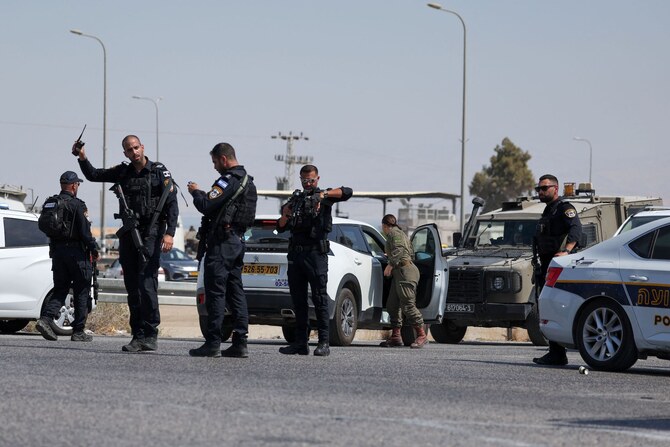
ALLENBY CROSSING, West Bank: Three Israelis were shot and killed Sunday at the border crossing between the West Bank and Jordan, Israeli officials said, in what appeared to be an attack linked to the 11-month-old war in Gaza.
Israel's military said the gunman approached the Allenby Bridge Crossing from the Jordanian side in a truck and opened fire at Israeli security forces, who killed him in a shootout. Israel’s Magen David Adom rescue service said the three Israelis were all men in their 50s.
Relatives identified the gunman as Maher al-Jazi, a retired Jordanian soldier from Athroh, a town in the impoverished area of Maan.
Jordan is investigating the shooting, its state-run Petra News Agency reported. The Western-allied Arab country made peace with Israel in 1994 but is deeply critical of its policies toward the Palestinians. Jordan has a large Palestinian population and has seen mass protests against Israel over the war in Gaza.
The Allenby crossing over the Jordan River, also known as the King Hussein Bridge, is mainly used by Palestinians and international tourists, as well as for cargo shipments. The crossing has seen few security incidents over the years, but in 2014 Israeli security guards shot and killed a Jordanian judge who they said had attacked them.
Authorities in Israel and Jordan said the crossing was closed until further notice. Israel later announced the closure of both of its land crossings with Jordan, near Beit Shean in the north and Eilat in the south.
Israeli Prime Minister Benjamin Netanyahu condemned the attack and linked it to Israel's larger conflict with Iran and allied militant groups, including Hamas in Gaza and Hezbollah in Lebanon.
The Israeli-occupied West Bank has seen a surge of violence since Hamas' Oct. 7 attack out of Gaza triggered the war there. Israel has launched near-daily military arrest raids into dense Palestinian residential areas, and there has been a rise in Israeli settler violence and Palestinian attacks on Israelis.
Also on Sunday, loved ones mourned Aysenur Ezgi Eygi, an American-Turkish woman who was shot dead on Friday in the West Bank. She had been demonstrating against Israeli settlements there. The White House has said it was “deeply disturbed” and called on Israel to investigate, while her family seeks an independent investigation. Her body remained at a hospital in the West Bank city of Nablus.
In Gaza, meanwhile, an Israeli airstrike early Sunday killed five people, including two women, two children and a senior official in the Civil Defense — first responders who operate under the Hamas-run government.
The Civil Defense said the strike targeted the home of its deputy director for northern Gaza, Mohammed Morsi, in the urban Jabaliya refugee camp.
There was no immediate comment from the Israeli military. The army says it tries to avoid harming civilians and only targets militants.
Another Israeli strike hit the Eid family home in the Nuseirat refugee camp and killed at least two girls, according to an Associated Press journalist who counted the bodies and witnesses. First responders were looking for others under the rubble.
Gaza's Health Ministry says over 40,000 Palestinians have been killed in Gaza since the war began. It does not differentiate between fighters and civilians in its count. The war has caused vast destruction and displaced around 90% of Gaza's population of 2.3 million, often multiple times.
Hamas-led militants killed some 1,200 people, mostly civilians, in their Oct. 7 attack. They abducted another 250 and are still holding around 100 after releasing most of the rest in exchange for Palestinians imprisoned by Israel during a weeklong cease-fire last November. Around a third of the remaining hostages inside Gaza are believed to be dead.
The United States, Qatar and Egypt have spent months trying to broker a cease-fire and the return of the hostages, but the negotiations have repeatedly bogged down.
Israel captured the West Bank, Gaza and east Jerusalem — territories the Palestinians want for a future state — in the 1967 Mideast war. Israel withdrew soldiers and settlers from Gaza in 2005 but maintained control over its airspace, coastline and most of its land crossings. Along with Egypt, it imposed a blockade on Gaza after Hamas seized power from rival Palestinian forces in 2007.


![]()
![]()

Shooting attack at the West Bank-Jordan border crossing kills 3 Israelis

Short Url
https://arab.news/9fqxx
Shooting attack at the West Bank-Jordan border crossing kills 3 Israelis
- Israel says the gunman approached bridge crossing from Jordanian side in truck and opened fire at Israeli security forces, who killed assailant
- Jordanian authorities say investigating shooting at King Hussein crossing


Latest updates


© 2026 SAUDI RESEARCH & PUBLISHING COMPANY, All Rights Reserved And subject to Terms of Use Agreement.