WASHINGTON: University of Southern California law student Elizabeth Howell-Egan isn’t allowed on campus because of her role in last spring’s anti-war protests, but she is keeping up her activism.
She and like-minded students are holding online sessions on the Israel-Hamas war and passing out fliers outside the campus, which is now fortified with checkpoints at entrances and security officers who require students to scan IDs.
“Change is never comfortable. You always have to risk something to create change and to create a future that we want to live in,” said Howell-Egan, a member of the school’s Students for Justice in Palestine chapter, which is calling on USC to divest from companies profiting off the war.
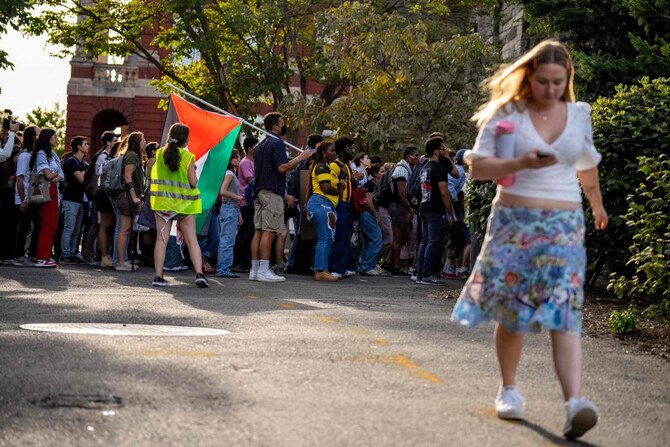
The stakes have gone up this fall for students protesting the war in Gaza, as US colleges roll out new security measures and protest guidelines — all intended to avoid disruptions like last spring’s pro-Palestinian demonstrations and protect students from hate speech. Activism has put their degrees and careers at risk, not to mention tuition payments, but many say they feel a moral responsibility to continue the movement.
Tent encampments — now forbidden on many campuses — so far have not returned. And some of the more involved students from last spring have graduated or are still facing disciplinary measures. Still, activist students are finding other ways to protest, emboldened by the rising death toll in Gaza and massive protests this month in Israel to demand a ceasefire.
Tensions over the conflict have been high on American campuses since the war began on Oct. 7, when Hamas-led militants killed 1,200 people in Israel and took 250 hostage. The war in Gaza has killed more than 40,000 people, according to Gaza health officials.
As the pro-Palestinian demonstrations took off nationally, Jewish students on many campuses have faced hostility, including antisemitic language and signs. Some colleges have faced US civil rights investigations and settled lawsuits alleging they have not done enough to address antisemitism.
A desire ‘to be part of something’
Temple University senior Alia Amanpour Trapp started the school year on probation after being arrested twice last semester during pro-Palestinian protests. Within days, she was back on the university’s radar for another demonstration.
As she reflects on the fallout from her activism, she thinks of her grandfather, a political prisoner killed in 1988 massacres orchestrated by Iran’s Ayatollah Khomeini.
“He paid the ultimate price for what he believed in. And so, I feel like the least I can do is stand my ground and face it,” she said.
Trapp, a political science major, devotes much of her time outside classes to Students for Justice in Palestine, which led her to the back-to-school protest on Aug. 29. The group of a few dozen protesters made several stops, including outside the Rosen Center, a hub of Jewish life that is home to Temple’s Hillel Chapter.
Some Jewish students inside said they were shaken by the demonstration. Protesters used megaphones to direct chats toward people inside, Temple President Richard Englert said. The university called it intimidation and opened an investigation.
“Targeting a group of individuals because of their Jewish identity is not acceptable and intimidation and harassment tactics like those seen today will not be tolerated,” Englert said.
Trapp said they were not out to intimidate anyone, but to condemn Hillel for what she called its support of Zionism. “To the students inside that felt threatened or harmed, I’m sorry,” she said.
Trapp is appealing a Temple panel’s ruling that she violated the college’s conduct code last spring. As she reflects on the discipline, she recalls a Temple billboard she saw on Interstate 95 after her first visit to campus.
“Because the world won’t change itself,” the ad beckoned. It reassured her that Temple was the right fit. “I so badly wanted to be part of something, you know, meaningful,” she said, “a community committed to change.”
A renewed push for divestment
At Brown University, some students who were arrested last spring are taking another tack to pressure the Ivy League school to divest its endowment from companies with ties to Israel.
Last spring, the university committed to an October vote by its governing board on a divestment proposal, after an advisory committee weighs in on the issue. In exchange, student protesters packed up their tents.
Now students including Niyanta Nepal, the student body president who was voted in on a pro-divestment platform, say they intend to apply pressure for a vote in favor of divestment. They are rallying students to attend a series of forums and encouraging incoming students to join the movement.
Colleges have long rebuffed calls to divest from Israel, which opponents say veers into antisemitism. Brown already is facing heat for even considering the vote, including a blistering letter from two dozen state attorneys general, all Republicans.
Rafi Ash, a member of the Brown University Jews For Ceasefire Now and Brown Divest Coalition, declined to say what activism might look like if the divestment push fails. A Jewish student who was among 20 students arrested during a November sit-in at an administrative building, Ash dismisses critics who see the anti-war protests as antisemitic.
“The Judaism I was taught promotes peace. It promotes justice. It promotes ‘tikkun olam’ — repairing the world,” said Ash, who is on disciplinary probation. “This is the most Jewish act I can do, to stand up for justice, for everyone.”
Barred from campus, but strategizing on protests
For Howell-Egan, the crackdown at USC and her suspension only deepened her desire to speak out.
“Even with this threat of USC imposing sanctions and disciplinary measures, I am at peace with it because I am standing up for something that is important,” Howell-Egan said. “There are no more universities in Gaza. We are in an incredibly privileged position for this to be our risk.”
She is not allowed to attend in-person classes because she was suspended in May for joining protests at the private school in Los Angeles.
There has been a trend of heavier punishments for students engaging in activism than in the past, including banishment from campus and suspensions that keep students “in limbo for months,” said Tori Porell, an attorney with the nonprofit Palestine Legal, which has supported student protesters facing disciplinary measures. Howell-Egan sees it as part of a strategy to stifle free speech.
In a memo this month, USC President Carol Folt said the campus has seen peaceful protests and marches for years. “However, the spring semester brought incidents that tested our values, disregarded our policies, sparked fears, and required unprecedented safety measures,” she said.
For now the focus of the USC Divest Coalition, which includes several student organizations, has moved off campus, to incorporate the wider community and take a cautious approach as students get a handle on the university’s new rules, Howell-Egan said.
In addition to the community outreach, students have been holding teach-ins.
“The idea is to raise our skill set and our understanding of where we stand in this moment, and where we are in this fight,” Howell-Egan said, “especially as we continue with it.”


![]()
![]()
![]()

As US colleges raise the stakes for protests, activists are weighing new strategies


Short Url
https://arab.news/phtkk
As US colleges raise the stakes for protests, activists are weighing new strategies
- “You always have to risk something to create change and to create a future that we want to live in,” said Howell-Egan, a member of the school’s Students for Justice in Palestine chapter
- The stakes have gone up this fall for students protesting the war in Gaza, as US colleges roll out new security measures and protest guidelines


Latest updates



© 2026 SAUDI RESEARCH & PUBLISHING COMPANY, All Rights Reserved And subject to Terms of Use Agreement.