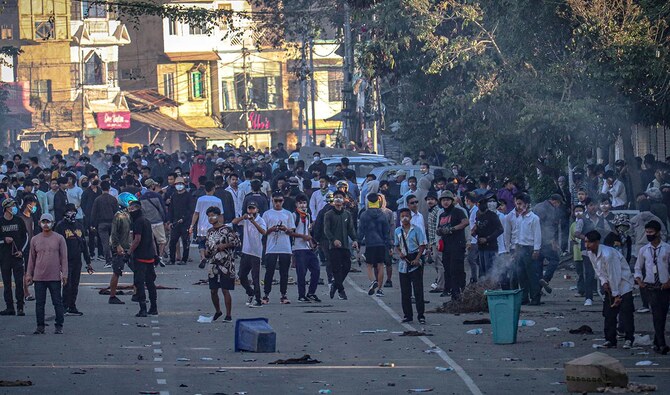
Ethnic violence in India’s Manipur escalates, six killed

Students protest against the killing of two missing students and demand peace in India's northeastern state of Manipur amid ongoing ethnic violence, in Imphal on September 27, 2023. (AFP/File)
Short Url
Updated 07 September 2024
Follow

Ethnic violence in India’s Manipur escalates, six killed

  • The majority Meitei community and the tribal Kukis have clashed sporadically since last year
  • More than 225 people have since been killed in clashes and some 60,000 have been displaced

GUWAHATI: Six people, including one civilian, were killed as fresh violence broke out between two warring ethnic communities in the northeast Indian state of Manipur on Saturday, authorities said.
The majority Meitei community and the tribal Kukis have clashed sporadically since last year after a court ordered the state government to consider extending special economic benefits and quotas in government jobs and education enjoyed by the Kukis to the Meiteis as well.
More than 225 people have been killed and some 60,000 have been displaced.
Saturday’s gunfire incident represents the most number of casualties for a single day in the latest spurt of violence that began a week ago. The attacks earlier this week have also seen the use of drones to drop explosive devices in what authorities have called a significant escalation.
Police say they suspect that the drones were used by Kuki militants — a claim denied by Kuki groups.
“Fighting has been going on between armed groups of both the communities since the morning,” said Krishna Kumar, deputy commissioner of the state’s Jiribam district where the clash occurred.
According to Indian media reports, the civilian was shot dead in his sleep. “He was fired upon in his room itself,” Kumar told Reuters, adding that security forces had been deployed to control the situation.
Manipur has ordered all schools in the state to remain shut on Saturday.
A state of 3.2 million people, Manipur has been divided into two ethnic enclaves since the conflict began in May 2023 — a valley controlled by the Meiteis and the Kuki-dominated hills. The areas are separated by a stretch of no-man’s land monitored by federal paramilitary forces.
On Sept. 1, two people were killed and several injured in the valley district of Imphal West. Later in the week, a 78-year-old man was killed and six were injured when a “long-range rocket” was deployed by militants and fell on the house of a former chief minister in the valley’s Bishnupur district, police said on Friday.


Indonesia to send record number of women officers to assist Hajj pilgrims

Updated 6 sec ago
Follow

Indonesia to send record number of women officers to assist Hajj pilgrims

  • Women comprise 33% of Indonesian Hajj officers in 2026
  • They will assist the world’s largest contingent of Hajj pilgrims

JAKARTA: Indonesia’s Ministry of Hajj and Umrah on Friday concluded a training program for Hajj officers, a group that this year includes a record number of female guides to help Indonesian pilgrims perform the spiritual journey.

The world’s biggest Muslim-majority nation, Indonesia sends the largest contingent of Hajj pilgrims every year, comprising 221,000 people in 2026.

They will be assisted by more than 1,600 Indonesian officers who came from different parts of the country to participate in a 20-day training program in East Jakarta to prepare them for the roles, ahead of the pilgrimage season in May.

“Education and training for Indonesian Hajj officers … are carried out as part of the operational preparations for the 2026 Hajj pilgrimage,” said Puji Raharjo, director general of Hajj management at the ministry, during the closing ceremony on Friday. 

“This program is aimed at ensuring the physical, mental, technical and organizational readiness of the officers in order to guide, serve and protect Indonesian Hajj pilgrims.” 

Indonesia is sending more than 500 female Hajj officers in 2026 — its largest group of women guides yet.

“This year, women officers comprise about 33 percent, the highest in the history of Hajj management in Indonesia,” Arifatul Choiri Fauzi, the minister of women’s empowerment and child protection, told reporters.

As over 55 percent of Indonesian Hajj pilgrims are women and most of them are elderly, female officers can help ensure that they are treated with more care and empathy, she added.

Fauzi said: “There are many issues that are more suitable to be handled by female officers, things related to women’s issues, assistance inside the room, or emergencies that concern the privacy of the (women) pilgrims.”

The training program, which ran from Jan. 10-30, was aimed at preparing the officers physically and educating them on existing Hajj policies and mechanisms, while also covering operational case studies and lessons on effective communication and Arabic, as well as simulations of real-life situations related to the pilgrimage.

Indonesian Hajj officers will undergo a round of training online in February, before another session is held with reference to their departure locations in Indonesia.

“Every year, Indonesia sends the largest number of pilgrims in the world. This fact demands us to be truly ready and organized with officers who are dependable. Hajj officers fill a strategic role, you represent the state for the pilgrims, (and) you represent the state in front of the world,” Minister of Hajj and Umrah Mochamad Irfan Yusuf said while addressing this year’s batch of Hajj officers.

“This training and guidance program is therefore very important, as this is where you all prepare in order to understand the extent of your duties, strengthen coordination and come together in unity and discipline for the mission ahead.”