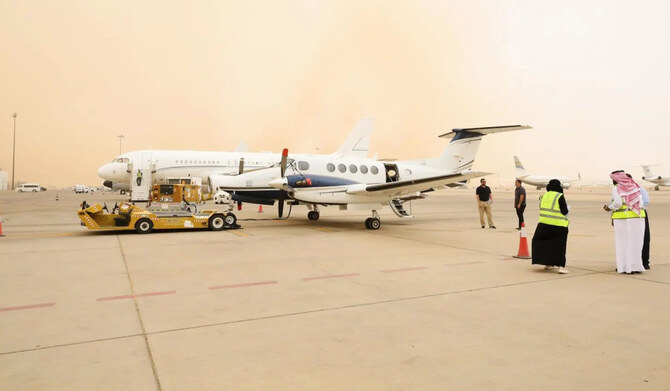

RIYADH: The Kingdom has taken significant strides in its cloud-seeding program to increase rainfall, expand green areas, and combat desertification across the Kingdom, according to the Saudi Press Agency.
Ayman Al-Bar, executive director of the Regional Cloud Seeding Program, told the SPA on Thursday that the process involves aircraft and drones dispersing environmentally safe materials into clouds over carefully selected areas.
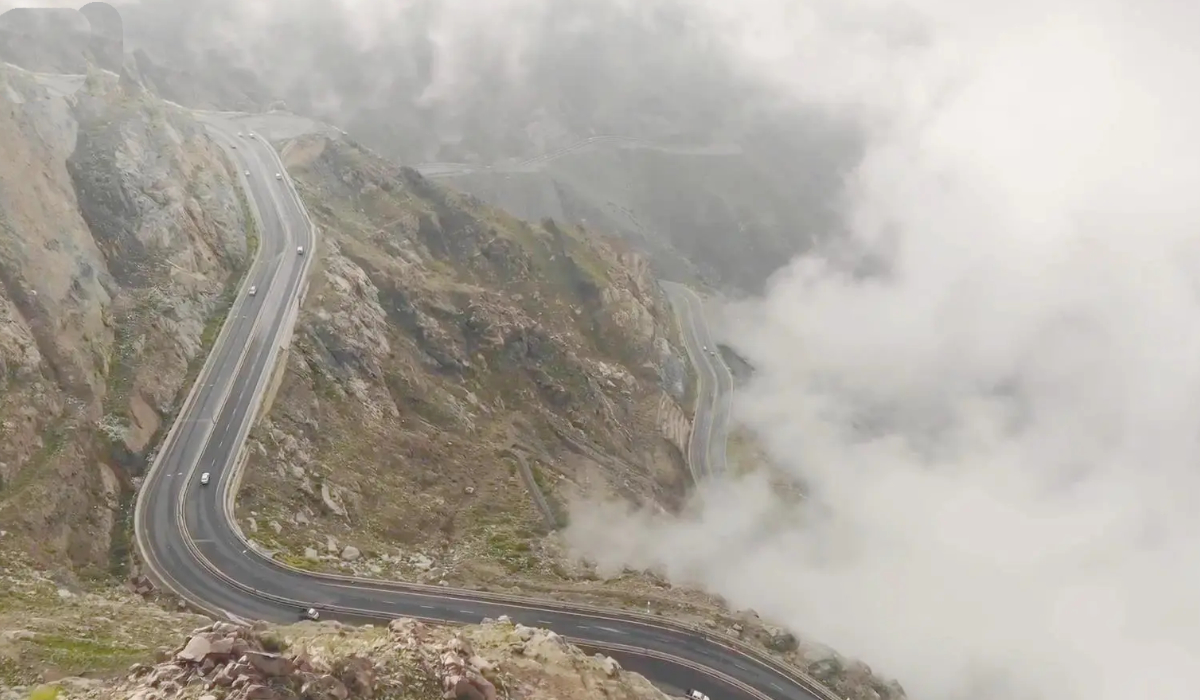
The process involves aircraft and drones dispersing environmentally safe materials into clouds over carefully selected areas, official said. (SPA)
By targeting specific areas, a single cloud can increase its rainfall by up to 20 percent under ideal conditions, said Al-Bar.
In 2023, the program targeted six regions in Saudi Arabia, conducting 415 cloud-seeding flights, and dispersing 7,876 flares with four aircraft for over 1,300 hours.
Research on the operations was conducted by a separate aircraft for over 110 hours.
FASTFACTS
• Plan for more aircraft and local pilots for cloud-seeding operations.
• Need better ‘quantity and quality’ rainfall, says meteorology official.
Al-Bar added: “The initiative has now entered its fifth phase, marking a new milestone in the country’s efforts to enhance water security. Our approach is tailored to enhance both the quantity and quality of rainfall from specific cloud types.”
Hussein bin Mohammed Al-Qahtani, spokesperson for the National Center of Meteorology, told the SPA that last year’s total rainfall was an estimated 4 billion cubic millimeters.
Al-Qahtani also highlighted the center’s efforts to localize cloud-seeding expertise, with 18 Saudi Arabia pilots joining the program.
According to the SPA, Saudi Arabia began its cloud-seeding initiative in 2004 and partnered with Weather Modification Inc. under the scientific oversight of the National Center for Atmospheric Research.
This collaboration focused on conducting cloud-seeding experiments in the Asir region, coupled with a comprehensive feasibility study.
Building on its initial findings, the Kingdom expanded its efforts in 2006-2007. During this period, a six-month cloud-seeding trial was conducted across central Saudi Arabia, encompassing the regions of Riyadh, Qassim, and Hail.
The program reached a new milestone in 2009 with a contract involving the WMI. This phase saw the deployment of 10 specialized aircraft for cloud-seeding operations, involving several elite Saudi Arabia scientists.
It takes about 30 minutes for the effects of cloud seeding to be seen, depending on the delivery method, which includes direct injection at the cloud top, base seeding or releasing the agent in the updraft below the cloud base.
Materials used vary based on temperature conditions, including solid carbon dioxide, or dry ice, used at low temperatures, and calcium chloride particles used at higher temperatures to form condensation nuclei.