

Tech giant Google announces more investment in Pakistan, support for youth training — PM

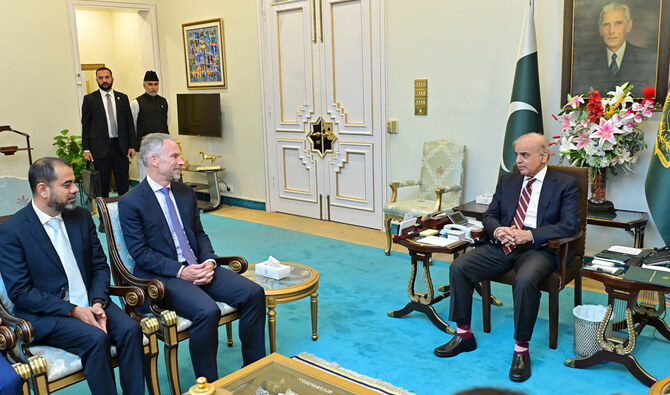
Pakistan Prime Minister Shehbaz Sharif (R) gestures during a meeting with a four-member Google delegation led by the company’s president for the Asia Pacific region, Scott Beaumont (2L), in Islamabad on September 5, 2024. (Photo courtesy: PMO)
Short Url
Updated 06 September 2024
Follow

Tech giant Google announces more investment in Pakistan, support for youth training — PM

  • PM meets Google delegation, shares plans to achieve IT export target of $25 billion in five years
  • Google to produce half a million Chromebooks in Pakistan by 2026, presents first to PM Sharif

ISLAMABAD: Pakistani Prime Minister Shehbaz Sharif said on Thursday tech giant Google had decided to increase its investments in Pakistan and support youth skill training initiatives in the South Asian nation.
A four-member Google delegation led by the company’s president for the Asia Pacific region, Scott Beaumont, called on Sharif on Thursday in Islamabad. 
At a ceremony earlier in the day, Sharif had announced. an IT export target of $25 billion in the next five years, saying the government would allocate funds for training of the youth and improvement in IT infrastructure and the regulatory environment.
“Apprising the prime minister of its plans of future engagement, Mr. Scott said Google has decided to further increase its investment footprint in Pakistan and support the Government’s initiatives of Youth’s skills training,” Pakistani news agency APP reported. 
“In order to maximize the economic benefits of technology, the large youth population and expanding economy are important factors for a value-driven tech giant like Google, he added.”
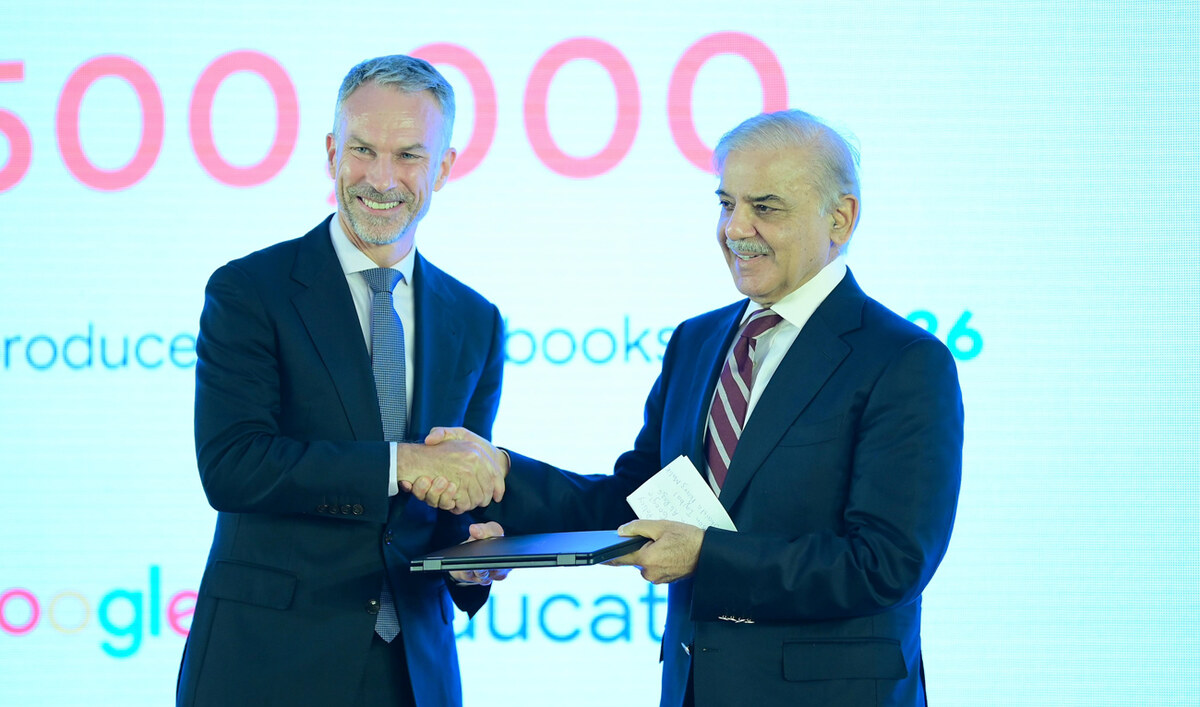


Pakistan Prime Minister Shehbaz Sharif (R) receives Chromebook by Google’s president for the Asia Pacific region, Scott Beaumont (L), during a launch event of an initiative to manufacture 500,000 Chromebooks in Pakistan, in Islamabad on September 5, 2024. (Photo courtesy: PMO)

At a ceremony on Thursday, Google launched an initiative to produce half a million Chromebooks in Pakistan by 2026, marking the occasion by presenting the first locally manufactured device to Sharif. 
“The target is simple and we have to touch the figure of $25 billion in the next five years,” PM Sharif said on Thursday while addressing the ceremony. “Give me a pathway on how to achieve this figure.”
Pakistan is banking on its nascent but growing IT industry to increase its exports and generate critical foreign exchange revenue for a cash-strapped country. IT exports soared to $3.2 billion in the fiscal year 2023-2024, marking a robust 24 percent year-on-year increase from the previous fiscal’s $2.59 billion.
But the push to boost the sector is facing challenges as Internet speeds in Pakistan have dropped by 30-40 percent over the past few weeks, affecting millions of Pakistanis, adversely hitting businesses and drawing nationwide complaints. 
The telecommunications authority has attributed the slowdown to damaged underwater cables while IT Minister Shaza Khawaja has blamed a surge in VPN use, but digital advocacy groups and IT unions say the Internet slowdown may be linked to the government’s trial of an upgraded web management system or national firewall to control what it deems “anti-state propoganda.” The government says any firewall, if imposed, will not be used for censorship purposes.
Last month, the Pakistan Software Houses Association (P@SHA) said Pakistan’s economy could lose up to $300 million due to Internet disruptions caused by the imposition of a national firewall.


IMF warns against policy slippage amid weak recovery as it clears $1.2 billion for Pakistan

Updated 11 December 2025
Follow

IMF warns against policy slippage amid weak recovery as it clears $1.2 billion for Pakistan

  • Pakistan rebuilt reserves, cut its deficit and slowed inflation sharply over the past one year
  • Fund says climate shocks, energy debt, stalled reforms threaten stability despite recent gains

ISLAMABAD: Pakistan’s economic recovery remains fragile despite a year of painful stabilization measures that helped pull the country back from the brink of default, the International Monetary Fund (IMF) warned on Thursday, after it approved a fresh $1.2 billion disbursement under its ongoing loan program.

The approval covers the second review of Pakistan’s Extended Fund Facility (EFF) and the first review of its climate-focused Resilience and Sustainability Facility (RSF), bringing total disbursements since last year to about $3.3 billion.

Pakistan entered the IMF program in September 2024 after years of weak revenues, soaring fiscal deficits, import controls, currency depletion and repeated climate shocks left the economy close to external default. A smaller stopgap arrangement earlier that year helped avert immediate default, but the current 37-month program was designed to restore macroeconomic stability through strict monetary tightening, currency adjustments, subsidy rationalization and aggressive revenue measures.

The IMF’s new review shows that Pakistan has delivered significant gains since then. Growth recovered to 3 percent last year after shrinking the year before. Inflation fell from over 23 percent to low single digits before rising again after this year’s floods. The current account posted its first surplus in 14 years, helped by stronger remittances and a sharp reduction in imports. And the government delivered a primary budget surplus of 1.3 percent of GDP, a key program requirement. Foreign exchange reserves, which had dropped dangerously low in 2023, rose from US$9.4 billion to US$14.5 billion by June.

“Pakistan’s reform implementation under the EFF arrangement has helped preserve macroeconomic stability in the face of several recent shocks,” IMF Deputy Managing Director Nigel Clarke said in a statement after the Board meeting.

But he warned that Islamabad must “maintain prudent policies” and accelerate reforms needed for private-sector-led and sustainable growth.

The Fund noted that the 2025 monsoon floods, affecting nearly seven million people, damaging housing, livestock and key crops, and displacing more than four million, have set back the recovery. The IMF now expects GDP growth in FY26 to be slightly lower and forecasts inflation to rise to 8–10 percent in the coming months as food prices adjust.

The review warns Pakistan against relaxing monetary or fiscal discipline prematurely. It urges the State Bank to keep policy “appropriately tight,” allow exchange-rate flexibility and improve communication. Islamabad must also continue raising revenues, broadening the tax base and protecting social spending, the Fund said.

Despite the progress, Pakistan’s structural weaknesses remain severe.

Power-sector circular debt stands at about $5.7 billion, and gas-sector arrears have climbed to $11.3 billion despite tariff adjustments. Reform of state-owned enterprises has slowed, including delays in privatizing loss-making electricity distributors and Pakistan International Airlines. Key governance and anti-corruption reforms have also been pushed back.

The IMF welcomed Pakistan’s expansion of its flagship Benazir Income Support Program, which raises cash transfers for low-income families and expands coverage, saying social protection is essential as climate shocks intensify. But it warned that high public debt, about 72 percent of GDP, thin external buffers and climate exposure leave the country vulnerable if reform momentum weakens.

The Fund said Pakistan’s challenge now is to convert short-term stabilization into sustained recovery after years of economic volatility, with its ability to maintain discipline, rather than the size of external financing alone, determining the durability of its gains.