


ALGIERS: Young people comprise more than half of Algeria’s 45 million people, and many are anxious for change. But with incumbent President Abelmadjid Tebboune set for an easy reelection on Saturday, some fear it won’t be forthcoming.
Courting the youth vote, Tebboune has promised more jobs, a higher minimum wage, and better unemployment benefits.
This reflects high unemployment in Algeria, where one in three young people is out of work.
Tebboune came to power after the youth-driven Hirak pro-democracy protests ousted his veteran predecessor Abdelaziz Bouteflika, in 2019.
But the movement waned, and many of its supporters have become disenchanted.
BACKGROUND
Today, Algeria stands as Africa’s top gas exporter and third-largest economy, with President Abelmadjid saying his tenure helped achieve that despite ‘a war against COVID-19 and corruption.’
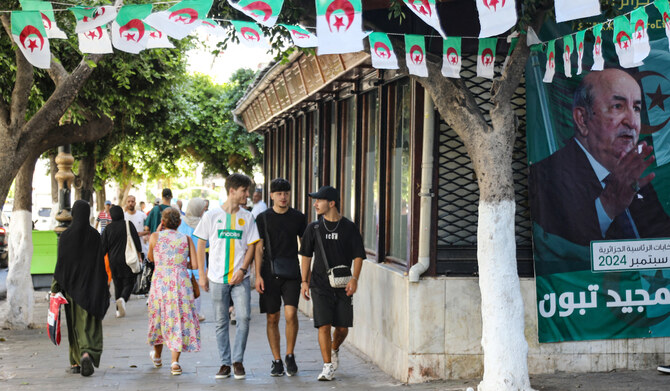
“The past five years brought nothing new,” Abdenour Benkherouf, a 20-year-old hairdresser wandering with a friend in downtown Algiers, said.
“We haven’t seen anything good since 2019, since we won the African Cup,” he smirked.
Karim Beldjoudi, his friend who was wearing a Barcelona football shirt, agreed.
“We’re living now as we lived then,” he said, referring to 2019, the year Tebboune was elected in a widely boycotted poll.
“Five years have gone by just like that, one after the other,” said Beldjoudi, who is unemployed.
Today, about a third of Algeria’s 24 million registered voters are under 30. However, as in 2019, when a record 60 percent of voters abstained, the majority will likely still not vote.
No official figures show the abstention rate among the young in Algeria, where 23 million people are younger than 30.
This constitutes a challenge for Tebboune, who claimed the presidency amid a record abstention rate of 60 percent five years ago.
At a recent rally in Oran last month, he pledged to create 450,000 jobs and increase monthly unemployment benefits if reelected.
Launched in 2022, unemployment benefits now provide 13,000 dinars ($97) to people aged 19 to 40. Tebboune has promised to raise this to 20,000 dinars, which would match the current minimum wage.
Fouad Brahimi, a 22-year-old artist, said this wouldn’t be enough.
“We need job opportunities because this allowance is not sustainable,” he said.
Although Algeria’s economy has grown at an annualized rate of about 4 percent over the past two years, it remains heavily dependent on oil and gas to fund its social assistance programs.
“Tebboune has indeed put in work, but he is also perpetuating a project left by his predecessors,” Brahimi added.
Tebboune had referred to Bouteflika’s rule as a “decade of the mafia” when wealth was concentrated in the hands of a “gang.”
Today, Algeria stands as Africa’s top gas exporter and third-largest economy, with Tebboune saying his tenure helped achieve that despite “a war against COVID-19 and corruption.”
Standing by an election poster of Tebboune, 21-year-old Chadli Isshak said that because of the pandemic, the president “wasn’t able to fulfill all his promises.”
“He did create jobs and is reducing Algeria’s debt,” said the student.
“But two or three years have not been enough for him to do everything he wanted,” he added.
“We will see in his second term if he can keep his promises.”
Sami Rahmani, 39, said he was satisfied with the president’s record despite being unemployed.
“He has worked hard, and I would like to see him do more in the upcoming five years,” he said.
“He should look into helping the marginalized youth. We have people with diplomas but no jobs.”
Each year, thousands of graduates resign themselves to jobs that do not match their degrees, working in precarious and, at times, informal jobs such as street vending.
Rahmani said his support for Tebboune had made him a “traitor to the Hirak” in the eyes of others.
The movement withered with the onset of the pandemic, coupled with ramped-up policing and a sweeping crackdown on protesters in which hundreds were arrested.
Faced with disillusionment, many young Algerians have left the country, formally, through student and other visas or via makeshift boats in the hope of crossing the Mediterranean to Europe.
Benkherouf and Beldjoudi, the friends interviewed by AFP in the city center, said most people their age “now have the same dream: harga,” referring to irregular migration.


