Decades after independence, France-Algeria ties still tense

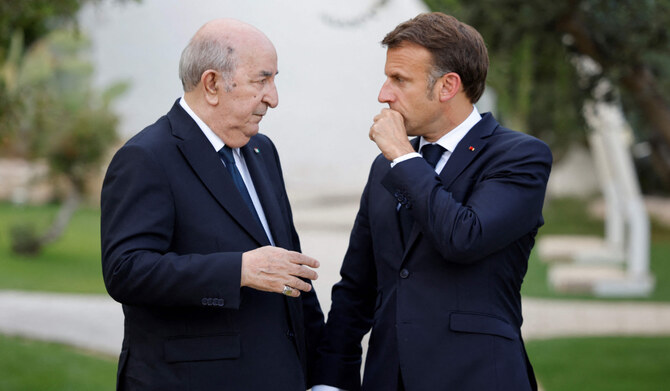
France's President Emmanuel Macron (R) talks with Algeria's President Abdelmadjid Tebboune (L) as they attend the G7 Summit hosted by Italy at the Borgo Egnazia resort in Savelletri on June 13, 2024. (AFP)
Short Url
Updated 01 September 2024
Follow

Decades after independence, France-Algeria ties still tense

  • Several historians believe that recognizing French colonization as a “crime against humanity” would be more appropriate
  • During the historians’ debate, Algeria asked France to return the skulls of resistance fighters and historical and symbolic artifacts from 19th-century Algeria, including items that belonged to Algerian anti-colonial figure Emir Abdelkader

ALGIERS: The fraught relations between France and its former colony Algeria had eased a little in recent years, but a new rift over Paris backing Morocco’s autonomy plan for disputed Western Sahara has sent rapprochement efforts into a tailspin.
Algerian President Abdelmadjid Tebboune, who is seeking a second term in presidential elections on September 7, was set to travel to France for a state visit, but this has been rescheduled twice and it is now doubtful in will happen at all.
Last month, Algiers withdrew its ambassador to Paris after French President Emmanuel Macron said Morocco’s autonomy plan was the only solution for the territory.
Algeria, which backs the territory’s pro-independence Polisario Front, denounced this as a “step that no other French government had taken before.”
France colonized Algeria in 1830 and the North African country only gained independence in 1962, after a war that authorities say killed more than 1.5 million Algerians.
French historians say half a million civilians and combatants died during the war for independence, 400,000 of them Algerian.
While France has made several attempts over the years to heal the wounds, it refuses to “apologize or repent” for the 132 years of often brutal rule that ended in the devastating eight-year war.
Experts now accuse both countries of exploiting the war for present-day political ends.
“The national narrative about the Algerian war is still dominant and during a campaign like the presidential election, Algerians are sensitive to these issues in their internal policy choices,” Hasni Abidi of the Geneva-based CERMAM Study Center told AFP.
Abidi said Tebboune now needed to “readjust his electoral speeches to protect himself from criticism on foreign policy” after the “complete fiasco” of failed attempts to restore relations with Macron.

Last week, Algeria marked its Moudjahid National Day commemorating war combattants with a speech by Tebboune, in which he said France wrongly “believed it could stifle the people’s revolution with iron and fire.”
In 2022, the two countries set up a joint commission of historians in an attempt to mend historical differences and appease tensions.
But, according to Abidi, the commission didn’t work fast enough and “did not succeed in freeing itself from political supervision.”
The expert said France’s latest move backing Morocco’s plan in Western Sahara “will deal another blow to the issue of memory” at the risk of “reopening old wounds and stigma from the colonial past.”
What followed France’s conquest of then Ottoman ruled Algiers was the destruction of its socio-economic structures, mass displacement, and the bloody repression of numerous revolts before the war erupted in 1954.
This chapter in the two countries’ history has been “exploited according to their issues and interests of the moment,” historian Hosni Kitouni told AFP.
During the historians’ debate, Algeria asked France to return the skulls of resistance fighters and historical and symbolic artifacts from 19th-century Algeria, including items that belonged to Algerian anti-colonial figure Emir Abdelkader.
“These items are in museums in France, where, from a legal standpoint, their presence is illegal,” Amira Zatir, an adviser at the Emir Abdelkader Foundation, told AFP.
She said many of these items were stolen when French forces looted the emir’s library during the Battle of Smala in 1843.
Algeria has also demanded the return of original archives from the Ottoman and colonial eras that were transferred to France before and after Algeria’s independence.
Algeria seeks reparations for actions committed by the former occupying power, such as the 17 nuclear tests conducted in its Sahara desert between 1960 and 1966.
Mustapha Boudina, a 92-year-old former war combattant who now heads the National Association of Former Death Row Inmates, said Algeria should require even more reparations.
“We need to put pressure on our enemies of the time so that they repent and apologize” for their “numerous crimes,” he said.
Several historians believe that recognizing French colonization as a “crime against humanity” would be more appropriate.
That was exactly how Macron described it during a visit to Algiers amid his presidential campaign in 2017, sparking an outcry from the French right.


Ambassadors, military attaches visit border villages, are briefed on weapons centralization south of Litani River

Updated 6 sec ago
Follow

Ambassadors, military attaches visit border villages, are briefed on weapons centralization south of Litani River

  • Aoun: Contacts ongoing at home and abroad to consolidate security in southern Lebanon

BEIRUT: A delegation of Arab and foreign ambassadors and military attaches toured areas south of the Litani River on Monday, accompanied by Lebanese Army Chief Gen. Rodolphe Haykal, for a briefing on the progress in implementing the plan to confine weapons to the state.

According to a military source, the visit aimed to “review the tasks being carried out by the Lebanese Army to implement the Homeland Shield Plan mandated by the Council of Ministers.”

The first phase of the plan is scheduled to conclude by the end of this month, after which the army will move to the next stage: centralizing all weapons north of the Litani line.

Diplomats are expected to convey their field observations to their respective governments on the eve of a US–Saudi–French meeting with the army commander on Dec. 17 and 18 in Paris, where they will also discuss supporting the Lebanese Army, the weapons centralization plan, and the progress achieved.

The commander of the southern Litani sector, Brig. Gen. Nicolas Thabet, briefed the diplomatic delegation on the operations being carried out by the army during a meeting held at the Benoit Barakat Barracks in Tyre, which was joined by the army commander and senior officers. The delegation then moved on to inspect the western sector.

Haykal stressed “the importance of supporting the army and the commitment of all parties to the ceasefire agreement and respect for Lebanese territorial sovereignty.”

While Thabet presented an operational overview to the ambassadors, diplomats focused on evaluating the first phase of the weapons centralization plan, the mechanisms for transitioning to the second phase, and the obstacles facing the army.

The diplomats inspected several army positions deployed along the forward edge, including the town of Aita Al-Shaab and the Wadi Zibqin area, where a Hezbollah facility had previously been located.

A week earlier, Thabet had disclosed that “during the execution of its mission south of the Litani, the army has dealt with 177 tunnels since the launch of the Homeland Shield Plan, closed 11 crossings along the Litani River, and seized 566 rocket launchers.”

Monday’s tour coincided with a meeting on the other side of the border between US Envoy Thomas Barrack and Israeli Prime Minister Benjamin Netanyahu in Tel Aviv, focused on de-escalating tensions with Lebanon and Syria.

On Monday, Israel continued through its media to promote the prospect of an imminent Israeli military escalation against Hezbollah unless it is disarmed by the end of the year.

According to the Lebanese Army, “the recent Israeli strikes targeted civilian homes. The army inspected them after they were hit and found no evidence that they contained any weapons.”

Army command further clarified that “after the Israeli enemy threatened two days ago to bomb homes, the Lebanese Army conveyed a message to the relevant mechanism expressing its readiness to inspect the houses before any strike to determine whether they contained weapons or ammunition.”

However, Israeli forces allegedly rejected the proposal and went ahead with air raids on the homes, destroying them.

For his part, President Joseph Aoun said on Monday before visitors that “contacts are ongoing domestically and internationally to consolidate security and stability in the south through negotiations via the mechanism committee, which will hold a meeting next Friday.”

He added that the mechanism’s work “enjoys Lebanese, Arab, and international support, particularly following the appointment of former Ambassador Simon Karam as head of the Lebanese delegation.”

Aoun noted that “the choice of negotiation is the alternative to war, which would yield no results but would cause further harm and destruction to Lebanon and the Lebanese without exception.”