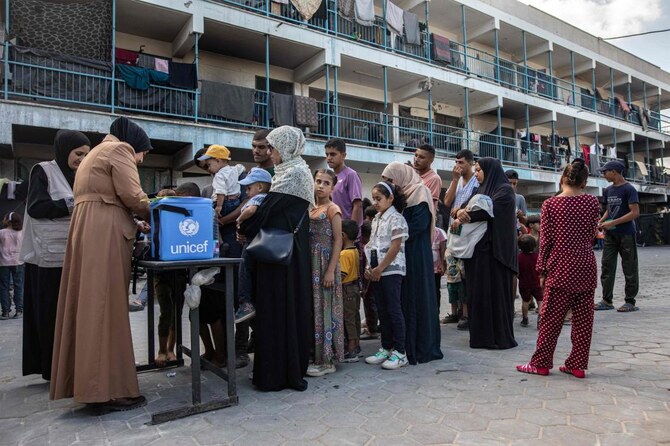
KHAN YUNIS, Palestinian Territories: Children in Khan Yunis tilted their heads back, mouths open, as they received oral drops during the second phase of a polio vaccination campaign in Gaza, which began on Thursday.
“I have been vaccinated,” five children said proudly one by one, their inked fingers proof of their inoculation against polio.
Gaza’s health ministry reported the first case of polio in 25 years last month, amid the devastating Israel-Hamas war in the Palestinian territory.
At tent camps for the displaced, schools-turned-shelters and health centers, parents brought babies, infants and teenagers for vaccines provided by UN agencies.
“I live in a tent next to a sewage pond with significant disease and epidemic issues, and mosquitoes and worms have affected us,” said Amani Ashur, 37, who brought his one-year-old son Abdul Rahman to be vaccinated.
Like most Gazans, Ashur has been displaced at least once, finding shelter in the Al-Amal neighborhood of Khan Yunis. His child, like many others, has fallen ill from diseases spreading through the makeshift shelters.
Gazans said they feared the spread of diseases due to the overcrowded and unsanitary conditions in the camps and shelters.
“I was worried about my child, so I brought him to be vaccinated,” said Safaa Al-Balbisi, 34, about her two-year-old son Yahya.
“The war, lack of cleanliness, and living in tents and streets, along with the widespread sewage issues, have all contributed to the spread of diseases.”
Raafat Tuman, 46, brought his two-year-old son Adam to Khan Yunis’s Nasser hospital after learning of the campaign on social media.
“I decided to vaccinate my child to protect him from (polio) and other illnesses,” he said.
Hundreds of families gathered at a school-turned-shelter, waiting for the vaccines to arrive.
Thursday marked the fifth day of polio vaccinations in Gaza and the first in the south of the coastal territory.
UN agency for Palestinian refugees (UNRWA) spokeswoman Louise Wateridge said the aim was to vaccinate 200,000 children against the disease during this phase.
So far, the vaccination drive was going as planned, said Majdi Dahir, Gaza health ministry technical director for the polio campaign.
“The campaign in the Central governorate proved to be highly successful, exceeding the target, which is very positive,” he said, hoping for similar success in the south.
Overall, the campaign aims to fully vaccinate more than 640,000 children in Gaza, with a third phase set to be launched in the north.
Wateridge warned, however, that “in the southern area it’s going to be more difficult to reach a lot of the population,” as the designated humanitarian zones — where Israel has agreed not to strike during the campaign — do not cover all children.
A relative lull in fighting in these areas has offered a brief respite to families after weeks of intense bombing and fighting.
There were still “a lot of strikes this morning and through the night,” Wateridge said, but “one thing I noticed yesterday was, you know, going an hour without hearing a bomb, you notice that.”


![]()


Gazans rush to vaccinate children as new polio drive launches
Short Url
https://arab.news/42xcu
Gazans rush to vaccinate children as new polio drive launches
- Gaza’s health ministry reported the first case of polio in 25 years last month
- Parents bring babies, infants and teenagers for vaccines provided by UN agencies


Kuwait emir lambasts ‘brutal’ Iran attacks, affirms right to self-defense
KUWAIT CITY: Kuwait’s emir on Monday condemned Iran’s attacks on his country, where 12 people have been killed so far, as Tehran strikes out at the Gulf in response to US-Israeli attacks.
“Our country has been subjected to a brutal attack by a neighboring Muslim country, which we consider a friend, even though we have not permitted the use of our land, airspace, or coasts for any military action against it, and we have repeatedly informed them of this through our diplomatic channels,” said Sheikh Meshal Al-Ahmad Al-Sabah in a televised speech.
He also insisted on Kuwait’s “full and inherent right to self-defense,” speaking for the first time since Iran’s attacks began on February 28.
“Our country has been subjected to a brutal attack by a neighboring Muslim country, which we consider a friend, even though we have not permitted the use of our land, airspace, or coasts for any military action against it, and we have repeatedly informed them of this through our diplomatic channels,” said Sheikh Meshal Al-Ahmad Al-Sabah in a televised speech.
He also insisted on Kuwait’s “full and inherent right to self-defense,” speaking for the first time since Iran’s attacks began on February 28.
Latest updates


© 2026 SAUDI RESEARCH & PUBLISHING COMPANY, All Rights Reserved And subject to Terms of Use Agreement.