

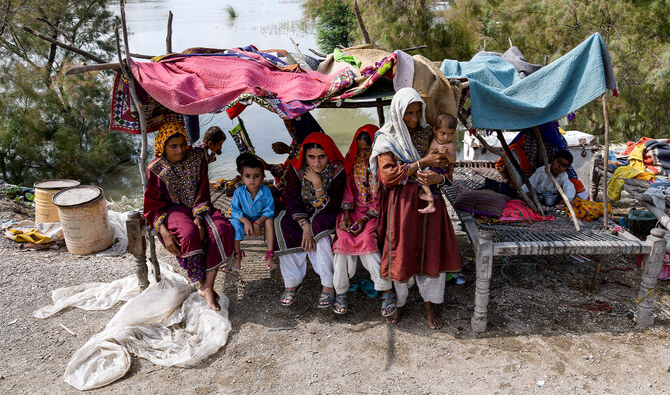

ISLAMABAD: Millions of people in Pakistan continue to live along the path of floodwaters, showing neither people nor the government have learned any lessons from the 2022 devastating floods that killed 1,737 people, experts said Thursday, as an aid group said half of the victims among 300 people killed by rains since July are children.
Heavy rainfall is currently drenching those areas that had been badly hit by the deluges two years ago.
The charity Save the Children said in a statement that floods and heavy rains have killed more than 150 children in Pakistan since the start of the monsoon season, making up more than half of all deaths in rain-affected areas.
The group said that 200 children have also been injured in Pakistan because of rains, which have also displaced thousands of people. Save the Children also said that people affected by floods were living in a relief camp in Sanghar, a district in the southern Sindh province, which was massively hit by floods two years ago.
“The rains and floods have destroyed 80 percent of cotton crops in Sanghar, the primary source of income for farmers, and killed hundreds of livestock,” the charity said, and added that it’s supporting the affected people with help from a local partner.
Khuram Gondal, the country director for Save the Children in Pakistan, said that children were always the most affected in a disaster.
“We need to ensure that the immediate impacts of the floods and heavy rains do not become long-term problems. In Sindh province alone, more than 72,000 children have seen their education disrupted,” he said.
Another charity, UK-baed Islamic Relief, also said weeks of torrential rains in Pakistan have once again triggered displacement and suffering among communities that were already devastated by the 2022 floods and are still in the process of rebuilding their lives and livelihoods.
Asif Sherazi, the group’s country director, said his group is reaching out to flood-affected people.
There was no immediate response from the country’s ministry of climate change and national disaster management authority.
Pakistan has yet to undertake major reconstruction work because the government didn’t receive most of the funds out of the $9 billion that were pledged by the international community at last year’s donors’ conference in Geneva.
“We learned no lessons from that 2022 floods. Millions of people have built mud-brick homes on the paths of rivers, which usually remain dry,” said Mohsin Leghari, who served as irrigation minister years ago.
Leghari said that less rain is predicted for Pakistan for monsoon season compared to 2022, when climate-induced floods caused $30 billion in damage to the country’s economy.
“But, the floodwater has inundated several villages in my own Dera Ghazi Khan district in the Punjab province,” Leghari said. “Floods have affected farmers, and my own land has once again come under the floodwater.”
Wasim Ehsan, an architect, also said Pakistan was still not prepared to handle any 2022-like situation mainly because people ignore construction laws while building homes and even hotels in the urban and rural areas.
He said the floods in 2022 caused damages in the northwest because people had even built homes and hotel after slightly diverting a river. “This is reason that a hotel was destroyed by the Swat river in 2022,” he said.
Saad Edhi, an official at the country’s largest ambulance service, also said based upon his past experience of supervising relief operations, he could say that Pakistan may suffer damages if it faces the 2022-like floods.


