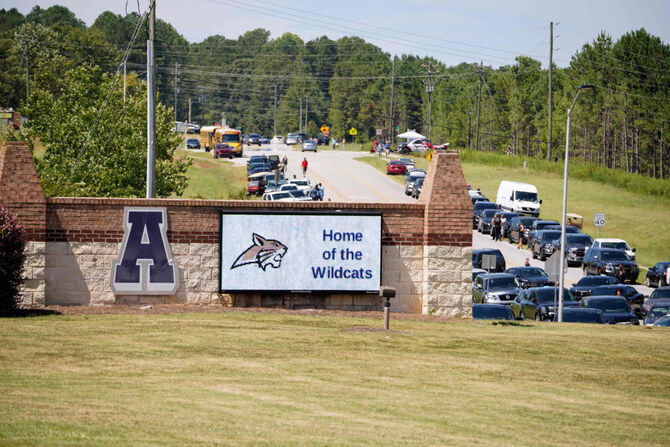

WASHINGTON: A shooting rampage Wednesday in the US state of Georgia that left two students and two teachers dead and nine wounded is only the latest in a tragic and relentless cycle of gun violence at US schools.
Police said the shooter, a 14-year-old male student at Apalachee High School in the city of Winder, was taken into custody.
Here are America’s deadliest classroom gun massacres of the last quarter century:
• Nineteen students and two teachers were shot dead on May 24, 2022 when an 18-year-old gunman stormed their Uvalde, Texas elementary school and opened fire.
As families mourned the victims, an uproar swelled over the slow police response. Officers eventually shot and killed the assailant responsible for America’s worst school shooting in a decade.
But it soon emerged that more than a dozen officers waited for over an hour outside classrooms where the shooting was taking place and did nothing as children lay dead or dying inside.
In October the education board that oversees schools in Uvalde suspended the police force whose bungled response to the mass shooting was widely criticized.
• Ten people, including eight students, were killed when a 17-year-old student armed with a shotgun and a revolver opened fire on his high school classmates in rural Santa Fe, Texas.
Classes had just started on the morning of May 18, 2018, when the shooting began.
Following the tragedy, Texas Governor Greg Abbott unveiled 40 recommendations, mainly focused on increasing armed security on school campuses and stepping up mental health screenings to identify troubled children.
Gun ownership can be a point of pride for many Texans, and even some Santa Fe High School students spoke out against linking the shooting to the need for tighter gun control.
• On February 14, 2018, a 19-year-old former student at Marjory Stoneman Douglas High School who was expelled for disciplinary reasons returned to the Parkland, Florida, school and opened fire.
He killed 14 students and three adult staff.
Stoneman Douglas students have become crusaders against gun violence under the banner “March for Our Lives,” lobbying for tougher gun control laws and organizing protests and rallies.
Their campaign took off on social media, mobilizing hundreds of thousands of young Americans — but so far failing to bring about significant legislative action.
• A 20-year-old man with a history of mental health issues killed his mother in Newtown, Connecticut, on December 14, 2012, before blasting his way into Sandy Hook Elementary School.
Twenty children, aged six and seven, were shot dead, as well as six adults. The shooter then committed suicide.
The parents of Sandy Hook victims have led numerous campaigns to toughen gun control laws, but their efforts have largely failed.
Conspiracy theorists have falsely claimed the massacre was a government hoax, involving “actors” in a plot to discredit the gun lobby. The far-right agitator Alex Jones was ordered to pay nearly $1 billion in damages for making such claims.
• A South Korean student at the Virginia Polytechnic Institute opened fire on the Blacksburg, Virginia, campus on April 16, 2007, killing 32 students and professors before taking his own life.
Thirty-three people were wounded.
The gunman had apparently idolized the shooters at a 1999 school massacre in Columbine, Colorado, referring to them as “martyrs” in a video, part of a hate-filled manifesto he mailed to police during his assault.
• Two teenagers from Columbine, Colorado, armed with an assortment of weapons and homemade bombs, went on a rampage at their local high school.
Twelve students and a teacher were killed during the April 20, 1999, massacre. Another 24 people were wounded.
Columbine, whose name has become synonymous with school shootings, was one of the first — and still counts among the deadliest — such shootings in the United States.