LONDON: The UK’s Grenfell Tower fire disaster that killed 72 people was the result of “decades of failure” by government and construction industry bodies and the “systematic dishonesty” of building material firms, a damning final report said on Wednesday.
The fire in the early hours of June 14, 2017 spread rapidly through the 24-story block in west London due to highly combustible cladding fixed to the exterior.
Started in a faulty freezer on the fourth floor, the blaze took barely half an hour to climb to the building’s top floor with catastrophic consequences.
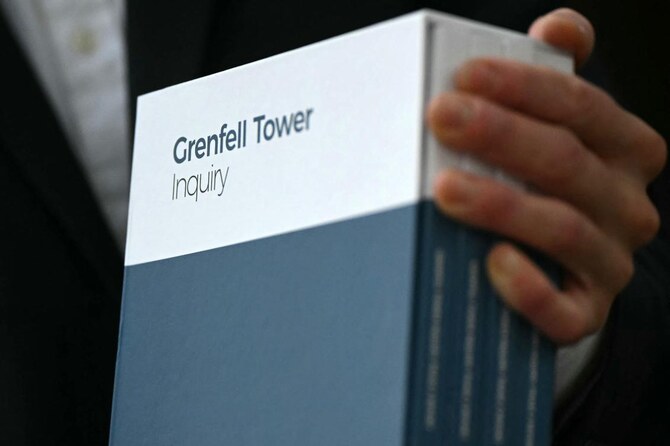
The highly-critical report marks the end of a two-part independent inquiry led by retired judge Martin Moore-Bick into Britain’s worst residential fire since World War II.
Unveiling his findings, Moore-Bick said all the 72 deaths as a result of the fire were “all avoidable” and said the victims had been “badly failed.”
Some of those who played a part in the sowing the seeds of disaster had shown “incompetence,” as well as “dishonesty and greed,” he said.
The report makes scathing criticism of government and other influential bodies over a refurbishment of Grenfell that led to the cladding and other dangerous materials being installed.
In particular the report condemns firms involved in supplying rainscreen cladding panels and other insulation products.
Accusing them of “systematic dishonesty,” it said they “engaged in deliberate and sustained strategies to manipulate the testing processes, misrepresent test data and mislead the market.”
Following the release of the report, Prime Minister Keir Starmer pledged that his government would ensure a similar tragedy does not occur again.
“The Government will carefully consider the report and its recommendations, to ensure that such a tragedy cannot occur again,” he said in a written statement to parliament.
The London Fire Brigade (LFB) also comes in for heavy criticism with senior officers described as “complacent.”
The service failed to ensure that the danger posed by the increasing use of cladding “was shared with the wider organization and reflected in training,” it said.
It also failed to learn the lessons of a previous fire in 2009 which “should have alerted the LFB to the shortcomings in its ability to fight fires in high-rise buildings.”
Residents who phoned the emergency services were told to remain in their flats and await rescue for nearly two hours after the fire broke out.
The “stay-put” advice, now considered to have cost lives, has since been revised.
It led to some of the men, women and children who died, including whole family groups, becoming trapped in their own homes.
Abdulaziz El-Wahabi, 52, and his wife Faouzia, 41, died on the 21st floor with their three children, the youngest of whom, Mehdi, was eight years old.
Mehdi’s teacher recalled his ability to “make us laugh and smile” and “lighten our mood.”
Abdulaziz was described as a “loyal family man” who would always “help neighbors with their bags and open doors.”
Faouzia was “lively and friendly.”
The tragedy’s youngest victims were a still-born child and a six-month-old baby, Leena Belkadi, found with her mother in a stairwell between the 19th and 20th floors.
The disaster has left many people living in buildings covered in similar cladding permanently fearful of a repeat tragedy.
Those who owned their own homes also faced financial problems as their apartments became unsaleable.
The UK’s then Conservative government announced in 2022 that developers would be required to contribute more to the cost of the removal, with those in buildings over 11 meters high not having to pay at all.
But a fire in Dagenham, east London, just over a week ago illustrated the ongoing risks.
Over 80 people had to be evacuated in the middle of the night after waking to smoke and flames in a block where work to remove “non-compliant” cladding was part-completed.
London fire commissioner Andy Roe said there were still around 1,300 buildings in London alone where urgent “remediation” work still needed to be done.
Bereaved relatives and survivors said ahead of the report they hoped it would bring them what they say is the “truth we deserve.”
For some that means jail for those who “made decisions putting profit above people’s safety.”
“For me there’s no justice without people going behind bars,” said Sandra Ruiz, whose 12-year-old niece Jessica Urbano Ramirez died.
London’s Metropolitan Police, however, has said its investigators will need until the end of 2025 to finalize its own investigation.
Prosecutors will then need a year to decide whether anyone will face charges.
For former Grenfell Tower resident Edward Daffarn, however, a delay that long is unacceptable.
“We are not prepared to wait for much longer, and this report needs to be the catalyst for significant movement forward from the Met Police in bringing charges against people who perpetrated the deaths of 72 people,” he said.


![]()

Grenfell inferno ‘culmination of decades of failure’: UK inquiry
Short Url
https://arab.news/4fvux
Grenfell inferno ‘culmination of decades of failure’: UK inquiry
- The fire in the early hours of June 14, 2017 spread rapidly through the 24-story block in west London
- Started in a faulty freezer on the fourth floor, the blaze took barely half an hour to climb to the building’s top floor


Latest updates


© 2026 SAUDI RESEARCH & PUBLISHING COMPANY, All Rights Reserved And subject to Terms of Use Agreement.