KYIV, Ukraine: The head of the United Nations’ nuclear watchdog on Tuesday described the situation at Europe’s largest nuclear power plant as “very fragile” following fresh attacks near the site in central Ukraine, and vowed to expand the agency’s inspections to include critical electricity supplies.
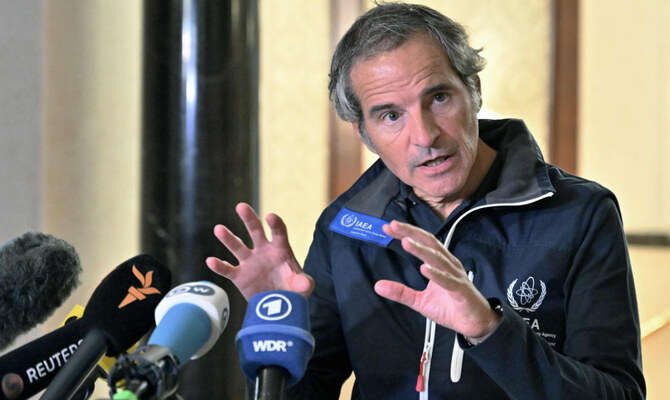
Rafael Mariano Grossi, the director-general of the International Atomic Energy Agency, was making his 10th visit to Ukraine since the Russia-Ukraine war began in February 2022.
He was headed to the Zaporizhzhia Nuclear Power Plant after talks in Kyiv with Ukrainian President Volodymyr Zelensky and top energy officials.
“I think the situation – I have very often characterized it – as very fragile,” Grossi told reporters in the Ukrainian capital. “The station is again on the verge of being on a blackout. We’ve had eight of those in the past. A blackout (means) no power: no power, no cooling. No cooling, then maybe you have a disaster.”
Earlier, Grossi posted on X that he was on his way to Zaporizhzhia to “help prevent a nuclear accident.”
The Zaporizhzhia plant, which came under Russian control in the wake of its full-scale invasion, saw artillery shelling in the area on Monday that damaged the facility’s power access, according to its operator Energoatom, which blamed Russia for the attacks.
“Russian shelling damaged one of the two external overhead lines through which … the Zaporizhzhya NPP receives power from the Ukrainian power system,” the operator said in a post on Telegram. “In the event of damage to the second line, an emergency situation will arise,” the Ukrainian agency said, adding that technicians couldn’t access the site of the damage because of the “real threat of repeated shelling.”
Analysts say an explosion at the Zaporizhzhia plant would produce radiation and likely trigger panic, but the radiation risk beyond the immediate blast area would be relatively low and nothing like the scale of the 1986 Chernobyl disaster. Also, if the wind is in an easterly direction, radiation could be pushed toward Russia.
The Zaporizhzhia region is one of four — along with Donetsk, Kherson and Luhansk — in southern and eastern Ukraine that Russia partly, and illegally, annexed in September 2022, seven months after it invaded its neighbor.
The Vienna-based IAEA says ongoing attacks in the Zaporizhzhia area, as well as damage to Ukraine’s grid, pose threats to the power supply that’s vital to the country’s nuclear power stations. The watchdog said its staff at Zaporizhzhia recently had to shelter indoors because of reported drone threats in the area.
Other than Zaporizhzhia, Ukraine has three active nuclear plants.
Grossi, who is traveling with a team of IAEA experts and officials, began a round of meetings in Kyiv with a stop at the Ministry of Energy and talks with the minister, Herman Halushchenko. Grossi said he had accepted a Ukrainian request to expand inspections to include electricity substations providing power to Ukraine’s nuclear power plants. He did not give further details but told reporters: “This is a new dimension, an important dimension I hope, of our support here, which we discussed and agreed with President Zelensky just now.” ___ Illia Novikov in Kyiv, Ukraine, contributed.

UN nuclear watchdog warns conditions ‘very fragile’ at Ukraine’s Zaporizhzhia power plant
Short Url
https://arab.news/cbtwp
UN nuclear watchdog warns conditions ‘very fragile’ at Ukraine’s Zaporizhzhia power plant
- Analysts say an explosion at the Zaporizhzhia plant would produce radiation and likely trigger panic, but the radiation risk beyond the immediate blast area would be relatively low
Discussions with Board of Peace ‘on hold’ due to Iran war, Indonesia says
JAKARTA: Indonesia’s foreign minister said talks on US President Donald Trump’s Gaza “Board of Peace,” of which the Southeast Asian nation is a key troop-contributing member, were on hold due to the Middle East war.
The US and Israeli air war against Iran has killed scores of civilians, thrown global air transport into chaos and sent oil prices surging after the effective closure of the Strait of Hormuz.
“All BoP discussions are on hold as all attention has shifted to the situation in Iran,” Minister Sugiono, who goes by one name, said late on Tuesday in response to a question on calls for Indonesia to exit the peace board in the aftermath of the fresh conflict in the Middle East.
“We will also consult with our friends and colleagues in the Gulf because they are also under attack,” Sugiono told reporters after attending an event alongside President Prabowo Subianto.
Indonesia’s participation on the board has drawn criticism from experts and Muslim groups at home, who say it compromises the world’s largest Muslim-majority nation’s longstanding support for the Palestinian cause.
Indonesia backs a two-state solution.
The Indonesian Ulema Council, a leading clerical body, said on March 1 that Indonesia should leave the board, citing Trump’s attack on Iran as rendering the initiative ineffective.
Meanwhile, Nahdlatul Ulama, Indonesia’s largest Muslim organization, said Jakarta should use its position to press Israel and the United States to halt the violence.
Trump first proposed the board in September when he unveiled a plan to end Israel’s war in Gaza, later expanding its remit to address other global conflicts typically handled by the United Nations.
Sugiono also said Prabowo is willing to be a mediator in the Iran war in a bid “to cool down and de-escalate the situation in the region.”
Indonesia is readying 1,000 troops for potential deployment in Gaza by early April as part of a proposed multinational peacekeeping force, its army said, as part of the UN-mandated International Stabilization Force. It has also been given the deputy commander role of the force.
The US and Israeli air war against Iran has killed scores of civilians, thrown global air transport into chaos and sent oil prices surging after the effective closure of the Strait of Hormuz.
“All BoP discussions are on hold as all attention has shifted to the situation in Iran,” Minister Sugiono, who goes by one name, said late on Tuesday in response to a question on calls for Indonesia to exit the peace board in the aftermath of the fresh conflict in the Middle East.
“We will also consult with our friends and colleagues in the Gulf because they are also under attack,” Sugiono told reporters after attending an event alongside President Prabowo Subianto.
Indonesia’s participation on the board has drawn criticism from experts and Muslim groups at home, who say it compromises the world’s largest Muslim-majority nation’s longstanding support for the Palestinian cause.
Indonesia backs a two-state solution.
The Indonesian Ulema Council, a leading clerical body, said on March 1 that Indonesia should leave the board, citing Trump’s attack on Iran as rendering the initiative ineffective.
Meanwhile, Nahdlatul Ulama, Indonesia’s largest Muslim organization, said Jakarta should use its position to press Israel and the United States to halt the violence.
Trump first proposed the board in September when he unveiled a plan to end Israel’s war in Gaza, later expanding its remit to address other global conflicts typically handled by the United Nations.
Sugiono also said Prabowo is willing to be a mediator in the Iran war in a bid “to cool down and de-escalate the situation in the region.”
Indonesia is readying 1,000 troops for potential deployment in Gaza by early April as part of a proposed multinational peacekeeping force, its army said, as part of the UN-mandated International Stabilization Force. It has also been given the deputy commander role of the force.
© 2026 SAUDI RESEARCH & PUBLISHING COMPANY, All Rights Reserved And subject to Terms of Use Agreement.


