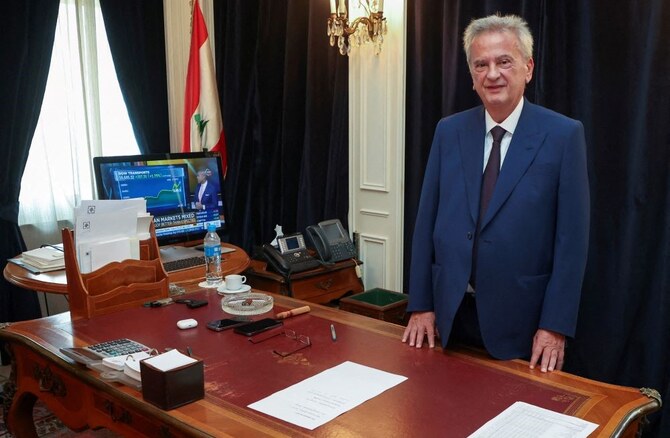
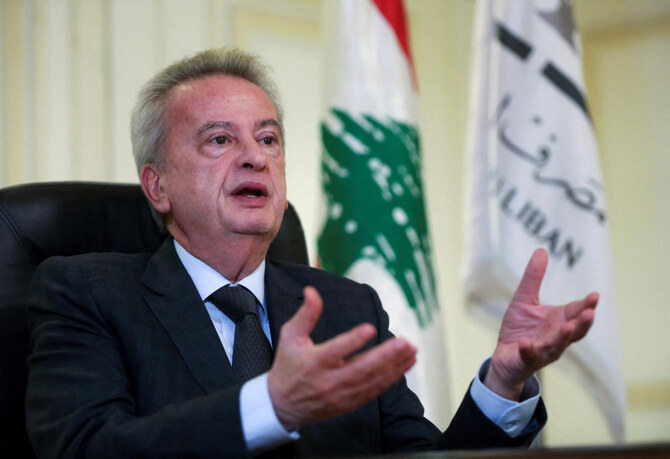

BEIRUT: Former Lebanese central bank governor Riad Salameh was detained on Tuesday on suspicion of embezzlement.
It comes as Lebanon awaits a decision by the Middle East and North Africa Financial Action Task Force, or MENA FATF, concerning the country’s anti-money laundering and counterterror financing systems.
Salameh was detained by order of the public prosecutor, Judge Jamal Al-Hajjar, and will soon face investigation.
He was questioned for three hours about the alleged embezzlement and laundering of more than $110 million through Optimum Invest, a Lebanese brokerage firm.
The company had close ties to the central bank from 2015-2018, during Salameh’s governorship.
Al-Hajjar said: “The judicial step taken against Salameh is preventive detention, effective for four days, after which he will be referred by the Beirut Court of Appeal to the investigating judge, who will question him and make an appropriate judicial decision, which could include an arrest warrant.”
A security source told Arab News that Salameh “attended the interrogation session at the Justice Palace in Beirut without being accompanied by his lawyer.”
It was the first time that Salameh has appeared before the judiciary since the end of his term in July 2023.
In the three years from 2015-2018, Lebanon’s central bank traded public treasury bonds with Optimum, making quick profits on a fast turnaround. The strategy resulted in profits of up to $8 billion, though the identities of the beneficiaries remain unclear.
Salameh faces charges in Lebanon of crimes including money laundering, embezzlement and illicit enrichment. He previously denied all charges during earlier interrogations. A search and investigation warrant has been issued against him, preventing him from traveling.
Dozens of guards took part in the operation to transfer Salameh from the courthouse to the General Directorate of Internal Security Forces for his detention.
Prime Minister Najib Mikati described the arrest as a “judicial decision,” adding: “We will not intervene. The judiciary is fulfilling its duty, and we are all under the rule of law.”
Justice Minister Henry Khoury said: “The judiciary has acted, and we respect its decision.”
The grace period provided by the MENA FATF at the behest of the central bank of Lebanon is expected to end in the coming weeks, after which Lebanon will be placed on the gray list.
Throughout the grace period, Lebanon’s government has failed to implement any of its promised reforms, and the parliament has yet to pass essential laws and regulations to protect the country’s financial system from abuse.
Recently, a formal economic source said: “Lebanon is running out of time to implement the necessary initial reforms to avoid being placed on the FATF’s gray list. The classification is imminent, and efforts by relevant officials in the Lebanese government are underway to engage with international financial entities in hopes of securing additional time for Lebanon to undertake the required reforms, thereby preventing the negative repercussions on the Lebanese economy that would result from such a classification.”
The source added: “The possibility of granting additional time to Lebanon is quite feasible, given that the country has been experiencing a genuine state of war for almost a year. Furthermore, the relevant international financial entities will take this matter into consideration.”
A delegation from the central bank including judges, security officers, legal experts and specialists is scheduled to attend a meeting of the FATF group in Brussels. The purpose of the meeting is to inform the Lebanese side about the progress of financial reforms.
According to media reports, the acting governor of the central bank of Lebanon, Wassim Mansouri, will travel to London to engage with correspondent banks and inform them of the situation in Lebanon and the measures being implemented by the government.
Lebanon is struggling to complete judicial rulings on people accused of money laundering, and law enforcement is failing to address financial crime in the country.
This situation is particularly concerning given the remarkable expansion of the country’s cash economy, which is estimated by the World Bank to be worth almost $10 billion, representing about 50 percent of gross domestic product.
If Lebanon is placed on the gray list, its banking industry faces isolation from the global economic system, and its financial operations will be subject to fresh international scrutiny.
The oversight will be authorized to scrutinize all money transfers exiting Lebanon, including examining sources, purposes and the legitimacy of funds.
The Lebanese government and central bank will also be subject to the same conditions.