NEW DELHI: Terrified for her safety, Indian actress Sreelekha Mitra remembers pushing chairs and a sofa against her hotel door after she said an award-winning veteran director sexually harassed her.
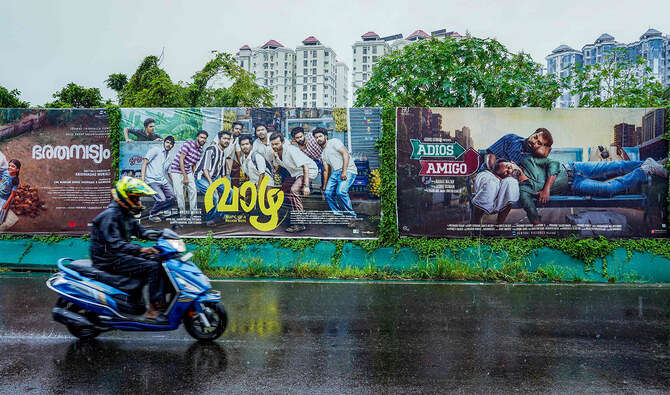
Mitra waited 15 years to speak out about the incident, one of several cases exposing the dark underbelly of India’s Malayalam-language “Mollywood” film industry that has won awards at Cannes.
Her revelation was spurred by an explosive government report documenting widespread sexual harassment in an industry dominated by powerful and wealthy men who believe that an actress willing to kiss on screen would do the same in real life.
“That entire night I stayed awake,” Mitra, 51, told AFP.
Mitra was invited to a gathering at the director’s house, where she said he lured her into his room for a phone call with a cinematographer.
“He started playing with my hair and neck... I knew if I did not say anything then, his hand would roam around other parts of my body,” she said, describing events from 2009, when she was 36.
She left and returned to her hotel.
“The intentions behind his moves were pretty clear to me... I was petrified.”
Her case and close to a dozen others have triggered a MeToo reckoning in the industry, with at least 10 prominent figures accused, according to Indian media.
Kerala-based Mollywood is known for critically acclaimed movies with strong and progressive themes, a change from the big dance and song numbers of India’s giant Hindi-language Bollywood in Mumbai.
The industry is prolific, producing up to 200 films a year, loved not only by southern India’s 37 million Malayalam speakers, but also dubbed and streamed across the rest of India and abroad.
Internationally, its films have won awards, including the 1999 satire Marana Simhasanam (“Throne of Death“), winner of the Camera d’Or at Cannes.
This year’s “Manjummel Boys,” a survival thriller, took $29 million at the box office, the highest-grossing Malayalam movie ever and the fifth-most successful in India this year.
The industry report, released August 19, said women actors faced the widespread “worst evil” of sexual harassment.
The report was released by the Hema Committee, headed by a former high court judge, set up after a leading Malayalam actress reported she was sexually assaulted in 2017.
Gopalakrishnan Padmanabhan, a prominent Malayalam actor better known by his stage name Dileep, was arrested for allegedly orchestrating the assault.
He was imprisoned for three months before being released on bail. The case continues.
But the release of the report has opened discussion on the far wider issue of chronic violence against women, encouraging people like Mitra to speak out in public for the first time.
It said that women who considered speaking out about sexual assault were silenced by threats to their life, and to their families.
Award-winning actress Parvathy Thiruvothu, 36, called the investigation a “game changer” and a “historic moment.”
“There was this idea that women working in the industry should feel grateful for having been given an opportunity by the men who were hiring them,” said Thiruvothu, a member of the campaign group Women in Cinema Collective.
Allegations of abuse in Indian cinema are not new.
It witnessed a wave in 2018, shortly after the 2017 MeToo movement erupted in Hollywood against disgraced US movie producer Harvey Weinstein.
But Thiruvothu called the latest allegations more than “MeToo Part Two.”
“It’s shaking everything,” she told AFP. “It isn’t an individual-to-individual complaint anymore. It’s about a systemic structure that has continued to fail women.”
Since the report, several top actors have been accused.
The Association of Malayalam Movie Artists was dissolved following the resignation of its chief on “moral grounds” with some members among the accused.
Ranjith Balakrishnan, 59, chairman of the state’s film academy, has also quit.
Balakrishnan, who denies any wrongdoing, was the man Mitra accused of sexual harassment.
Police have filed a case against him for outraging a woman’s modesty, a non-bailable offense.
Mitra, who until the release of the report had only mentioned the incident to an industry colleague, told AFP that Balakrishnan had misused “his power.”
Thiruvothu offered a message to all women in the film industry who have survived sexual assault.
“You are a skilled artist... do not listen to anyone who tells you to find another job if it is so difficult for you,” she said.
“This is your industry, as much as it is anybody else’s. Speak up, so that we are taking the space that is rightfully ours.”


India’s ‘Mollywood’ cinema rocked by MeToo abuse claims
https://arab.news/zg8eu
India’s ‘Mollywood’ cinema rocked by MeToo abuse claims

- Explosive government report has documented widespread sexual harassment in an industry dominated by powerful and wealthy men
- Case of Sreelekha Mitra and close to a dozen others have triggered a MeToo reckoning in the industry, with 10 prominent figures accused

Canadian Lebanese singer Maya Waked on music, identity, home
- Late father’s love of music shaped childhood’s soundtrack
DUBAI: For Canadian Lebanese singer Maya Waked, music has always been inseparable from memory.
Some of her earliest recollections are rooted in her family home in Lebanon, where her late father’s love of music shaped the soundtrack of her childhood.
“He had a beautiful voice, so he used to sing a lot at home,” she recalled, adding that he made her and her sisters listen to Arab icons like Fairuz, Asmahan, Umm Kulthum and Mohammed Abdel Wahab. “These are my first memories.”

Music was not just something playing in the background; it was an experience her parents actively nurtured. Waked grew up attending weekly concerts, operas and musical events, an upbringing she describes as “a blessing.” But when she left Lebanon as a teenager, that connection briefly shifted. Living and studying in France for a few years, she found herself leaning into European culture, wanting to feel modern and influenced by her new surroundings.
It was only later, after moving to Canada, that her relationship with her Arab identity came into sharp focus. “This is where it hit me that my roots are my refuge,” she said. “My resources. This is where I find myself ... my stability.” In Canada she hosted a radio program for the Arabic diaspora, speaking Arabic on air and reconnecting with her culture while far from home.
Waked said she never felt torn between cultures. Instead, she learned to live comfortably in all of them. “You can have your identity that is a mix of everything,” she said, explaining that while she sings mainly in Lebanese, her music carries influences from French literature, jazz, bossa nova and global sounds. That multiculturalism has become the foundation of her artistic identity.
Waked’s sound today blends Arabic melodies with improvisation and international textures, resonating across borders.

Her recent performance in Saudi Arabia, at the Ritz-Carlton Jeddah, marked a new milestone in her regional journey. It was her first time performing in the Kingdom, and she said: “It was a very meaningful experience for me. I felt that the audience was very curious and very open. They are great listeners and very cultured. They know the songs and recognized some of the tunes.”
Looking ahead, Waked said she was currently in the process of recording new music and planning a music video following performances across the region.


