

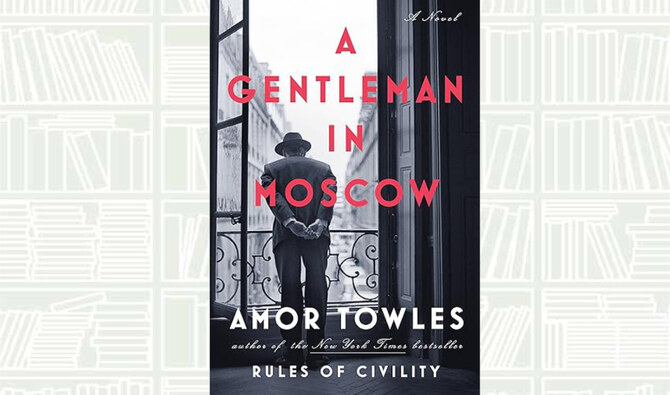
What We Are Reading Today: ‘A Gentleman in Moscow’

Photo/Supplied
Short Url
Updated 01 September 2024
Follow

What We Are Reading Today: ‘A Gentleman in Moscow’

  • Towles keeps the story centered on Rostov’s journey, highlighting the challenges of life under house arrest

Author: Amor Towles

“A Gentleman in Moscow” is a work of historical fiction by American author Amor Towles and set in Russia in the 1920s.

The story follows Count Alexander Rostov, a Russian aristocrat placed under house arrest in Moscow’s Hotel Metropol after the Bolshevik Revolution.

Despite his confinement, Rostov adapts to his surroundings with dignity and determination.

Towles, known for his bestselling novels “Rules of Civility” and “The Lincoln Highway,” published “A Gentleman in Moscow” in 2016. He drew inspiration from his experiences in luxury hotels, particularly one in Geneva in which some guests were permanent residents.

One of the book’s strengths is Towles’ exploration of the human experience. Through Rostov’s eyes, readers witness the changes in Russia that shaped social life.

Towles keeps the story centered on Rostov’s journey, highlighting the challenges of life under house arrest.

The author’s vivid descriptions bring the Hotel Metropol to life, with its ornate interiors and hidden corners serving as the backdrop for Rostov’s daily adventures. He maintains his aristocratic lifestyle while engaging with the world beyond his confinement.

While many have rated the novel as worthy of four stars, some critics have found it slow-paced. Reviewer Rohan Singh Jora said: “This book is eloquently written with the author’s sophisticated knowledge of a true gentleman. Although well-written, some chapters are monotonous and slow-paced.”

However, the book offers a profound look into human psychology, resilience, and hope. Towles’ writing makes the story captivating and leaves a lasting impression on readers.


Mini op-ed: We need a ‘potluck’ culture of reading

Updated 10 March 2026
Follow

Mini op-ed: We need a ‘potluck’ culture of reading

DUBAI: The number of times we hear, “My kids don’t read,” “I don’t have the time,” or “Do people even read anymore?” is alarming.

With newspapers declared dead and YouTube summaries or ChatGPT reviews becoming the main course of words, I often wonder: have those asking these questions considered the role they play?

Each of us — school representatives, librarians, parents, educators, children, and even occasional readers — must ask whether we are helping create a culture where reaching for a book feels as natural as reaching for a smartphone.

Even the smallest effort counts. I think of a reading culture as a potluck where everyone brings something small, and together it becomes a wholesome meal. If you do not know where to begin, look around.

Purva Grover is an author, poet, playwright, stage director, TEDx speaker, and creative entrepreneur. (Supplied)

The UAE is rich in public libraries including in Sharjah and Dubai, such as the Mohammed Bin Rashid Library, which is proof that access is not the issue. 

Meanwhile, Saudi Arabia is embedding reading into its national identity under Vision 2030 through digital libraries, major book fairs, and daily school reading.

Not a reader? Events such as the Emirates Airline Festival of Literature or the Sharjah International Book Fair offer easy entry points for conversation, community and curiosity.

They are built on cultural blocks that subtly encourage even non-readers into reading spaces. You could even start a reading club. I run one in Dubai called The Reading Village and have seen its quiet magic.

Culture is built by saying yes. And no to pirated PDFs on WhatsApp, as well as unchecked screen habits.

Tiny habits can help build an environment where reading becomes as much a part of our lives as scrolling on Netflix to decide what to binge-watch next.

Purva Grover is an author, poet, playwright, stage director, TEDx speaker, and creative entrepreneur. She is the founder of The Reading Village, a Dubai-based community.