

Saudi automotive industry to get a boost with high-level East Asia visit

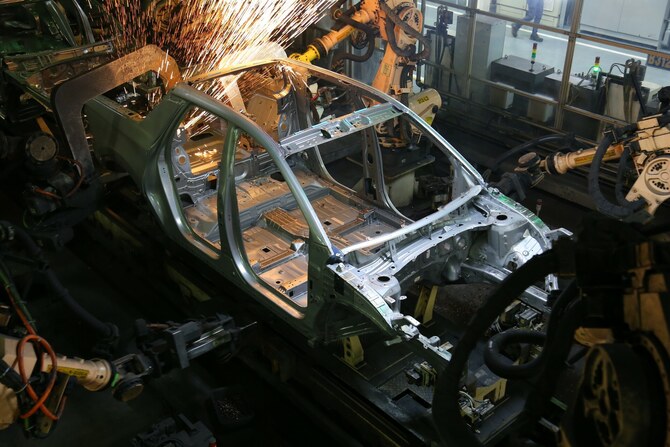
The Saudi automotive market holds considerable regional influence, accounting for 40 percent of total sales in the Middle East and North Africa. File/Getty Images
Short Url
Updated 01 September 2024
Follow

Saudi automotive industry to get a boost with high-level East Asia visit

  • Minister of Industry and Mineral Resources Bandar Alkhorayef will lead a delegation to China and Singapore from Sept. 1 to 8
  • Visit aims to bolster bilateral relations, attract investment to the Kingdom, and explore joint-venture opportunities in the industrial sector

RIYADH: Saudi Arabia’s efforts to localize its automotive industry are set to gain significant traction with a high-profile ministerial visit to East Asia.

Minister of Industry and Mineral Resources Bandar Alkhorayef will lead a delegation to China and Singapore from Sept. 1 to 8. The visit aims to bolster bilateral relations, attract investment to Saudi Arabia, and explore joint-venture opportunities in the industrial sector, as reported by the Saudi Press Agency.

The Saudi automotive market holds considerable regional influence, accounting for 40 percent of total sales in the Middle East and North Africa. This visit aligns with the Kingdom’s ambition to become a major automotive hub and a leader in innovative, eco-friendly vehicle solutions.

This initiative supports Saudi Vision 2030, which seeks to diversify the economy and establish Saudi Arabia as a global leader in industrial development.


Saudi Arabia and China share a robust strategic relationship that has flourished over more than 80 years, growing rapidly in economic, developmental, and cultural fields. China is Saudi Arabia’s largest trading partner, with trade exceeding $100 billion in 2023. Notable Chinese investments in Saudi Arabia last year included $5.6 billion in automotive manufacturing, $5.26 billion in the minerals sector, and $4.26 billion in semiconductors.

The visit will also involve meetings with prominent global companies in automation and technology. Notably, discussions with Huawei in Guangzhou will focus on collaboration in smart solutions and leveraging technologies from the Fourth Industrial Revolution — an era characterized by rapid technological advancements integrating digital, biological, and physical domains.

Additional meetings in Guangzhou will include talks with GAC Group and General Lithium. In Hong Kong, the delegation will engage with officials from the Trade and Industry Department, the Innovation and Technology Bureau, logistics firm Hutchison Ports, and the Federation of Hong Kong Industries. They will also meet with Cyberport, a leader in advanced technology, and automotive firm Johnson Electric, among other key commercial and industrial players.

In Singapore, the agenda features discussions with the deputy prime minister, the minister of trade and industry, and the minister of manpower. The delegation will also meet with A*STAR, the Singapore Manufacturing Federation, and visit Tuas Port, the world’s largest automated port, alongside additional ministries and companies.

In 2023, Saudi non-oil exports to Singapore totaled SR9.3 billion ($2.47 billion), while imports amounted to SR5.9 billion. Key exports included plastics, chemicals, electrical appliances, and metals, while major imports from Singapore were ships, optical instruments, medical devices, and pharmaceuticals.

The automotive sector remains a focal point of Saudi Arabia’s national industry strategy, emphasizing the development of innovative technologies and market growth.


Saudi Arabia, Japan trade rises 38% between 2016 and 2024, minister says

Updated 58 min 57 sec ago
Follow

Saudi Arabia, Japan trade rises 38% between 2016 and 2024, minister says

RIYADH: Trade between Saudi Arabia and Japan has increased by 38 percent between 2016 and 2024 to reach SR138 billion ($36 billion), the Kingdom’s investment minister revealed.

Speaking at the Saudi-Japanese Ministerial Investment Forum 2026, Khalid Al-Falih explained that this makes the Asian country the Kingdom’s third-largest trading partner, according to Asharq Bloomberg.

This falls in line with the fact that Saudi Arabia has been a very important country for Japan from the viewpoint of its energy security, having been a stable supplier of crude oil for many years.

It also aligns well with how Japan is fully committed to supporting Vision 2030 by sharing its knowledge and advanced technologies.

“This trade is dominated by the Kingdom's exports of energy products, specifically oil, gas, and their derivatives. We certainly look forward to the Saudi private sector increasing trade with Japan, particularly in high-tech Japanese products,” Al-Falih said.

He added: “As for investment, Japanese investment in the Kingdom is good and strong, but we look forward to raising the level of Japanese investments in the Kingdom. Today, the Kingdom offers promising opportunities for Japanese companies in several fields, including the traditional sector that links the two economies: energy.”

The minister went on to note that additional sectors that both countries can also collaborate in include green and blue hydrogen, investments in advanced industries, health, food security, innovation, entrepreneurship, among others.

During his speech, Al-Falih shed light on how the Kingdom’s pavilion at Expo 2025 in Osaka achieved remarkable success, with the exhibition receiving more than 3 million visitors, reflecting the Japanese public’s interest in Saudi Arabia.

“The pavilion also organized approximately 700 new business events, several each day, including 88 major investment events led by the Ministry of Investment. Today, as we prepare for the upcoming Expo 2030, we look forward to building upon Japan’s achievements,” he said.

The minister added: “During our visit to Japan, we agreed to establish a partnership to transfer the remarkable Japanese experience from Expo Osaka 2025 to Expo Riyadh 2030. I am certain that the Japanese pavilion at Expo Riyadh will rival the Saudi pavilion at Expo Osaka in terms of organization, innovation, and visitor turnout.”

Al-Falih also shed light on how Saudi-Japanese relations celebrated their 70th anniversary last year, and today marks the 71st year of these relations as well as how they have flourished over the decades, moving from one strategic level to an even higher one.