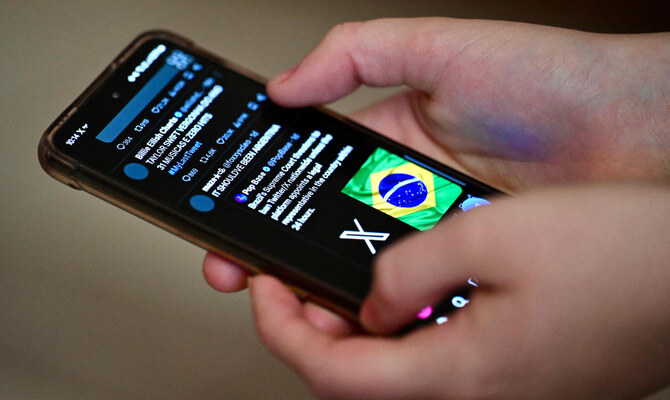
SAO PAULO: The blocking of social media platform X in Brazil divided users and politicians over the legitimacy of the ban, and many Brazilians on Saturday had difficulty and doubts over navigating other social media in its absence.
The shutdown of Elon Musk’s platform started early Saturday, making it largely inaccessible on both the web and through mobile apps after the billionaire refused to name a legal representative to the country, missing a deadline imposed by Supreme Court Justice Alexandre de Moraes. The blockade marks an escalation in a monthslong feud between Musk and de Moraes over free speech, far-right accounts and misinformation.
Brazil is one of the biggest markets for X, with tens of millions of users.
“I’ve got the feeling that I have no idea what’s happening in the world right now. Bizarre,” entertainment writer and heavy X user Chico Barney wrote on Threads. Threads is a text-based app developed by Instagram that Barney was using as an alternative. “This Threads algorithm is like an all-you-can-eat restaurant where the waiter keeps serving things I would never order.”
Bluesky, a social media platform that was launched last year as an alternative to X and other more established sites, has seen a large influx of Brazilians in the past couple of days. The company said Friday it has seen about 200,000 new users from Brazil sign up during that time, and the number “continues to grow by the minute.” Brazilian users are also setting records for activities such as follows and likes, Bluesky said.
Previous users of other platforms welcomed Brazilians to their ranks. “Hello literally everyone in Brazil,” a user wrote on Threads. “We’re a lot nicer than Twitter here,” said another.
Platform migration isn’t new for Brazilians. They were huge adopters of Orkut and, when Orkut went kaput, they very gladly moved to other platforms.
X is not as popular in Brazil as Facebook, Instagram, YouTube or TikTok. However, it remains an important platform on which Brazilians engage in political debates and is highly influential among politicians, journalists and other opinion makers.
It’s also where they share their sense of humor. Many of the country’s most famous memes originate from posts on X before spreading to other social networks. Last week, for instance, Brazilians collaboratively crafted an absurd storyline for a fictional telenovela, complete with a theme song created using artificial intelligence tools.
Pop stars and their fanbases were also hit by Brazilians being left off the platform.
“Wait a lot of my fan pages are Brazilian!!! Come back hold up!!,” Cardi B said Friday on X. A fan page dedicated to Timothée Chalamet, known by the handle TimotheeUpdates, said it would temporarily cease updating as all of its administrators are Brazilian.
De Moraes said X will stay suspended until it complies with his orders, and he also set a daily fine of 50,000 reais ($8,900) for people or companies using virtual private networks, or VPNs, to access it. Some legal experts questioned the grounds for that decision and how it would be enforced. Others suggested the move was authoritarian.
The Brazilian Bar Association said Friday in a statement that it would request the Supreme Court review the fines imposed on all citizens using VPNs or other means to access X without due process. Brazil’s bar association argued that sanctions should never be imposed summarily before ensuring an adversarial process and the right to full defense.
“I’ve used VPNs a lot in authoritarian countries like China to continue accessing news sites and social networks,” Maurício Santoro, a political science professor at the State University of Rio de Janeiro, said on the platform before its shutdown. “It never occurred to me that this type of tool would be banned in Brazil. It’s dystopian.”
A search Friday on X showed hundreds of Brazilian users inquiring about VPNs that could potentially enable them to continue using the platform by making it appear they are logging on from outside the country.
“Tyrants want to turn Brazil into another commie dictatorship but we won’t back down. I repeat: do not vote on those who don’t respect free speech. Orwell was right,” right-wing congressman Nikolas Ferreira, one of former President Jair Bolsonaro’s closest allies, published before X went off. Musk replied with an emoji suggesting agreement: “100”.
Ferreira is a 28-year-old YouTuber who received the most votes of the 513 elected federal lawmakers in the 2022 election. De Moraes ordered the block of his social media accounts after a mob of Bolsonaro supporters attacked Brazil’s Congress, presidential palace and Supreme Court in January 2023 seeking to overturn the election.
Lawmaker Bia Kicis said “the consequences of Alexandre de Moraes’ attacks to Elon Musk, X and Starlink will be regrettable for Brazilians.” She also urged Rodrigo Pacheco, the president of the country’s Senate, to act. Kicis has repeatedly urged Pacheco to open impeachment proceedings against the Supreme Court justice.
“We need to leave this state of apathy and stop the worst from happening,” the pro-Bolsonaro lawmaker, whose profiles were temporarily blocked by de Moraes in 2022, also said.
The former president said Saturday on Instagram that X’s departure from Brazil was “another blow to our freedom and legal security.”
“It not only affects our freedom of expression, but also undermines the confidence of international companies in operating on Brazilian soil, with impacts ranging from national security to the quality of the information that reaches our citizens,” Bolsonaro said.
On Friday, President Luiz Inácio Lula da Silva backed de Moraes’ decision and took aim at Musk for positioning himself as though he was above the law during an interview with Radio MaisPB.
“Any citizen, from anywhere in the world, who has investments in Brazil, is subject to the Brazilian Constitution and Brazilian laws. Therefore, if the Supreme Court has made a decision for citizens to comply with certain things, they either have to comply or take another course of action,” Lula said. “It’s not because the guy has a lot of money that he can disrespect it.”
Ana Júlia Alves de Oliveira, an 18-year-old student, shared that many young people like her no longer watch newscasts or read newspapers, relying solely on social media platforms like X for their news. Without this platform, she felt disconnected.
“I kind of lost touch with what’s going on around the world,” she said. “I saw a lot of entertainment there too, so this is a new reality for me.”


On the first day without X, many Brazilians say they feel disconnected from the world
https://arab.news/9ajv3
On the first day without X, many Brazilians say they feel disconnected from the world

- Brazil is one of the biggest markets for X, with tens of millions of users


Eurovision Sport, Camb.ai to provide live subtitling for Paralympic Winter Games
- Partnership aims to increase accessibility for all audiences
- Milano Cortina Games run from Friday to March 15
LONDON: Eurovision Sport, the European Broadcasting Union’s free-to-air streaming platform, will provide live and on-demand subtitling for coverage of the Milano Cortina 2026 Paralympic Winter Games in partnership with AI language company Camb.ai
The service will run across all competition days, allowing viewers to stream all six Paralympic Winter Games sports on Eurovision Sport with real-time subtitles. The Games open on Friday and run through March 15.
Camb.ai will supply contextual speech-to-text transcription for both live and catch-up coverage, which the organizers said would support accessibility without altering the editorial integrity of broadcasts.
Eurovision Sport Managing Director Alan Fagan said the aim was to make the Games available to “the widest possible audience,” by scaling up digital accessibility across every event on the platform.
The initiative forms part of the EBU’s most extensive digital coverage of a Paralympic Winter Games to date and complements member broadcasters’ linear output.
It also reflects a wider industry push to make live sport easier to follow for viewers watching without sound, people with hearing impairments and audiences consuming content on demand.
Camb.ai’s Chief Technology Officer Akshat Prakash said the company was proud to deepen its partnership with Eurovision Sport, describing the platform as a leader in applying new technology to sports coverage.
The two organizations began working together in 2024, when they delivered what they described as Europe’s first AI-powered real-time translated sports commentary during European Athletics events.


