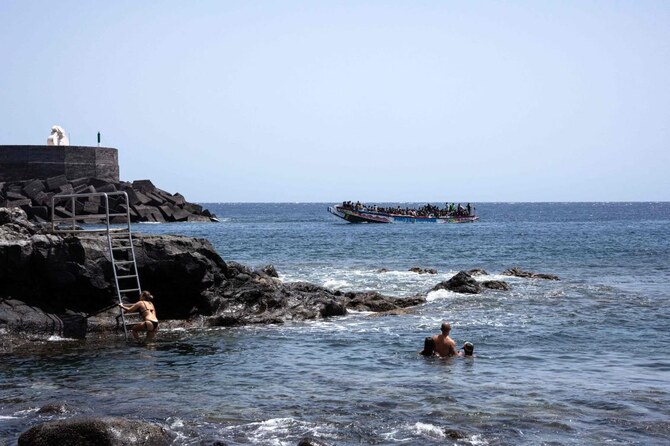
MADRID: A steep rise in the number of arrivals of migrants in Spain’s Canary Islands from Africa has fueled a fierce debate in the country over how to tackle illegal immigration.
The issue was thrust into the spotlight during a three-day visit by Spanish Prime Minister Pedro Sanchez to West Africa which wrapped up Thursday.
The trip was aimed at curbing the record number of unauthorized migrants arriving in the Atlantic archipelago in search of a better life in Europe.
“Spain is committed to safe, orderly and regular migration,” the Socialist premier said soon after he arrived Tuesday in Nouakchott, the capital of Mauritania, in the first stop of his tour which also included Gambia and Senegal.
He called for “circular migration” schemes which allow people to enter Spain legally to work for a limited time in sectors like agriculture, which face labor shortages during harvest time, before returning home.
“Immigration is not a problem, it is a necessity that comes with certain problems,” Sanchez said.
His comments were immediately blasted by Spain’s main opposition Popular Party (PP), which said the statements would encourage more migrants to try to enter the country illegally at a time when the Canary Islands is struggling to cope with an influx of migrants.
Nearly every day, Spain’s coast guard rescues a boat carrying dozens of African migrants toward the seven-island archipelago located off the northwest coast of Africa.
Over 22,000 migrants have landed in the Canary Islands so far this year, compared to just under 10,000 during the same time last year.
The archipelago received a record 39,910 migrants in 2023, a figure it is on track to surpass this year.
“It is irresponsible to encourage a pull effect in the worst irregular migration crisis,” PP leader Alberto Nunez Feijoo said, accusing Sanchez of going to Africa to “promote Spain as a destination” for migrants.
This is “the opposite” of what other nations in the European Union are doing, he added.
During the final leg of Sanchez’s tour in Dakar, the capital of Senegal, he appeared to take a harder tone by stressing that human trafficking rings that organize boat crossings to Spain sometimes have links to terrorist networks or drug smuggling gangs.
He said security was a “top priority” and said it is “essential to return those who have come to Spain illegally.”
Deportations, however, require the agreement of the country of origin of a migrant, which is not easy to get.
Cristina Monge, a political scientist at the University of Zaragoza, said Sanchez had tried to strike a balance in his comments on the issue in Africa but his message was “a bit contradictory.”
His first speech in Mauritania came “from a European, human rights perspective” but when he talked about the need for deportations the support “he gains on the right, he loses on the left,” she told AFP.
While the PP welcomed Sanchez’s sudden emphasis on security, hard-left party Sumar — the junior coalition partners in his minority government — immediately opposed it.
“Following the same migration recipes called for by the right is a failure and a mistake,” Labour Minister Yolanda Diaz, who founded Sumar, wrote on X.
With the number of crossing attempts expected to increase further in the coming weeks as Atlantic waters become calmer, the controversy is expected to intensify, especially since the PP has hardened its position on the issue in recent years in response to the rise of far-right party Vox which is hostile to immigration.
The Spanish government estimates there are some 200,000 people in Mauritania waiting to go to the Canaries. The bulk of them are from Mali where a military regime is battling an Islamist insurgency.

Migrant influx fuels debate in Spain over illegal migration
Short Url
https://arab.news/wp8zd
Migrant influx fuels debate in Spain over illegal migration
- Issue was thrust into spotlight during three-day visit by Spanish Prime Minister Pedro Sanchez to West Africa
Greenland prepares next generation for mining future
SISIMIUT: At the Greenland School of Minerals and Petroleum, a dozen students in hi-viz vests and helmets are out for the day learning to operate bulldozers, dump trucks, excavators and other equipment.
The Greenlandic government is counting on this generation to help fulfill its dream of a lucrative mining future for the vast Arctic territory coveted by US President Donald Trump.
Founded in 2008, the school, based in El-Sisimiut in the southwest of the island, offers students from across Greenland a three-year post-secondary vocational training.
Apart from their practical classes, the students, aged 18 to 35, also learn the basics of geology, rock mechanics, maths and English.
Teacher Kim Heilmann keeps a watchful eye on his students as they learn to maneuver the heavy equipment.
“I want them to know it’s possible to mine in Greenland if you do it the right way,” he told AFP.
“But mostly the challenge is to make them motivated about mining,” he added.
The remote location of Greenland’s two operational mines, and the ensuing isolation, puts many people off, the school’s director Emilie Olsen Skjelsager said.
A Danish autonomous territory, Greenland gained control over its raw materials and minerals in 2009.
The local government relies heavily on Danish subsidies to complement its revenues from fishing, and is hoping that mining and tourism will bring it financial independence in the future so that it can someday cut ties with Denmark.
“The school was created because there is hope for more activities in mining, but also to have more skilled workers in Greenland for heavy machine operating and drilling and blasting, and exploration services,” Olsen Skjelsager said.
By the end of their studies, some of the students — “a small number, maybe up to five” — will go on to work in the mines.
The rest will work on construction sites.
- Lack of skills -
Greenland is home to 57,000 people, and has historically relied on foreign workers to develop mining projects due to a lack of local know-how.
“We have some good people that can go out mining and blasting and drilling and all that kind of stuff,” explained Deputy Minister of Minerals Resources, Jorgen T Hammeken-Holm.
“But if you have a production facility close to the mining facility, then you need some technical skills in these processing facilities,” he said.
“There is a lack of educated people to do that.”
Going forward, geologists, engineers and economists will be needed, especially as Greenland’s traditional livelihoods of hunting and fishing are expected to gradually die out as professions.
The students’ tuition is paid by the Greenland government, which also gives them a monthly stipend of around 5,000 kroner ($800).
Inside the school, a glass case displays some of the minerals that lie — or are believed to lie — under Greenland, including cryolite, anorthosite and eudialyte, which contains rare earth elements essential to the green and digital transitions.
“New mine sites have been searched (for) all over Greenland,” said Angerla Berthelsen, a 30-year-old student who hopes to find a job in the mining sector one day.
There are “lots of possibilities” in Greenland, he said, sounding an optimistic note.
- Doubts over deposits -
But questions remain about Greenland’s actual resources, with the existence and size of the deposits still to be confirmed.
According to the Geological Survey of Denmark and Greenland (GEUS), Greenland is home to 24 of the 34 critical raw materials identified by the EU as essential for the green and digital transitions.
“A large variety of geological terrains exists, which have been formed by many different processes. As a result, Greenland has several types of metals, minerals and gemstones,” it says in a document on its website.
“However, only in a few cases have the occurrences been thoroughly quantified, which is a prerequisite for classifying them as actual deposits,” it stressed.
Deputy minister Hammeken-Holm said it was “more or less a guess” for now.
“Nobody knows actually.”
In addition, the island — with its harsh Arctic climate and no roads connecting its towns — currently doesn’t have the infrastructure needed for large-scale mining.
There are currently only two operational mines on the island — one gold mine in the south, and one for anorthosite, a rock containing titanium, on the west coast.
The Greenlandic government is counting on this generation to help fulfill its dream of a lucrative mining future for the vast Arctic territory coveted by US President Donald Trump.
Founded in 2008, the school, based in El-Sisimiut in the southwest of the island, offers students from across Greenland a three-year post-secondary vocational training.
Apart from their practical classes, the students, aged 18 to 35, also learn the basics of geology, rock mechanics, maths and English.
Teacher Kim Heilmann keeps a watchful eye on his students as they learn to maneuver the heavy equipment.
“I want them to know it’s possible to mine in Greenland if you do it the right way,” he told AFP.
“But mostly the challenge is to make them motivated about mining,” he added.
The remote location of Greenland’s two operational mines, and the ensuing isolation, puts many people off, the school’s director Emilie Olsen Skjelsager said.
A Danish autonomous territory, Greenland gained control over its raw materials and minerals in 2009.
The local government relies heavily on Danish subsidies to complement its revenues from fishing, and is hoping that mining and tourism will bring it financial independence in the future so that it can someday cut ties with Denmark.
“The school was created because there is hope for more activities in mining, but also to have more skilled workers in Greenland for heavy machine operating and drilling and blasting, and exploration services,” Olsen Skjelsager said.
By the end of their studies, some of the students — “a small number, maybe up to five” — will go on to work in the mines.
The rest will work on construction sites.
- Lack of skills -
Greenland is home to 57,000 people, and has historically relied on foreign workers to develop mining projects due to a lack of local know-how.
“We have some good people that can go out mining and blasting and drilling and all that kind of stuff,” explained Deputy Minister of Minerals Resources, Jorgen T Hammeken-Holm.
“But if you have a production facility close to the mining facility, then you need some technical skills in these processing facilities,” he said.
“There is a lack of educated people to do that.”
Going forward, geologists, engineers and economists will be needed, especially as Greenland’s traditional livelihoods of hunting and fishing are expected to gradually die out as professions.
The students’ tuition is paid by the Greenland government, which also gives them a monthly stipend of around 5,000 kroner ($800).
Inside the school, a glass case displays some of the minerals that lie — or are believed to lie — under Greenland, including cryolite, anorthosite and eudialyte, which contains rare earth elements essential to the green and digital transitions.
“New mine sites have been searched (for) all over Greenland,” said Angerla Berthelsen, a 30-year-old student who hopes to find a job in the mining sector one day.
There are “lots of possibilities” in Greenland, he said, sounding an optimistic note.
- Doubts over deposits -
But questions remain about Greenland’s actual resources, with the existence and size of the deposits still to be confirmed.
According to the Geological Survey of Denmark and Greenland (GEUS), Greenland is home to 24 of the 34 critical raw materials identified by the EU as essential for the green and digital transitions.
“A large variety of geological terrains exists, which have been formed by many different processes. As a result, Greenland has several types of metals, minerals and gemstones,” it says in a document on its website.
“However, only in a few cases have the occurrences been thoroughly quantified, which is a prerequisite for classifying them as actual deposits,” it stressed.
Deputy minister Hammeken-Holm said it was “more or less a guess” for now.
“Nobody knows actually.”
In addition, the island — with its harsh Arctic climate and no roads connecting its towns — currently doesn’t have the infrastructure needed for large-scale mining.
There are currently only two operational mines on the island — one gold mine in the south, and one for anorthosite, a rock containing titanium, on the west coast.
© 2026 SAUDI RESEARCH & PUBLISHING COMPANY, All Rights Reserved And subject to Terms of Use Agreement.