

Aircraft relocation ordered in Karachi amid cyclone warning as monsoon claims 285 lives in Pakistan

1 / 2
An undated file photo of a PIA aircraft at runway during rainy weather at the Karachi Airport. (Photo courtesy: Pakistan Today)
2 / 2
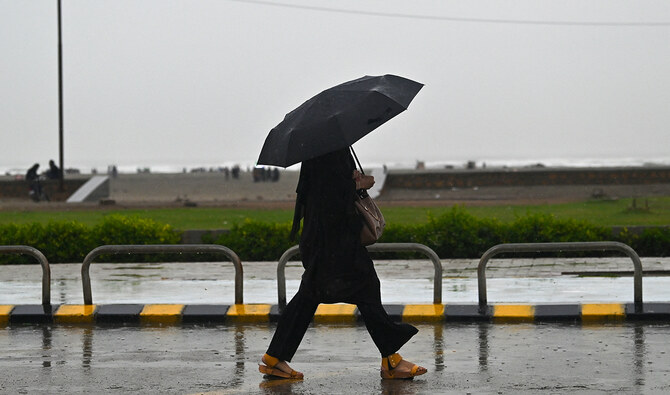
A woman holds an umbrella as she walks past Seaview Beach, amid rainfall in Karachi on August 29, 2024. (AFP)
Short Url
Updated 31 August 2024
Follow

Aircraft relocation ordered in Karachi amid cyclone warning as monsoon claims 285 lives in Pakistan

  • Authorities say heavy rains may inundate low-lying areas, as sea conditions likely to remain rough
  • Heavy rainfall triggered flash floods in metropolitan city causing power outages and school closures

KARACHI: The airport authorities in Pakistan’s seaside metropolis of Karachi on Saturday directed to relocate all aircraft at the Jinnah International Airport amid cyclonic warning, as different parts of the country are being lashed by heavy monsoon rains that have claimed 285 lives since the season began in July.

Earlier in the day, the Pakistan Meteorological Department (PMD) said cyclonic storm ASNA, brewing in the Arabian Sea, had moved westward.

The weather system, which developed over India’s Rann of Kutch coast, resulted in a deep depression that intensified into the cyclonic storm on Friday. The PMD said it was located about 200 kilometers southwest of Karachi and was likely to keep moving west-southwestwards.

“Airlines, ground handling and aviation companies operating in the general aviation area at the airport have been instructed to remain on full alert,” said an official statement by the airport authority. “Due to the stormy rains in Karachi, aircraft have been instructed to be parked in safe locations.”

“All aviation companies are advised to protect all their assets,” it added. “Stormy rains are expected to continue for the next few days.”

Pakistan has already been witnessing monsoon rains since the beginning in July, which, according to the National Disaster Management Authority, have claimed 29 lives in Balochistan, 88 in Khyber Pakhtunkhwa, 106 in Punjab, 50 in Sindh, four in Gilgit Baltistan and eight in Azad Jammu Kashmir.

No loss of lives has been reported in the capital city, Islamabad, so far.

The PMD alert during the day predicted that heavy rains could inundate low-lying areas of the Makran coast with sea conditions likely to remain rough.

The PMD also advised fishermen in Sindh and Balochistan provinces not to venture into the sea on Saturday.

“PMD cyclone warning center in Karachi is closely monitoring the system and will issue the update accordingly,” it added.

Heavy rains triggered flash floods in Karachi on Friday, causing power outages and closure of schools in the city.

Pakistan is recognized as one of the world’s most vulnerable countries to the effects of climate change. This year, the South Asian country recorded its “wettest April since 1961,” with 59.3 millimeters of rainfall, while some areas of the country faced deadly heat waves in May and June.

In 2022, unusually heavy rains triggered floods in many parts of the country, killing over 1,700 people, inflicting economic losses of around $30 billion, and affecting at least 30 million people.


Pakistan rules out joining Abraham Accords, opposes use of force against Iran

Updated 5 sec ago
Follow

Pakistan rules out joining Abraham Accords, opposes use of force against Iran

  • Foreign Office says Pakistan’s participation in Gaza Board of Peace unrelated to Israel normalization
  • Spokesman says Pakistan “firmly opposed to interference in internal affairs” of Iran, imposition of sanctions

ISLAMABAD: Pakistan on Thursday said it will not join the Abraham Accords, the US-brokered normalization agreements between Israel and several Arab states, rejecting any suggestion that its recent joining of the Gaza Board of Peace signaled a change in its longstanding position on Israel.

The Abraham Accords are a series of US-brokered agreements signed in 2020 that established diplomatic, economic and security ties between Israel and several Arab countries, including the United Arab Emirates, Bahrain, Sudan and Morocco. By contrast, the Gaza Board of Peace is a diplomatic initiative focused on supporting a ceasefire, humanitarian assistance and post-war reconstruction in Gaza, and does not involve recognition of Israel or security commitments.

Prime Minister Shehbaz Sharif joined the Gaza Board of Peace earlier this month alongside other world leaders, prompting speculation that Islamabad’s involvement could be linked to broader regional normalization efforts. Pakistan does not recognize Israel and has consistently said it will not normalize ties without a just resolution of the Palestinian issue.

“It is a misconception that joining the Board of Peace is in any way connected to any Abraham Accords or any side draft to this issue. Pakistan’s positions remain unchanged and we will not become a party to the Abraham accord,” Foreign Office spokesman Tahir Andrabi told reporters at a weekly briefing. 

He said Pakistan had joined the Gaza Board of Peace “in good faith” and had not committed to any military role, adding that Islamabad had not decided to join the international stabilization force (ISF) for Gaza and that membership of the board did not imply contributing troops.

“Our basic objectives of joining the Board of Peace are three: one is to consolidate and sustain ceasefire, second is to support reconstruction, and third is to advance … a lasting peace based on the Palestinian right to self-determination,” he said.

The spokesman added that Pakistan was part of a broader collective effort, noting that seven other Muslim countries had also joined the initiative.

“Pakistan, joining the Board of Peace should be seen in the continuum of the initiative by eight Muslim countries to promote peace in Gaza, leading toward a lasting solution to the Palestinian question,” he said. 

“All eight countries have joined the Board of Peace with a single collective voice. The Board of Peace offers a viable glimmer of hope for Gaza and for wider Palestinian questions.”

Responding to another question, Andrabi said the peace board initiative did not replace the United Nations.

“We hope that the framework established by the Board of Peace will lead to concrete steps toward permanent ceasefire, expanded humanitarian assistance, and the reconstruction of Plaza, and in advanced Palestinian’s people’s right to self-determination,” he said, adding that Pakistan hoped the process would culminate in “an independent, sovereign, contiguous state of Palestine, based on the pre-1967 borders, with Al-Quds Al-Sharif, as its capital.”

“Pakistan looks forward to continuing to play a constructive role as part of the Board of Peace in achieving these goals. And ending the suffering of our Palestinian brothers and sisters,” he said.

USE OF FORCE AGAINST IRAN

Asked about reports of possible US military action against Iran and rising regional tensions, Andrabi said Pakistan opposed the use of force and supported diplomacy.

“Pakistan remains firmly opposed to interference in internal affairs of our brotherly country, Iran. We have opposed the use of force. We have opposed the imposition of sanctions and this position continues,” he said.

The comments come as the Middle East faces heightened tensions over Iran’s internal unrest and fraught relations with the United States. 

In recent weeks, widespread demonstrations have swept across major Iranian cities, driven by economic hardship, high inflation and discontent with the government’s handling of domestic issues. Human rights groups say hundreds of people have been killed and thousands arrested in repeated crackdowns on protests, some of the largest in the country since the 1979 revolution, as authorities impose Internet blackouts and other restrictions to suppress dissent.

At the same time, US-Iran tensions have escalated significantly. Washington has deployed a substantial naval presence, including an aircraft carrier strike group, to the region while issuing stern warnings to Tehran over its nuclear ambitions and other activities. 

President Donald Trump and senior US officials have signaled that military force remains an option if Iran does not comply with demands to negotiate, raising fears of wider conflict. Iran has rejected negotiations under pressure and vowed to defend itself if attacked, and regional and global leaders have called for restraint amid the growing risk of confrontation.

Against this backdrop of domestic upheaval and potential international escalation, Andrabi said Islamabad had reiterated its opposition to the use of force and stressed the importance of peace and diplomacy.

He said Deputy Prime Minister and Foreign Minister Ishaq Dar had twice spoken by phone with his Iranian counterpart in recent days and had also engaged with US officials during the World Economic Forum in Davos last week.

“So, our advocacy for peace, diplomacy continues and this remains our stated position,” the FO spokesman said. “This region cannot afford war, turmoil, and because this, in essence, stops the economic development, peace, and prosperity. So, we hope that peace and diplomacy will prevail.”